Customer Relationship Management (CRM) has been the holy grail of sales organizations for years. Businesses have relied on these systems for decades to manage customer information, pipelines, and most importantly, make sure that no lead gets away. But here's the ugly truth: the majority of CRMs aren't doing much to help sell for companies; they're simply glorified filing cabinets.
The actual question isn't one of "do you have a CRM." It's this: is your CRM actively generating revenue, or is it merely a storage box for leads that might possibly convert one in every hundred times?
The Problem With "Storage-Only" CRMs
A classic CRM implementation typically works like this: leads flow in from forms, phone calls, or campaigns, get entered into the system, and just sit around waiting for someone to do something. The CRM becomes an archive, a virtual rolodex of names, numbers, and perhaps some notes.
But in our hyper-competitive economy today, that's not sufficient. If your CRM just stores information, it doesn't make any difference whether you have 1,000 or 100,000 leads—you're still not selling smarter, quicker, or more effectively. Salespeople spend more time maintaining records than talking to prospects.
Worse yet, this data-storing technique consistently produces the illusion of productivity. Managers look at "full pipelines" and believe progress is being made. Deals are stuck in real life, but reps are keeping around stale information without intelligent insight to act upon.
The Shift To Smart CRM Systems
That is why visionary companies are turning toward Smart CRM Systems—systems not only to collect information, but to analyze, rank, and even automate sales activity.
Unlike their static predecessors, smart CRMs harness data, AI, and automation to create a dynamic sales engine. Instead of a rep asking, “Who should I call today?” the system surfaces the best opportunities based on behavior, history, and probability to close. Instead of storing a prospect’s last interaction, it predicts the next best move.
The distinction between a storage CRM and a smart CRM is like that between a filing cabinet and a co-pilot. One stores your papers; the other guides you along the whole trip.
What a Smart CRM Actually Does
Let's get real. A clever CRM doesn't simply make life easier for your sales team—it transforms the way you think about growth. These are the essential features that distinguish storage from strategy:
Lead Scoring and Prioritization
Not every lead is equal. A sharp CRM leverages data—such as engagement history, demographic fit, and behavioral cues—to automatically qualify leads. That is, your reps focus their efforts on the contacts most likely to purchase, rather than wasting time on ghosts.
Automated Workflows
Smart systems organize redundant tasks: reminder emails, follow-up messages, pipeline reminders. Rather than entering notes manually or sending individual messages, the CRM does the grunt work for you. That time gets channeled into more valuable activities such as pitching and closing.
Predictive Analytics
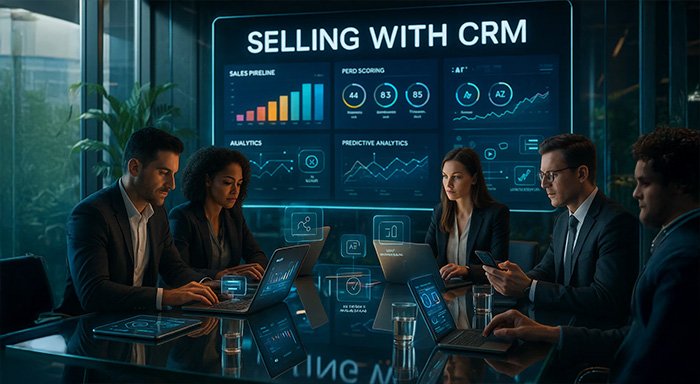
Those days are over when forecasting was based on guesswork. Intelligent CRMs use AI to look at patterns in deals and make predictions. This does not just enhance the accuracy of forecasting but also enables the sales leaders to identify weak spots before losses occur.
Seamless Integration
A contemporary CRM is not a standalone entity. It integrates with your marketing platforms, communications tools, and even financial systems. That integration breaks down silos, so customer data flows throughout the company.
Real-Time Coaching
Certain CRMs are sophisticated enough these days to deliver real-time insights—such as suggesting talking points for a call based on the customer's history. That makes sales reps consultative partners instead of script-readers.
Why Companies Avoid the Upgrade
If intelligent CRMs are that mighty, why are most companies still struggling with rudimentary storage systems? The explanations generally come down to cost, complacency, and fear.
Cost Issues: Executives view intelligent CRMs as costly "nice-to-haves." What they fail to notice is the expense of missed opportunities when reps are stuck in mundane work.
Inertia: If the legacy CRM "is working fine," groups tend to resist the disruption of moving to a smarter one.
Fear of Complexity: New tools may appear daunting at first glance, so companies hold on to comfortable though outdated platforms.
Ironically, smart CRMs are typically built with simplicity as their goal. The complexity is handled under the hood by the AI, but the user experience simplifies.
The Competitive Advantage of Selling Smarter
When customers are demanding personalized, lightning-speed interactions, companies that are using storage-only CRMs are positioning themselves to lag behind. Competitors leveraging smart systems will:
Connect with prospects at the moment with the message.
Pre-emptively anticipate objections before they happen.
Provide experiences that are perceived as unique and human—even when being driven by automation.
This isn't merely about selling more; it's about relationship-building that supports long-term growth.
How to Tell If Your CRM Is Holding You Back
Ask yourself these questions:
Do sales reps complain about spending more time inputting data than selling?
Are follow-ups falling through the cracks even when you have a "full" pipeline?
Does your team use gut intuition more than real data when prioritizing leads?
Do customers ever say they feel forgotten or unvalued during the sales cycle?
If the answer to any of these is “yes,” your CRM may be more of a storage locker than a sales accelerator.
Moving Forward: Building a Sales-Centric Tech Stack
Upgrading to a smart CRM doesn’t mean abandoning everything you’ve built. It means rethinking the role of CRM in your sales process. Instead of treating it as a reporting tool, treat it as a growth driver.
When evaluating smart CRM systems, focus on:
Automation: How much time will it save your reps?
Intelligence: Does it give actionable insights, or just dashboards?
Adoption: Will your staff actually use it, or will it end up as shelfware?
Scalability: Will it scale with your business, or will you outgrow it in two years' time?
The businesses that will succeed in the next ten years won't be those that have the most information. They'll be those that have the most intelligent systems to make the information work for them.
Final Word
The question is not if you require a CRM—any business does. The question is if your CRM is making you sell or simply saving leads. With the advent of automation and AI, to settle for a digital rolodex is not only wasteful; it's risky.
Smart CRM software isn't something you can't afford anymore—it's what keeps you playing catch-up versus leading the pack. Unless your CRM is closing deals for you, it's time to expect more.