Internal Linking Automation Tool: Scale Internal Links Without Missing SEO Opportunities
By Nusrat Jahan Mim 05-06-2026 71
Internal linking is one of the most overlooked SEO opportunities I see on growing websites.
Most site owners understand that internal links help search engines discover content and distribute authority. The problem is that once a site grows beyond a few dozen pages, managing links manually becomes almost impossible. Important pages get buried, orphan pages appear, and valuable content stops receiving the visibility it deserves.
That's where an internal linking automation tool becomes valuable.
In this guide, I'll explain how internal linking automation works, why it matters for modern SEO, and how you can use it to fix internal linking gaps programmatically without sacrificing content quality or user experience.
Why Internal Linking Still Matters in Modern SEO
Google's understanding of content has become significantly more advanced, but internal links remain one of the strongest signals website owners can directly control.
Internal links help search engines:
Discover new pages faster
Understand topic relationships
Identify important content
Pass authority throughout a website
Improve crawl efficiency
They also help users navigate your site more effectively, increasing engagement and reducing bounce rates.
For example, if you publish a detailed guide about technical SEO, linking it from related articles about site audits, crawl budgets, and indexing sends clear signals about the page's importance and relevance.
Without a structured linking strategy, many valuable pages remain isolated despite having excellent content.
The Challenge of Manual Internal Linking
When a website contains 20 pages, adding internal links manually is manageable.
When it contains 500, 5,000, or 50,000 pages, things become very different.
Common problems include:
Orphan Pages
These are pages with little or no internal links pointing to them. Search engines may struggle to discover or prioritize them.
Uneven Link Distribution
Some pages accumulate dozens of internal links while equally important pages receive very few.
Missed Contextual Opportunities
Writers often focus on creating new content and forget to revisit older articles to add relevant links.
Time-Consuming Audits
Large-scale internal link audits can take hours or even days when performed manually.
As websites expand, these issues compound and can negatively affect organic performance.
What Is an Internal Linking Automation Tool?
An internal linking automation tool is software that identifies, recommends, creates, or manages internal links across a website based on predefined rules, content relevance, or AI-powered analysis.
Rather than manually reviewing hundreds of pages, the system scans your content and surfaces linking opportunities automatically.
Most modern tools can:
Detect orphan pages
Identify pages with weak internal link profiles
Recommend contextual link placements
Discover related content relationships
Monitor internal link health over time
Fix internal linking gaps programmatically
The goal is not simply to create more links. It is to create better connections between relevant content at scale.
How to Fix Internal Linking Gaps Programmatically
One of the biggest advantages of automation is the ability to identify and resolve linking issues systematically.
1. Build a Content Relationship Map
Start by grouping content into topic clusters.
For example:
Core Topic: Internal Linking
Supporting Content:
Internal linking best practices
Anchor text optimization
Crawl budget management
Site architecture
Topic clusters
An automation tool can detect these relationships and suggest logical connections between pages.
Internal Linking Opportunity: Link to a related guide about topic clusters and content hubs.
2. Identify Underlinked Pages
Many SEO tools provide metrics showing how many internal links point to each page.
Look for pages that:
Drive conversions
Target valuable keywords
Generate backlinks externally
Support important business objectives
These pages often deserve stronger internal link support.
3. Automate Contextual Recommendations
The most effective internal links appear naturally within content.
Modern automation platforms analyze page topics and suggest placements where links improve both SEO and usability.
For example, an article discussing crawlability could naturally link to a guide about technical SEO audits.
This approach avoids excessive sitewide links while maintaining contextual relevance.
4. Monitor New Content Automatically
A common issue occurs when new content is published but never receives internal links.
Automation systems can continuously scan fresh articles and recommend connections to existing content immediately after publication.
This helps new pages get discovered and indexed faster.
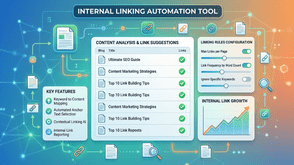
Key Features to Look for in an Internal Linking Automation Tool
Not all solutions are equally useful.
When evaluating tools, I typically prioritize the following capabilities.
Content Relevance Analysis
The tool should understand topic similarity rather than relying solely on keyword matching.
Semantic analysis produces much stronger recommendations.
Orphan Page Detection
Quick identification of pages with weak or nonexistent internal links can uncover hidden SEO opportunities.
Link Opportunity Suggestions
Look for systems that explain why a recommendation exists rather than generating links blindly.
Custom Rules and Controls
You should be able to define:
Pages to exclude
Anchor text preferences
Link limits per page
Priority content groups
Scalability
A solution that works for 100 pages may struggle with 100,000 pages.
Ensure the platform can grow alongside your website.
Common Mistakes to Avoid
Automation can save enormous amounts of time, but poor implementation creates new problems.
Over-Automating Anchor Text
Using the same anchor repeatedly can create unnatural patterns.
Diversify anchor text based on context.
Ignoring User Experience
Links should help readers, not just search engines.
If a link feels forced, it probably is.
Creating Too Many Links
More is not always better.
Focus on relevance rather than volume.
Skipping Regular Reviews
Even automated systems benefit from periodic audits.
Content evolves, and linking strategies should evolve alongside it.
Measuring the Impact of Internal Linking Automation
To evaluate success, monitor metrics beyond link counts.
Useful KPIs include:
Organic traffic growth
Crawl frequency
Indexation improvements
Reduced orphan pages
Increased page authority distribution
Improved rankings for target pages
In many cases, improvements appear gradually as search engines recrawl and reassess site structure.
The biggest gains often come from helping important but underlinked pages receive the visibility they deserve.
Is an Internal Linking Automation Tool Worth It?
For small websites with a handful of pages, manual linking may still be sufficient.
However, once a site begins publishing content consistently, automation becomes increasingly valuable.
An effective internal linking automation tool helps uncover opportunities that are difficult to spot manually, improves content discoverability, and reduces the operational burden of maintaining a healthy site architecture.
More importantly, it allows SEO teams to focus on strategy instead of repetitive maintenance tasks.
Conclusion
Internal linking remains one of the most controllable and impactful aspects of SEO. As websites grow, managing those links manually becomes inefficient and error-prone.
A quality internal linking automation tool can help you identify orphan pages, strengthen topic clusters, and fix internal linking gaps programmatically at scale. The result is a stronger site structure, better content discovery, and a more efficient path for both users and search engines.
If you're reviewing your SEO strategy this year, start by auditing your internal link structure. You may discover that some of your biggest ranking opportunities are already sitting on your website, waiting to be connected.
Tags : .....