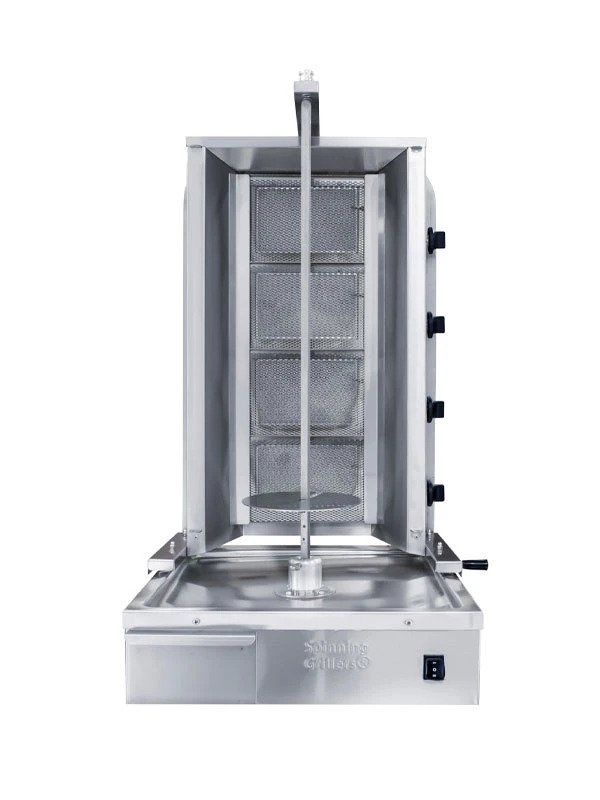
A tall stack of meat slowly turning beside a source of heat is now one of the most recognizable sights in a shawarma, döner, or gyro restaurant. It looks like a straightforward cooking method, but the vertical rotisserie changed how meat could be cooked, sliced, portioned, and served. Its modern form developed in the Ottoman world during the 19th century, with Bursa in present-day Turkey closely associated with the rise of vertical döner. From there, the technique traveled, adapted to different ingredients and cultures, and became part of restaurant food traditions around the world.
The move from horizontal to vertical cooking
Rotating meat over a fire was not new when vertical döner appeared. Earlier Ottoman cooking traditions included meat stacked and roasted on horizontal spits. What changed was the position of the spit and the way the meat could be cooked and served. Historical sources place the development of vertical rotisserie cooking no later than the middle of the 19th century. Bursa is widely associated with this change, although historians and later accounts disagree about exactly who first developed the method.
| Period | Development |
|---|---|
| 17th century | Ottoman sources describe related stacked-meat cooking on horizontal spits |
| Early–mid 19th century | Vertical stacked-meat roasting emerges in Ottoman Anatolia |
| 1850s | Early photographic evidence shows vertical döner-style cooking |
| 1860s | İskender Efendi's Bursa tradition becomes closely associated with vertical döner |
| 1920s | Population movements help carry the cooking tradition into Greece |
| 1930s onward | Shawarma and related vertical-spit foods spread internationally |
| 1970s | Modern gyro becomes established as a popular food in Greece and abroad |
The timeline is useful because it shows that vertical rotisserie cooking was not the invention of one modern restaurant equipment company or one recent food trend. It developed from an older roasting tradition and then changed as cooks adapted it to their own kitchens. The earliest stages are particularly difficult to document because culinary history often relies on family records, oral traditions, cookbooks, photographs, and later accounts. For that reason, dates surrounding the first vertical spit should be treated as historical estimates rather than perfectly settled milestones.
Why vertical cooking was such an important change
Putting the meat vertically changed the relationship between the fire, the meat, and the person preparing it. Instead of roasting a whole animal or a large piece of meat horizontally, cooks could build a tall stack of prepared meat and expose its outer surface to heat. The spit rotated continuously, bringing different sections toward the heat. As the outside cooked and browned, it could be sliced away. The newly exposed layer then became the next cooking surface. This created a continuous process instead of one large piece being cooked and served all at once.
That process also solved a practical restaurant problem. A cook could prepare a relatively large quantity of meat on one spit and serve portions over an extended period rather than cooking every customer's portion separately. The equipment became part of the service system: the meat cooked while customers were being served, and slicing became part of the preparation process. Modern health guidance still recognizes that this is a distinctive cooking method because the outside of the cone can be cooked while the interior remains raw. Continuous cooking and proper temperature control are therefore important.
The rise of döner in Turkey
The modern history of döner is strongly connected with Bursa. The İskender family account describes İskender Efendi working with lamb that had traditionally been roasted horizontally and developing a vertical method in which prepared meat was placed on a vertical spit beside a charcoal fire. The family says this happened in the mid-19th century, while another version of its history identifies 1867 with the development of the Bursa style. Other historical accounts point to Hamdi Usta of Kastamonu as an earlier claimant. The safest conclusion is that vertical döner emerged in 19th-century Ottoman Anatolia rather than assigning the entire invention to one person.
Döner also changed the way meat was presented. Instead of serving different cuts from a whole roasted animal, thin slices could be taken from the browned outer surface. In the Bursa tradition associated with İskender Efendi, the meat was served thinly sliced. The family's historical account says the vertical method was partly intended to distribute the different qualities of the lamb more evenly among customers. That detail is important because it shows that the change was not only about saving space or cooking faster. It also changed the relationship between the cook, the meat, and the customer.
How döner became shawarma
The cooking method did not remain limited to Turkey. As people, food traditions, and restaurant practices moved across the region, vertical spit cooking developed into different regional forms. In the Arab world, a related preparation became known as shawarma. The basic visual process remained familiar: seasoned meat was arranged on a vertical spit, cooked gradually beside a heat source, and shaved from the outside as it browned. But the ingredients and flavors developed their own identity, including different combinations of meat, marinades, spices, breads, sauces, and pickles. That is why shawarma should be understood as its own culinary tradition rather than simply another name for döner.
There is also an interesting linguistic connection. The name “shawarma” is generally linked to the Turkish word çevirme, meaning something that turns or rotates. Döner has a similarly direct connection to rotation: the Turkish word dönmek means “to turn.” The names therefore preserve something fundamental about the cooking method. Before the dishes became international restaurant staples, the turning spit itself was central to how people understood the food. The technology and the name remained connected because the movement of the meat was not incidental; it was part of the cooking technique.
Where gyro fits into the story
Gyro followed another path. The modern Greek version developed its own identity from the broader vertical-spit tradition. Population movements between Greece and Turkey after the 1922–23 population exchange helped carry related culinary practices into Greece. Over time, Greek cooks adapted the preparation to local tastes and ingredients. Modern Greek gyro is particularly associated with pork and chicken, along with ingredients such as pita, tzatziki, tomato, onion, and fries. By the 1970s, gyro had become established as a popular food in Athens and had also appeared in cities such as Chicago and New York.
| Food | Culinary tradition | Common modern meats | Typical serving style |
|---|---|---|---|
| Döner | Turkish/Ottoman | Lamb, beef, chicken | Bread, dürüm, plate |
| Shawarma | Levantine/Arab | Chicken, lamb, beef | Pita, flatbread, plate |
| Gyro | Greek | Pork, chicken | Pita, salad, tzatziki |
| Al pastor | Mexican, influenced by Lebanese migration | Pork | Tortilla, onion, cilantro, pineapple |
This comparison also shows why the three foods should not simply be treated as interchangeable. Their cooking method has a common family resemblance, but their culinary identities developed in different places. Meat choice is one of the most visible differences, but it is only part of the story. Seasoning, bread, sauces, toppings, slicing style, and the way the food is served all contribute to the final dish. The vertical spit provided a common cooking framework; local cooks then filled that framework with the ingredients and flavors familiar to their own communities.
The technique traveled even farther
The story does not stop with Turkey, the Levant, and Greece. One of the most interesting examples is tacos al pastor in Mexico. Lebanese immigrants brought vertical-spit meat cooking traditions to Mexico during the early 20th century. Mexican cooks adapted the method to local ingredients and eventually developed al pastor, which became a distinct part of Mexican street-food culture. The result is not simply “Mexican shawarma.” It is an example of what happens when a cooking technique crosses cultures and becomes part of a new food tradition.
That pattern explains why vertical rotisserie cooking has been so successful. The equipment does not dictate one recipe. A rotating vertical spit can accommodate different meats, marinades, seasoning systems, and serving methods. A cook in Bursa could use lamb and serve thin slices with pide; a shawarma cook could use marinated chicken or lamb with flatbread, pickles, and garlic sauce; a Greek restaurant could prepare gyro with pork and tzatziki; and a Mexican taquero could build a completely different dish around the same basic idea.
What the vertical spit changed in the kitchen
The real importance of the vertical rotisserie is therefore bigger than the machine itself. It changed the workflow of meat cooking. Instead of cooking individual portions from start to finish, a restaurant could maintain a large rotating stack and remove cooked portions as needed. That made the cooking process continuous and closely connected to service. The cook could see the browned exterior, slice it, and expose another layer. The machine became both a cooking station and a portioning station.
Modern commercial vertical broilers have made that process more controlled and practical. Gas and electric models can provide adjustable heat, powered rotation, grease collection, and safety features that were obviously unavailable to the cooks who worked with charcoal fires in the 19th century. Yet the basic principle has remained surprisingly stable: stack the meat, rotate it, cook the exposed surface, shave it, and continue cooking the layers underneath.
Why the method still works today
More than a century after vertical döner emerged in its recognizable modern form, the basic technique remains relevant because it matches the way these foods are served. Shawarma, döner, and gyro are often ordered in portions throughout the day rather than as one large roast brought to the table at once. A vertical rotisserie allows the restaurant to keep cooking while serving. That combination of continuous cooking and continuous slicing is difficult to separate from the identity of the food itself.
There is also a food-quality reason the method remains popular. The exposed surface repeatedly develops browning and a firmer texture before being shaved away, while the meat underneath continues cooking. The result gives a serving a mixture of browned exterior pieces and softer interior meat. The process is not magic, and it cannot compensate for poor meat preparation or seasoning, but it creates a cooking environment that is particularly well suited to these foods.
From an old cooking idea to modern restaurant equipment
The modern vertical broiler may look very different from a charcoal hearth in 19th-century Anatolia, but the fundamental idea has not changed much. The biggest difference is control. Today's commercial equipment can rotate more consistently, regulate heat more precisely, collect rendered fat, and fit into a professional kitchen designed for continuous service.
That is why the history of shawarma, döner, and gyro is also partly a history of kitchen technology. A simple change—from horizontal roasting to vertical rotation—created a new way to cook and serve meat. Cooks in different countries then adapted that method to their own ingredients and traditions. What began as a regional cooking development eventually became a global restaurant technique, with shawarma, döner, gyro, and al pastor each carrying a different part of the story.