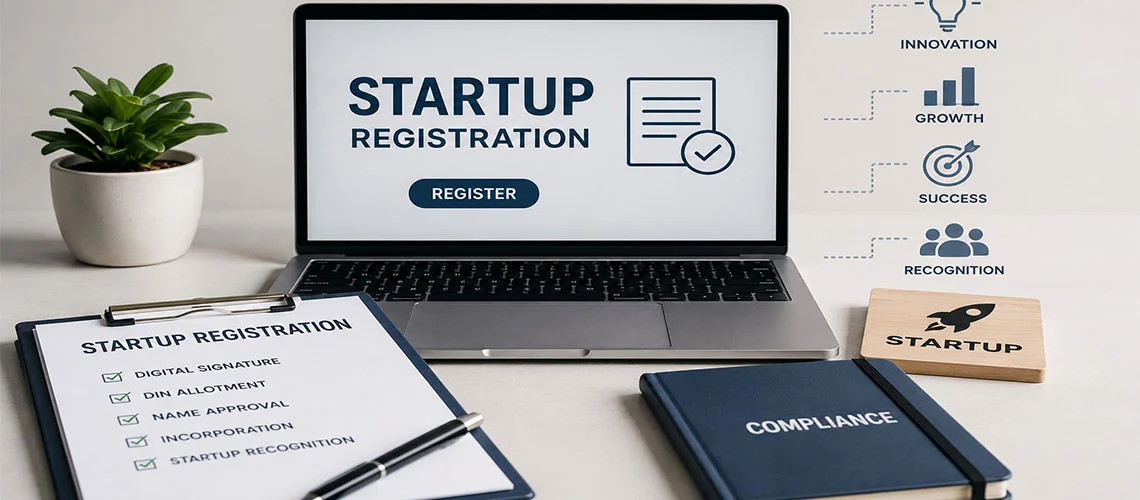
Starting a business in India has become easier with online registration systems and several government initiatives designed to support entrepreneurs. Many new founders want to know How to Register a Startup for Free in India without spending a large amount on professional services or unnecessary expenses.
While registering a company or business may involve certain statutory fees depending on the business structure, entrepreneurs can reduce costs by completing eligible processes themselves and using government portals. Startup recognition can also provide access to various benefits, subject to eligibility requirements.
This guide explains the basic process, business structures, government registration, and practical ways to start a business at a lower cost.
What Does Startup Registration Mean in India?
Startup registration generally involves legally establishing a business entity and, where eligible, obtaining recognition under the Government of India's startup framework.
A founder can choose different structures depending on the business model, number of founders, investment plans, and long-term objectives. Common options include:
- Private Limited Company
- Limited Liability Partnership (LLP)
- One Person Company (OPC)
- Partnership Firm
- Sole Proprietorship
For startups seeking external investment or planning to issue shares, a Private Limited Company is often considered a suitable structure. LLPs may be preferred by founders who want limited liability with comparatively flexible compliance requirements.
Before deciding, entrepreneurs should consider factors such as taxation, compliance, ownership, funding requirements, and future expansion.
Can You Register a Startup for Free in India?
One of the most common questions among entrepreneurs is How to Register a Startup for Free in India. The answer depends on what is meant by "free registration."
Certain government registration and recognition processes may be completed online without paying professional consultancy charges. However, incorporation of a business entity may still involve statutory government fees, stamp duty, or other applicable charges depending on the entity type, state, and circumstances.
Eligible startups can also explore government platforms and initiatives that simplify registration and provide access to support programs.
Therefore, founders should distinguish between:
- Free online application processes
- Government incorporation fees
- State-specific stamp duty
- Professional consultancy charges
- Optional services and certifications
By handling eligible applications independently and preparing documents correctly, founders may significantly reduce the overall cost of starting a business.
Step-by-Step Process to Start a Startup
1. Choose the Right Business Structure
The first step is selecting a suitable legal structure. Consider the number of founders, liability protection, investment plans, and expected business activities.
A Private Limited Company may be appropriate for startups planning to raise equity investment. An LLP can be useful for businesses that want limited liability and operational flexibility.
Choosing the right structure at the beginning can help avoid unnecessary restructuring later.
2. Select a Unique Business Name
The next step is choosing a suitable business name. The name should be distinctive and should not create confusion with an existing company or registered trademark.
Founders should check name availability before proceeding with incorporation. It is also useful to check whether the desired domain name and social media handles are available.
A strong and unique name can help build a recognizable brand from the beginning.
3. Prepare the Required Documents
The exact documentation depends on the selected business structure. Common documents may include:
- PAN card
- Aadhaar or other identity proof
- Address proof
- Passport-size photographs
- Registered office address proof
- Utility bill
- No-objection certificate, where applicable
For a company, founders and directors may also need digital signatures and other incorporation-related information.
Preparing documents in advance can make the registration process faster and reduce the chances of application errors.
4. Complete the Online Incorporation Process
The incorporation process is generally completed through the official government registration system. Applicants need to provide details about the proposed business, founders, directors, registered office, and business activities.
The application is reviewed by the relevant authority. If the information and documents meet the requirements, the business can receive its incorporation certificate or registration approval.
Entrepreneurs looking for How to Register a Startup for Free in India should carefully review the applicable government requirements because the exact costs and procedures can change based on the business structure and location.
5. Apply for Startup Recognition if Eligible
Business incorporation and startup recognition are not necessarily the same thing. After establishing an eligible business, founders may apply for startup recognition under the applicable government framework.
Recognition may provide eligible startups with access to certain benefits, exemptions, intellectual property support, networking opportunities, and government programs, subject to the relevant rules.
It is important to check the current eligibility criteria before applying.
What Are the Benefits of Startup Recognition?
Startup recognition can offer several potential advantages to eligible businesses.
Tax-Related Opportunities
Certain recognized startups may qualify for specific tax benefits if they meet the applicable conditions. These benefits are not automatic and may require separate applications or approvals.
Intellectual Property Support
Startups may receive support for protecting intellectual property, including assistance related to patents and trademarks under applicable schemes.
This can be particularly valuable for technology companies and businesses developing innovative products.
Government Schemes and Support
Recognized startups may be able to explore government-backed programs, funding opportunities, incubation support, and other initiatives.
The availability of benefits depends on the startup's eligibility and the specific scheme.
Improved Business Credibility
Formal registration and recognition can increase credibility when dealing with customers, investors, financial institutions, and potential business partners.
A properly structured business also makes it easier to maintain transparent records and establish professional operations.
How to Reduce Startup Registration Costs
Founders who want to minimize expenses can follow several practical steps.
First, understand the registration process before submitting any application. Incorrect information can lead to delays and additional work.
Second, prepare all documents carefully. Ensure that names, addresses, and identification details are consistent across documents.
Third, use official government portals instead of relying on unofficial websites that may charge unnecessary fees.
Fourth, compare the costs associated with different business structures before making a decision.
Finally, use professional assistance only when necessary. While consultants and professionals can be helpful for complex cases, founders with straightforward requirements may be able to complete some processes independently.
This is one of the most practical approaches when researching How to Register a Startup for Free in India while keeping initial business expenses under control.
Common Mistakes New Entrepreneurs Should Avoid
Many first-time founders make avoidable mistakes during business registration.
One common mistake is selecting a business structure without considering future funding requirements. Another is choosing a business name without checking availability.
Some entrepreneurs also fail to maintain proper records after incorporation. Registration is only the beginning. Businesses may have ongoing requirements related to taxation, accounting, annual filings, licenses, and regulatory compliance.
Founders should also avoid assuming that every startup automatically receives tax exemptions or government benefits. Eligibility requirements must always be checked before making financial decisions.
Do You Need Professional Help?
Professional assistance is not always mandatory, but it can be useful in complicated situations.
For example, founders with multiple shareholders, foreign investors, specialized business activities, or complex tax requirements may benefit from professional guidance.
However, entrepreneurs with simple requirements can first understand the process and identify which steps they can complete themselves.
When researching How to Register a Startup for Free in India, it is important to focus not only on registration costs but also on long-term compliance and legal responsibilities.
Conclusion
Starting a business in India does not always require a large initial budget. By choosing an appropriate business structure, preparing documents correctly, using official online platforms, and exploring eligible government initiatives, entrepreneurs can reduce many startup-related expenses.
The key to How to Register a Startup for Free in India is understanding the difference between company incorporation, government fees, professional charges, and startup recognition. Some processes may be completed without professional fees, but statutory charges and other costs can still apply depending on the circumstances.
Before starting the registration process, founders should research the latest government requirements and select a structure that matches their business goals. With careful planning, proper documentation, and timely compliance, entrepreneurs can build a strong foundation for long-term business growth in India.