Make your blog posts easier for search engines, AI assistants, and answer engines to understand using clear structure, natural language, and a few simple technical tweaks.
Why AI visibility matters for everyday creators
Imagine you run a small tech blog from Bengaluru. You spend your weekends testing budget smartphones, taking photos, checking battery life, and writing honest reviews in clear English. Your articles show up somewhere in Google, but when you ask an AI assistant, “Which is the best phone under ₹15,000 in India?”, you mostly see quotes from bigger sites. Your detailed review is nowhere in that AI answer box.
That gap is becoming more common. Many of us now ask questions directly to AI-powered tools and new search features that show AI-written summaries at the top of the results. These tools scan the web, pull small pieces of text from different pages, and stitch them into one answer. If your content is hard to skim, badly structured, or too generic, the AI may simply skip it, even if your article is actually helpful.
For a solo creator in India—whether you write about UPSC prep, recipes, gadgets, travel, or local finance—being easy for AI to understand is another way to be discoverable. This is where Answer Engine Optimization (AEO) becomes important. You are not writing only for bots, but if you present your knowledge clearly, you make life easier for three audiences at the same time: your human visitors, search engines, and AI-powered answer engines.
What optimizing content for AI really means
“Optimizing content for AI” can sound like some new, mysterious trick, but it is mainly a natural extension of good SEO (search engine optimization). Traditional SEO focuses on helping search engines understand your page and decide where to rank it. AI-focused optimization—and specifically Answer Engine Optimization (AEO)—adds one more layer: it makes it simple for AI models to find the exact lines on your page that answer a question and to trust those lines enough to quote them.
Search engines first crawl and index your page. They read your title, headings, paragraphs, links, and any extra labels you add, such as structured data, to figure out what the page is about and which searches it might match.
AI systems and answer engines then treat your article like a collection of smaller chunks—your intro, each section, each FAQ. When someone asks something like “easy aloo paratha recipe without maida”, the AI looks for chunks that clearly talk about that dish, ingredients, and steps. It does not care only about exact keywords; it also looks at related words and overall meaning, which is often called semantic search. In simple terms, optimizing for AI and Answer Engine Optimization means you focus on a few habits:
- Make the topic of each page and section extremely clear.
- Answer specific questions directly instead of hiding the point in long stories.
- Show real experience or evidence instead of vague claims.
- Keep a consistent, logical structure across your posts so related topics are easy to follow.
Classic SEO still matters—things like a good title tag, internal links, and clean URLs—but you also write each key paragraph so that it could stand on its own if an AI or answer engine quoted it in an answer box.
Learning goal
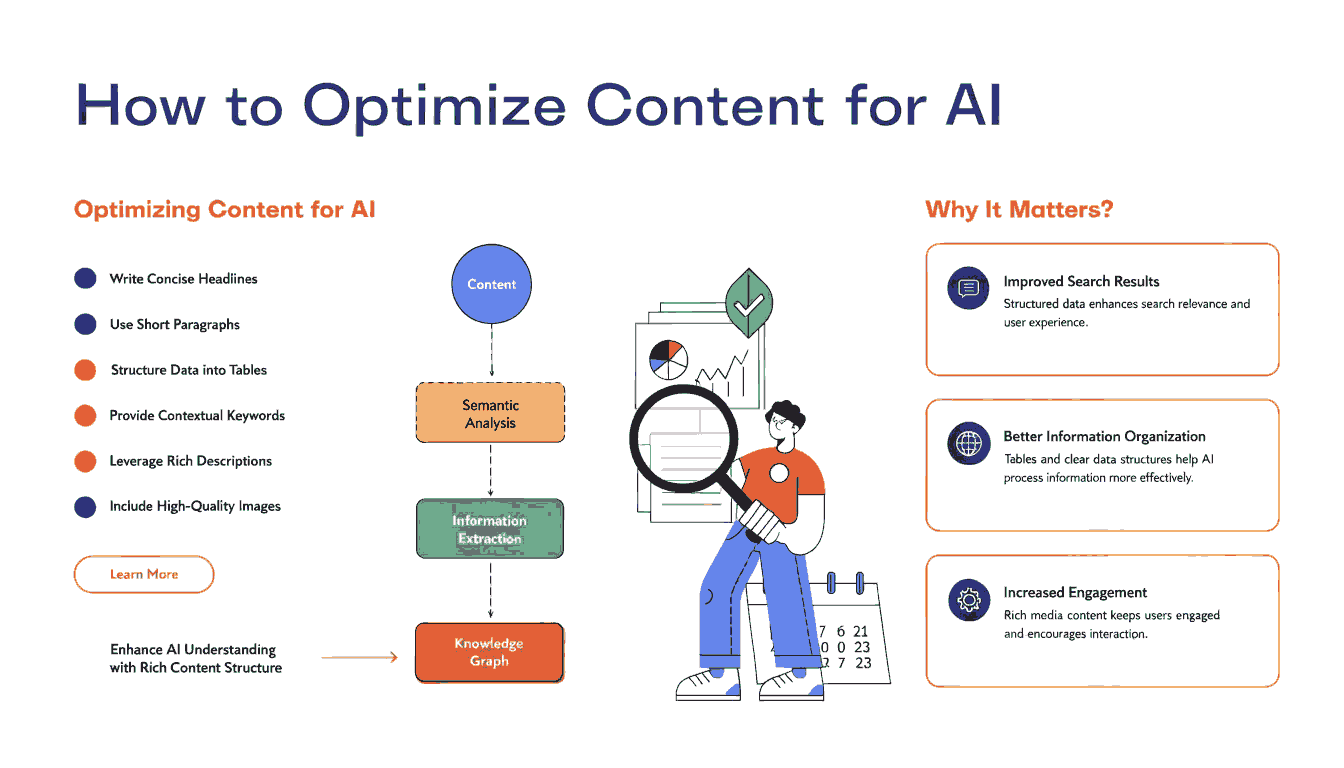
Help you visualise how one article is turned into many small sections that AI tools can understand, match to questions, and reuse as short quotes.
Image suggestion: Infographic showing how a blog post is broken into smaller chunks that search engines and AI assistants can scan and quote.
Search query: infographic diagram how search engines and AI read and chunk web pages
Designing clear structure so people and AI can follow
Think of your article like an exam answer sheet. A teacher skims your heading and first few lines to see if you understood the question. AI tools and answer engines do something similar. Start with a focused title that matches what someone would actually type. For example, instead of a vague “Phone Review”, use something like “Best phones under ₹15,000 in India (2026): Tested battery and camera results”. The title tells both humans and machines what to expect.
In your opening paragraph, say the main thing upfront. If you are writing a comparison, mention your top pick and who it suits. For example: “If you want a 5G phone under ₹15,000 mainly for gaming and social media, the ABC model is the best overall in my tests, with the XYZ as a strong second option for camera quality.” When an AI model scans your page, that kind of sentence is very easy to lift into a quick answer.
Next, break your article into clear sections with subheadings that sound like real questions or simple statements. If your main topic is “best phone under ₹15,000”, your subheadings might cover battery life, camera performance, gaming, and long-term use. On a recipe blog, you could have separate sections for ingredients, step-by-step method, tips, and common mistakes. Each section becomes a neat package an AI or answer engine can understand and potentially quote.
To round things off, add a short summary and a small FAQ near the end. The summary can repeat your main recommendation in one or two sentences and mention who it is for. The FAQ can address 3–5 questions you know readers care about, such as “Is this phone good for BGMI?” or “Can I freeze aloo paratha dough?”. These direct question-and-answer pairs are especially useful for Answer Engine Optimization (AEO) because they are easy for AI systems to extract.
Writing in natural language that AI can summarize and quote
When you hear “optimize for AI”, it is tempting to stuff your post with exact keywords like “best phone under 15000 India 5G best battery” in every second line. That usually backfires. AI systems are trained on natural language and user questions, so they actually do better with clear, everyday writing. A simple rule is: write the way you would explain it to a younger cousin, then gently fold in a few realistic search phrases.
One practical approach is to brainstorm a handful of ways someone might search for your topic, then place those phrases in smart spots instead of repeating them everywhere. For a budget phone review, that might include “phone under ₹15,000 in India”, “best camera under 15k”, or “cheap gaming phone”. Use these in your title, one or two subheadings, and early in the relevant paragraphs.
Direct, specific answers are another small tweak that makes a big difference for both AI systems and Answer Engine Optimization. Instead of writing, “The charging speed is decent and fairly quick,” say, “With the included charger, this phone goes from 0% to 100% in about 60 minutes.” That kind of precise, self-contained line is perfect for AI to quote.
Simple technical tweaks: SEO basics and structured data
Even the clearest content will struggle if search engines and AI tools cannot easily access your page. You do not need to become a developer, but a few basic checks help a lot. Make sure your site can be reached without logging in, that important pages are not accidentally blocked from indexing, and that you link to your key articles from your homepage or main menu so crawlers can find them.
Most readers in India will visit your site on a mobile phone, and search engines pay close attention to how well a page works on smaller screens. Use a responsive theme, choose a readable font size, and avoid cluttered layouts and aggressive pop-ups that cover the content.
Page speed is another important factor. Large uncompressed images and heavy scripts can slow things down. Faster pages are easier for bots to crawl and for AI systems to process, which also supports your Answer Engine Optimization efforts.
Structured data is simply extra labels you add to your page to describe what each part is—like FAQ, recipe, review, or how-to. Search engines and answer engines use these labels to understand your content better. Even adding basic FAQ schema can improve how AI reads and extracts your content.
Common mistakes when chasing AI traffic
One of the biggest mistakes is keyword stuffing. Another is publishing unedited AI-generated drafts without adding your own experience or verifying facts. These approaches often produce generic content that AI systems ignore.
Copying competitors or writing thin content also reduces your chances of being picked by AI systems. Answer Engine Optimization is not about tricks—it is about clarity, originality, and usefulness.
Putting it all together: a quick AI-friendly content checklist
- Make your title match the main question
- Give the answer early in your introduction
- Check that each heading has one clear job
- Add at least one quotable sentence per key point
- Use natural language with a few realistic search phrases
- Finish with a short summary and mini-FAQ
- Test the page on your own phone
- Add simple structured data and your personal touch
These steps also directly support Answer Engine Optimization (AEO) by making your content easier for AI systems to understand and quote.
Warning: Why these are guidelines, not guarantees
Search engines and AI systems change regularly, so no technique can guarantee rankings or AI visibility. Treat these tips as best practices and keep improving your content over time.
FAQs
Q1. Is optimizing content for AI different if my audience is mainly in India?
A: The basics are the same, but local context matters—prices in rupees, Indian cities, and relevant examples help both users and AI systems understand your content better.
Q2. Do I need to rewrite all my old blog posts?
A: No. Start with important posts and gradually improve them using better structure, clear answers, and FAQs.
Q3. Can I rely on AI tools to write my articles?
A: Use them for drafts, but always rewrite, fact-check, and add personal experience.
Q4. Do I need coding skills for structured data?
A: Not necessarily. Many tools and plugins can handle it for you.
Q5. How long does it take to see results?
A: It depends, but consistent improvements over time usually bring better visibility in both search and AI systems.
Conclusion
You will not see instant results, but by combining honest content, strong structure, and consistent Answer Engine Optimization (AEO), you build a site that works well for humans, search engines, and AI systems alike.
Tags : Answer Engine Optimization