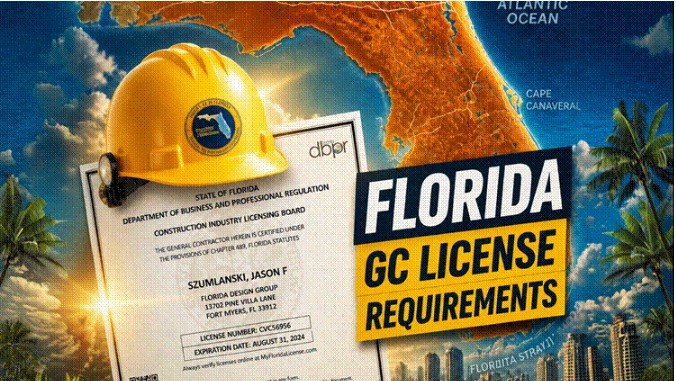
How to Meet Florida GC License Requirements?
Trying to get your Florida GC license? Full DBPR requirements, exam breakdown, and why nearly 1 in 2 people fail the first time.
If you've been working in the construction industry for years, building house frames, installing roofs, managing crews, you already know what it takes to get the job done. But without a Florida GC license, you're always one step behind: you have to rely on someone else to sign your permits, and that causes you to lose out on bigger contracts.
Understanding the Florida GC license requirements is the first step toward closing that gap. This guide walks you through the actual process, the real eligibility criteria, and the most common reasons people fail, so you can come fully prepared.
What Are the Requirements for a General Contractor License in Florida?
The Florida GC license requirements are set by the Florida Department of Business and Professional Regulation (DBPR). To be eligible, you must meet the following criteria:
● Age: You must be at least 18 years old.
● Experience: A minimum of 4 years of experience in the construction industry is required, with at least 1 year in a foreman or supervisor role.
● Credit: Typically, a credit score of at least 660 is required to demonstrate financial responsibility. If your credit score falls below the 660 threshold, this does not necessarily mean your application is denied. The DBPR may consider alternative ways to demonstrate financial responsibility, such as submitting audited financial statements, proving sufficient net worth, or designating a Financial Responsible Officer (FRO) to co-sign the application. The specific options available depend on your individual situation; therefore, the best course of action is to contact the DBPR directly via the website myfloridalicense.com or consult a licensing specialist, such as LicenseFix, they handle these cases regularly and can advise you on exactly which path applies to your situation.
● Insurance: You will need to provide proof of workers’ compensation and general liability insurance.
● Background Check: A criminal background check is part of the application process.
Meeting the Florida general contractor license requirements does not automatically mean you will be approved; it simply means you are eligible to take the exam. And that is where most people run into a roadblock.
What Types of Contractor Licenses Exist in Florida?
Florida separates contractor licenses into two main categories: Certified and Registered.
A Certified license is issued by the state and is valid statewide. You can work in any county in Florida without needing additional local approval. This is the license most professionals aim for.
Within those categories, the types of contractor licenses in Florida include:
● General Contractor — covers the broadest scope of construction work
● Building Contractor — commercial and residential structures
● Residential Contractor — one to three-family homes only
● Specialty Contractors — roofing, HVAC, plumbing, electrical, and others
If your goal is to take on commercial projects, manage large-scale builds, or stop depending on another contractor's license to operate, the General Contractor path is the one you want.
How Does the Florida Contractor Exam Actually Work?
Here's where a lot of people get surprised, especially if they've never taken a licensing exam before.
The Florida GC license requirements include passing a three-part exam:
- Business and Finance Exam — lien laws, workers' comp, financial management, Florida statutes
- Contract Administration Exam — project documents, contracts, submittals
- Project Management Exam — scheduling, safety, field operations
Each section has its own minimum passing score: 70% per section. If you fail one section but pass the others, you will need to retake only the section you failed, but you will have to pay the fee again and wait at least 30 days to reschedule the exam.
The Florida contractor exam is an open-book test, which leads many people to think it’s easy. But it isn’t. The exam is specifically designed so that if you don’t know where to look in your reference books before entering the testing room, you’ll run out of time. Speed and orientation are just as important as knowledge.
Industry data shows that the overall pass rate for first-time test-takers ranges from 35% to 45%, depending on the section. The Business and Finance section has a pass rate of about 50%, meaning that nearly 1 in 2 people fail on their first attempt.
Why Do So Many People Fail — And How Can You Avoid It?
The main reason people fail isn’t a lack of experience. It’s a lack of a proper preparation strategy.

Here’s how that plays out in practice:
They treat the open-book exam as if it were a closed-book exam: They don’t organize their textbooks, don’t practice navigating them under time pressure, and end up getting lost looking for answers during the actual exam.
They study the wrong things: The 19 reference books approved for the exam are not all equally important. Some sections appear constantly. Others hardly appear at all. Without knowing where the question clusters are concentrated, you end up wasting hours studying content that won’t help your score.
They stop doing timed practice exercises: Reading is not the same as applying knowledge in practice. Candidates who practice answering questions under actual exam conditions, with the same time limits, the same books, and no interruptions, consistently perform better than those who do not.
They use outdated materials: Florida laws are constantly updated. If your reference books are from a previous year, some of your answers will be wrong on questions you could have gotten right.
To pass the Florida contractor’s license exam, the most important thing you can do is treat your study materials as a navigation system, not a library. Before exam day, you should know which book covers each topic, have the main sections tabbed and highlighted, and have practiced finding specific answers in under 90 seconds.
Should You Take a Prep Course for Your General Contractor License Florida?
It's possible to study on your own, but the data tells a clear story. Candidates enrolled in a structured prep course for the Florida GC license requirements exam have significantly higher first-time pass rates than self-study candidates. Some established prep schools report over 96% pass rates for students who complete the full program, compared to less than 50% for those who study alone.
A good prep course offers several advantages that are very difficult to replicate on your own:
● It identifies which parts of which books actually appear on the exam.
● It provides a structured study schedule so you don’t neglect your weak areas.
● It offers feedback on practice exams, not just the correct answer, but also the reasoning behind it.
● It typically includes reference books with bookmarks and highlighted passages, which can save you more than 15 hours of manual preparation.
Investing in a prep course with a reputable school that shows you exactly what’s essential and offers support, such as LicenseFix School of Construction, is more cost-effective than paying retake fees, buying new materials, and wasting weeks or months waiting to reschedule the exam. Before you get overwhelmed and don’t know where to start, the LicenseFix team will guide you through every step of the process for obtaining a Florida general contractor’s license, offering assistance in English and Spanish.
After the Exam: Completing Your Application
Once you pass all three sections, you must submit your DBPR application, provide insurance certificates, pay licensing fees, and wait for your license to be issued. This is another stage where candidates get stuck, not because the Florida GC license requirements are unclear, but because the paperwork is easy to get wrong without guidance. LicenseFix provides full preparation for the Florida General Contractor exam, explaining in plain language which documents must be submitted, with assistance available not only in English but also in Spanish.
Ready to Meet the Florida GC License Requirements?
The Florida gc license requirements are real, and the exam is harder than most expect. But for contractors committed to growth, meeting them is one of the highest-return investments you can make. Pull your own permits, win larger contracts, and build a business that doesn't depend on anyone else's license. The path is demanding and it's absolutely worth it.
Tags : LicenseFix