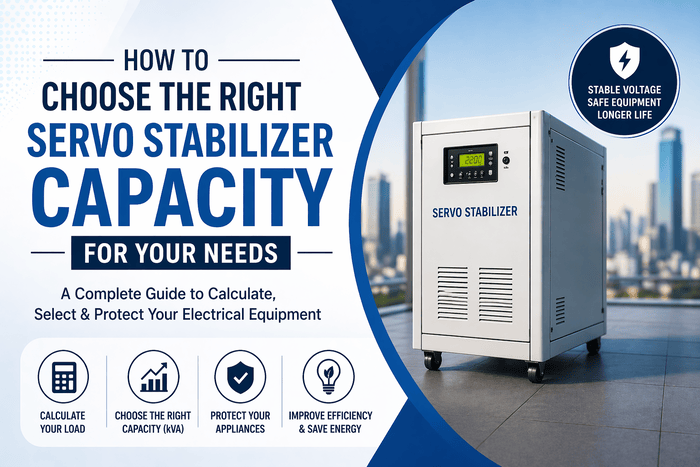
Voltage fluctuations are more common than most people realize, especially in rapidly developing regions like Ernakulam. Whether it’s for a home, office, or industrial setup, choosing the right servo stabilizer capacity is critical to protecting your electrical equipment and ensuring long-term efficiency. Many buyers make the mistake of selecting a stabilizer based on price alone, but capacity selection is what truly determines performance.
Understanding Servo Stabilizer Capacity
Servo stabilizer capacity is typically measured in kVA (kilovolt-ampere). This rating indicates how much electrical load the stabilizer can handle safely. Choosing the wrong capacity can lead to:
- Overloading and equipment failure
- Inefficient performance
- Increased maintenance costs
A properly sized stabilizer ensures consistent voltage output and protects all connected devices.
Step 1: Calculate Your Total Load Requirement
Start by identifying all the electrical appliances or machines you plan to connect. Each device has a power rating, usually mentioned in watts (W) or kilowatts (kW).
Example:
- Air Conditioner: 1500 W
- Refrigerator: 300 W
- Lighting & Fans: 500 W
- Other Appliances: 700 W
Total Load = 3000 W (or 3 kW)
To convert this into kVA:
kVA = kW / Power Factor
Assuming a power factor of 0.8:
3 / 0.8 = 3.75 kVA
Always round up and add a safety margin. In this case, a 5 kVA stabilizer would be ideal.
Step 2: Consider Future Expansion
Many buyers underestimate future power needs. If you plan to add more appliances or machinery later, it’s wise to choose a stabilizer with 20–30% extra capacity.
For example, if your current requirement is 5 kVA, consider opting for a 6–7.5 kVA stabilizer. This avoids the need for replacement later.
Step 3: Understand Your Application Type
Different environments require different stabilizer capacities:
🏠 Residential Use
- Typically ranges from 3 kVA to 10 kVA
- Suitable for air conditioners, TVs, refrigerators, and lighting
🏢 Commercial Use
- Usually between 10 kVA to 50 kVA
- Used in offices, small businesses, and retail stores
🏭 Industrial Use
- Can go from 50 kVA to several hundred kVA
- Designed for heavy machinery and continuous operations
Step 4: Check Input Voltage Range
In places like Ernakulam, voltage fluctuations can vary significantly. A good servo stabilizer should handle a wide input voltage range.
- Typical range: 150V – 270V (single phase)
- For industrial use: even wider ranges may be needed
If fluctuations are frequent, choosing a stabilizer with a broader range ensures uninterrupted performance.
Step 5: Phase Type Matters
Servo stabilizers come in two main types:
Single Phase
- Used for homes and small offices
- Lower capacity requirements
Three Phase
- Used for industrial and large commercial setups
- Handles higher loads and heavy equipment
Choosing the wrong phase type can result in inefficiency or system failure.
Step 6: Efficiency and Energy Consumption
A high-quality servo stabilizer should have efficiency levels above 95%. Lower efficiency means higher electricity bills and heat generation.
Also, if you’re pairing your stabilizer with systems like an online ups, energy efficiency becomes even more critical for long-term cost savings.
Step 7: Cooling Mechanism
Servo stabilizers generate heat during operation. Depending on your usage, you can choose between:
- Air-cooled stabilizers – Suitable for small to medium loads
- Oil-cooled stabilizers – Ideal for heavy-duty industrial use
Oil-cooled systems are more durable and perform better under continuous load conditions.
Step 8: Brand and Build Quality
Not all stabilizers are built the same. Look for:
- Copper-wound transformers (better durability)
- Digital control circuits
- Overload and short-circuit protection
A reliable brand ensures long-term performance and fewer breakdowns.
Step 9: Installation and Space Requirements
Before purchasing, consider:
- Available installation space
- Ventilation requirements
- Accessibility for maintenance
Industrial stabilizers, in particular, require dedicated space and proper setup.
Step 10: Work with a Trusted Local Supplier
Buying from a local expert has several advantages:
- Better understanding of regional voltage issues
- Faster installation and support
- Easier maintenance and servicing
If you’re planning to buy servo stabilizer in Ernakulam, choosing a supplier who understands local power conditions can make a significant difference in performance and reliability.
Common Mistakes to Avoid
Many buyers make these avoidable errors:
- Choosing a stabilizer with exact load capacity (no margin)
- Ignoring power factor in calculations
- Not considering future expansion
- Buying based only on price
- Overlooking compatibility with backup systems
Avoiding these mistakes ensures your investment lasts longer and performs better.
Final Thoughts
Choosing the right servo stabilizer capacity is not just a technical decision—it’s an investment in the safety and efficiency of your electrical systems. From calculating your load correctly to considering future expansion and local voltage conditions, every factor plays a role.
A well-chosen stabilizer will:
- Protect your appliances
- Reduce maintenance costs
- Improve energy efficiency
- Ensure uninterrupted performance
So, before you buy servo stabilizer, take the time to evaluate your requirements carefully. The right choice today can save you significant costs and trouble in the future.