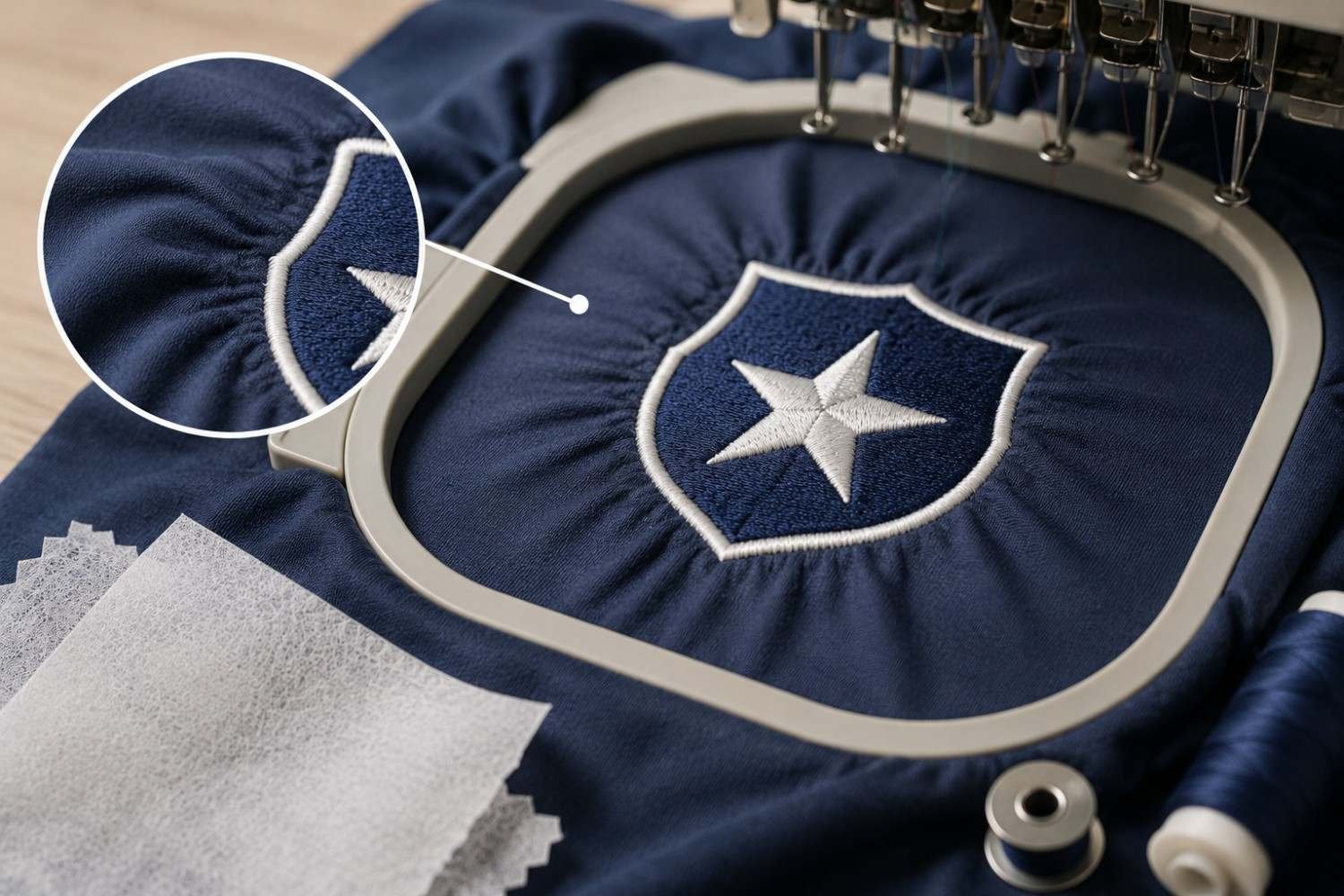
Needles are the cheapest thing on the machine and the one people think about least. They're also behind a surprising share of the faults that get blamed on the file your embroidery digitizing services provider sent.
The good news is that choosing them isn't complicated. There are two variables that matter most, one that matters occasionally, and a lot of noise around the edges. Here's what to actually pay attention to.
Start With the System, not the Size
Before size or point type, make sure you're using embroidery needles at all.
Commercial embroidery machines run the DBxK5 system. These are industrial needles with an eye roughly a quarter larger than a standard sewing needle's, plus a deeper groove down the shaft. Both features exist for the same reason: embroidery thread passes through the eye thousands of times per minute, and it needs room to do that without abrading.
Fit a standard sewing needle and you'll get thread breaks that look like a tension problem or a density problem. It isn't either. The thread is simply being sawed through by an eye that's too tight.
What the Two Numbers Mean
Every needle carries a pair of numbers, like 75/11, and they're the same measurement said twice.
The first is metric and it's the blade diameter in hundredths of a millimetre, so a 75 needle is 0.75 mm thick. The second is the older American sizing that most suppliers still print alongside it. Bigger numbers, thicker needle. The full range runs from about 60/8 up to 110/18, though nearly all garment embroidery lives between 65/9 and 85/13.
75/11 Covers Most of What You Run
This is the part worth hearing before you buy five sizes.
75/11 is the industry standard because it suits 40-weight thread, which is what almost everyone runs on almost everything. One contract embroiderer who spent fifteen years running a floor of over a hundred heads used a 75/11 sharp for about 99% of the work, changing only for the occasional difficult job.
So standardize. Keep 75/11 in sharp and ballpoint as your working stock, hold a few 65/9 or 70/10 for fine work and a few 80/12 for heavy material, and stop there. Juggling sizes on a production floor creates confusion and downtime for very little gain.
The Point Matches the Fabric
If size is about thread, point type is about what you're stitching into. This is the choice that actually changes results.
Sharp points cut through the weave. Use them on twill, denim, canvas, caps, heavy broadcloth, and on non-wovens like vinyl and leather. Anything tightly woven wants a sharp.
Ballpoints have a rounded tip that pushes fibers aside rather than cutting them. They're for knits: tees, fleece, sweatshirts, fine knit sweaters, and they also suit lightweight wovens like dress shirts. Put a sharp into a knit and you're severing loops, which shows up as holes that open up after a few washes.
That's the whole decision most days. Woven, sharp. Knit, ballpoint.
The Eye Has to Suit the Thread
Size follows thread weight rather than fabric weight, which catches people out.
The rule is to use the smallest needle that passes the thread without resistance. 40-weight sits comfortably in a 75/11. Finer 60-weight, used for small lettering and delicate detail, wants a smaller needle so you're not punching holes bigger than the stitches covering them. Heavier threads and metallics need a larger eye, and metallics in particular do better with an elongated-eye needle because they're fragile and abrade easily.
Two Sounds That Tell You It's Wrong
You don't need to measure anything to diagnose this. The machine tells you.
A popping sound as the needle enters, or visible holes left around the stitching, means the needle is too large for the fabric. Go down a size. Thread that shreds or breaks repeatedly usually means the eye is too small for the thread you're running, so go up, or check you're on a large-eye embroidery needle in the first place.
There's a third signal worth knowing. If the fabric is being pushed down into the needle plate rather than pierced cleanly, the needle is dull. That one isn't a sizing problem, it's a replacement problem.
Chrome or Titanium
Both work. The difference is how long they stay sharp.
Chrome-plated needles are the standard and they're cheap. Titanium-coated needles, sometimes sold as PD or perfect durability, carry a titanium-nitride finish that holds its point three to five times longer on abrasive, dense or tough materials.
Whether that's worth the extra depends on what you run. High-volume work on denim, canvas, caps or dense fills wears chrome down fast, and titanium pays for itself there. On light work at low volume it's harder to justify.
Change It Before It Fails
Most shops run needles far too long, because a dull needle doesn't announce itself the way a bent one does.
The guidance from machine manufacturers is to change chrome needles every four to eight sewing hours. Titanium stretches that considerably, but it's still finite. Change immediately if thread starts shredding, stitches skip, or you hear that popping penetration, regardless of how long the needle has been in.
A needle costs pennies. A run of ruined garments doesn't, and neither does the hour spent blaming a file that was fine all along. BitsNPixs gets sent plenty of those.
Where the File Comes Into It
One honest caveat, because needles get blamed for things they didn't do.
If thread breaks at random points, the needle, the threading or the tension is usually responsible. If it breaks at exactly the same coordinate on every single garment, the machine is following instructions that are hard to execute, and no needle change fixes that. Density set too high for the fabric, or stitches too short to sew cleanly, are file problems.
That's worth knowing before you order another box of needles. Providers offering professional embroidery digitizing services in the USA will retune density and underlay for the material you're actually running, and good embroidery digitizing services expect that conversation. A team like BitsNPixs would rather correct the file than have you chasing a fault that was never in the needle.
Tags : .....