A Wrong Wheel Becomes a Production Problem
A wheel can look correct on the shelf and still be wrong once it touches the job. Buyers often match only diameter and price, then get glazing, heat, poor finish or fast wear. The right Grinding Wheel has to match the workpiece, contact area, finish, speed, coolant, operating severity and machine power; Norton identifies all seven as core selection factors. And yet, some suppliers quote without asking what material you grind or what RPM the machine runs.
Cheap wheel selection is expensive.
Most buyers lose money later through rework, dressing time, rejected parts and downtime. A quotation based only on size and price is guesswork.
Grinding Wheel Specification: Read More Than the Diameter
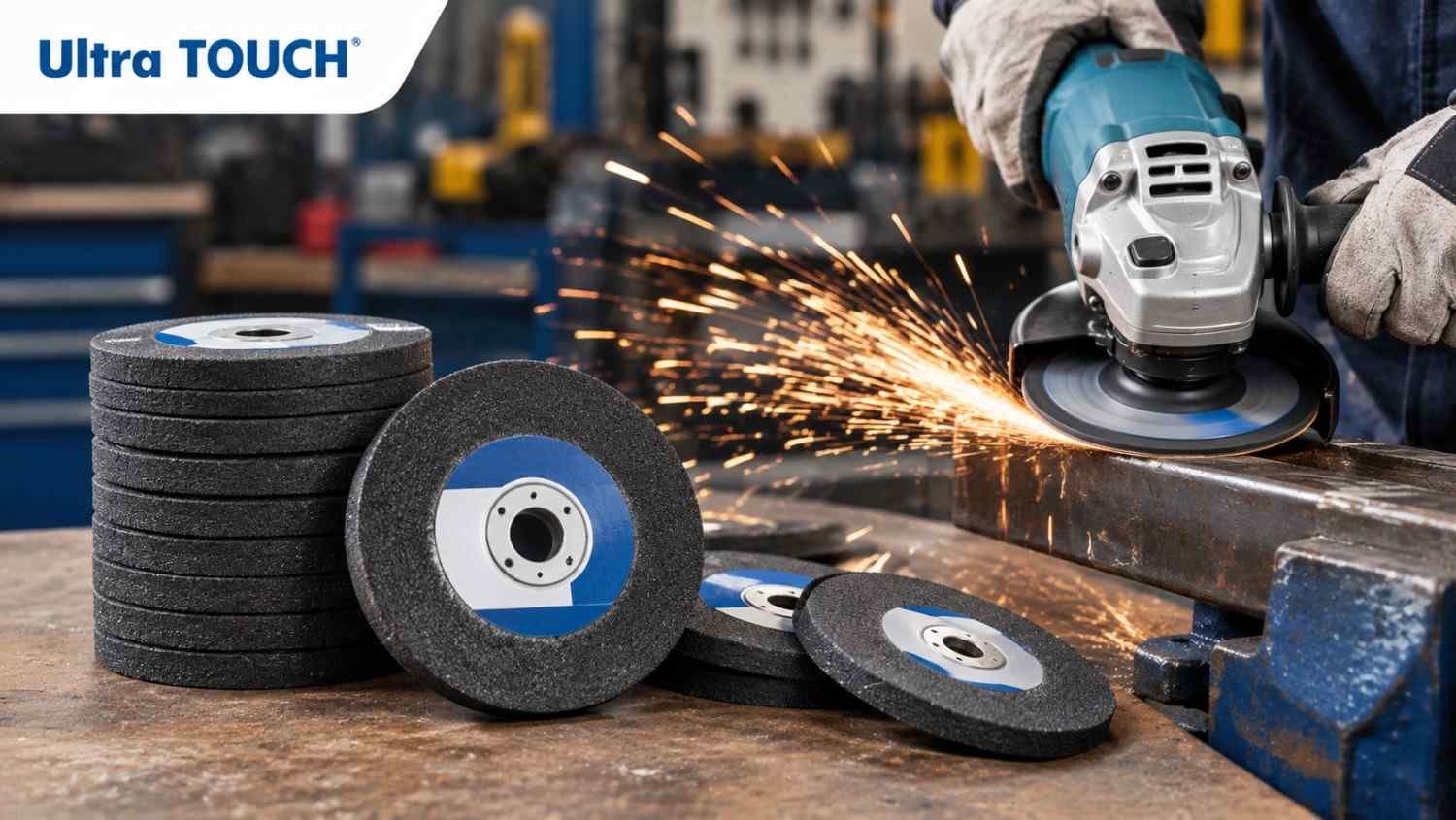
Ultra Touch lists wheel sizes from 4 inch (100 mm) to 12 inch (300 mm), but size alone does not determine performance.
Abrasive Type Must Match the Workpiece
Aluminium oxide is common for ferrous steels, while silicon carbide is generally used for non-ferrous materials and some non-metals; diamond and cBN serve harder or specialised applications. A supplier recommending one abrasive for every job is saving their own time, not yours.
Grit, Grade and Structure Control the Cut
Coarse grit removes stock faster; finer grit supports a finer finish. Norton broadly groups 12–24 as coarse, 30–70 as medium and 80–220 as fine. Grade is different from grit: it describes how strongly the bond holds abrasive grains.
Speed Rating Is a Safety Limit
Nobody tells you this strongly enough: never use a wheel whose maximum rated operating speed is below the machine requirement. OSHA guidance requires spindle speed to be checked before mounting and states that a wheel’s rated maximum speed must not be exceeded. Some industrial vitrified wheels are rated up to 80 m/s, but the marking on the actual wheel controls.
Five Supplier Checks That Expose Weak Quotations
Use these five checks before comparing price:
- Application data: Good—material, grinding type, finish target and stock removal are discussed. Bad—“This wheel works for everything.”
- Speed compatibility: Good—the supplier checks wheel speed against machine RPM. Bad—“Our standard wheel is fine.”
- Traceable specification: Good—abrasive, grit, grade, bond, dimensions and bore are stated. Bad—only diameter and price appear.
- Inspection guidance: OSHA guidance calls for abrasive wheels to be inspected and ring-tested before mounting where applicable. Bad—no handling or mounting guidance.
- Defect policy: Good—clear action for cracked, out-of-balance or wrongly supplied wheels. Bad—“We will see after delivery.”
A supplier who avoids these questions is transferring the risk to your factory.
Benefits That Protect Cost per Component
The correct specification protects margin in six practical ways:
- Lower rework from less burn, chatter and finish variation.
- Better wheel life when grade matches material and grinding pressure.
- More predictable cycle time with suitable grit selection.
- Lower dressing frequency where form retention matters.
- Reduced machine stress because sharp grains cut instead of rub.
- Safer operation through correct speed, mounting and inspection.
Norton notes that about a 1,000 SFPM change in wheel speed can make a wheel behave roughly one grade harder or softer. Which means small setup changes can alter real shop-floor performance.
Availability Across India Is a Supply-Chain Issue
Availability matters because a wheel that performs well but disappears during repeat procurement becomes a production risk. Ultra Touch states that its network reaches 150+ cities across India and operates from Mumbai, Maharashtra.
Buyers comparing Grinding Wheel Manufacturers should ask whether the same specification can be supplied again, not merely whether one sample is available. Dealers matter for local access; Wholesalers matter for bulk replenishment and inventory planning. For plants sourcing from Grinding Wheel Suppliers in India, batch consistency can matter more than a small one-time price saving.
About Ultra Touch: What We Put Behind the Supply
We have operated since 1995, and our website reports 75,000+ repeat orders and 4,500+ contractors and workshops served. We support buyers in selecting wheels based on material, hardness, grinding process and machine type. We also state that each wheel goes through testing for strength, cutting performance and safety before dispatch. That matters because repeat buying only works when the specification stays clear from enquiry to reorder.
We would rather ask for machine details than pretend every abrasive is interchangeable.
Send us the workpiece material, wheel diameter and bore, machine RPM, grinding operation, finish requirement, current wheel specification, monthly quantity and delivery PIN code. Our listed wheel range includes 100 mm options and extends to 300 mm.
Our published response commitment is a “quick response,” but no fixed number of hours is stated. A fixed MOQ is also not published, so it should be confirmed in the quotation rather than invented in marketing copy. Contact Ultra Touch at Website with the complete requirement so we can quote against the actual application.
Conclusion
A Grinding Wheel should be selected around material, grit, grade, bond, contact area and safe operating speed—not just diameter or unit price. Ultra Touch lists SS, angle-grinder, green, marble, metal and granite grinding-wheel categories, among others. Buyers who standardise the specification before negotiating price will be better positioned for repeatable production.
FAQs
1. Which Grinding Wheel is suitable for industrial steel grinding?
Aluminium oxide is a common starting point for ferrous steel, but material hardness, contact area, finish and machine power can change the correct grit and grade.
2. What should I ask Grinding Wheel Manufacturers before ordering?
Ask for abrasive type, grit, grade, bond, dimensions, bore, maximum operating speed and application suitability. If they cannot state those basics, do not buy on price alone.
3. Can Grinding Wheel Dealers help with application selection?
Good Grinding Wheel Dealers can help with local availability and basic matching. Caveat: unusual alloys, tight tolerances or recurring burn problems may need deeper technical support.
4. When should I buy through Grinding Wheel Wholesalers?
Grinding Wheel Wholesalers suit repeat consumption, distributor inventories and bulk procurement. Caveat: bulk pricing is useless if batch specifications keep changing.
5. How do I compare Grinding Wheel Suppliers in India?
Compare specification, speed rating, repeat-stock capability, packaging, delivery consistency and defect handling. Ultra Touch states coverage across 150+ Indian cities.
6. Is higher grit always better for surface finish?
No. Finer grit can support a better finish but may remove material more slowly; Norton broadly classifies 80–220 as fine grit.
7. Can one wheel fit every grinder with the same diameter?
No. OSHA guidance requires spindle speed to remain within the wheel’s rated maximum speed, and the wheel must fit the spindle correctly. Same diameter does not mean the same safe application.