Concrete is one of the most useful materials in home improvement. It can transform an outdoor area into a patio, create a durable driveway, provide a foundation for a shed, or form a walkway around a home. But before starting any concrete project, one practical question needs to be answered: how much concrete will you need?
Getting the quantity right matters. Ordering too little can interrupt the project and create additional delivery costs. Ordering too much can leave you paying for material that you cannot use. Fortunately, estimating concrete is easier than it may seem once you understand the basic measurements.
Start With Three Measurements
For a simple rectangular concrete project, you generally need three measurements:
- Length
- Width
- Thickness
Length and width determine the surface area, while thickness determines the total volume of concrete required.
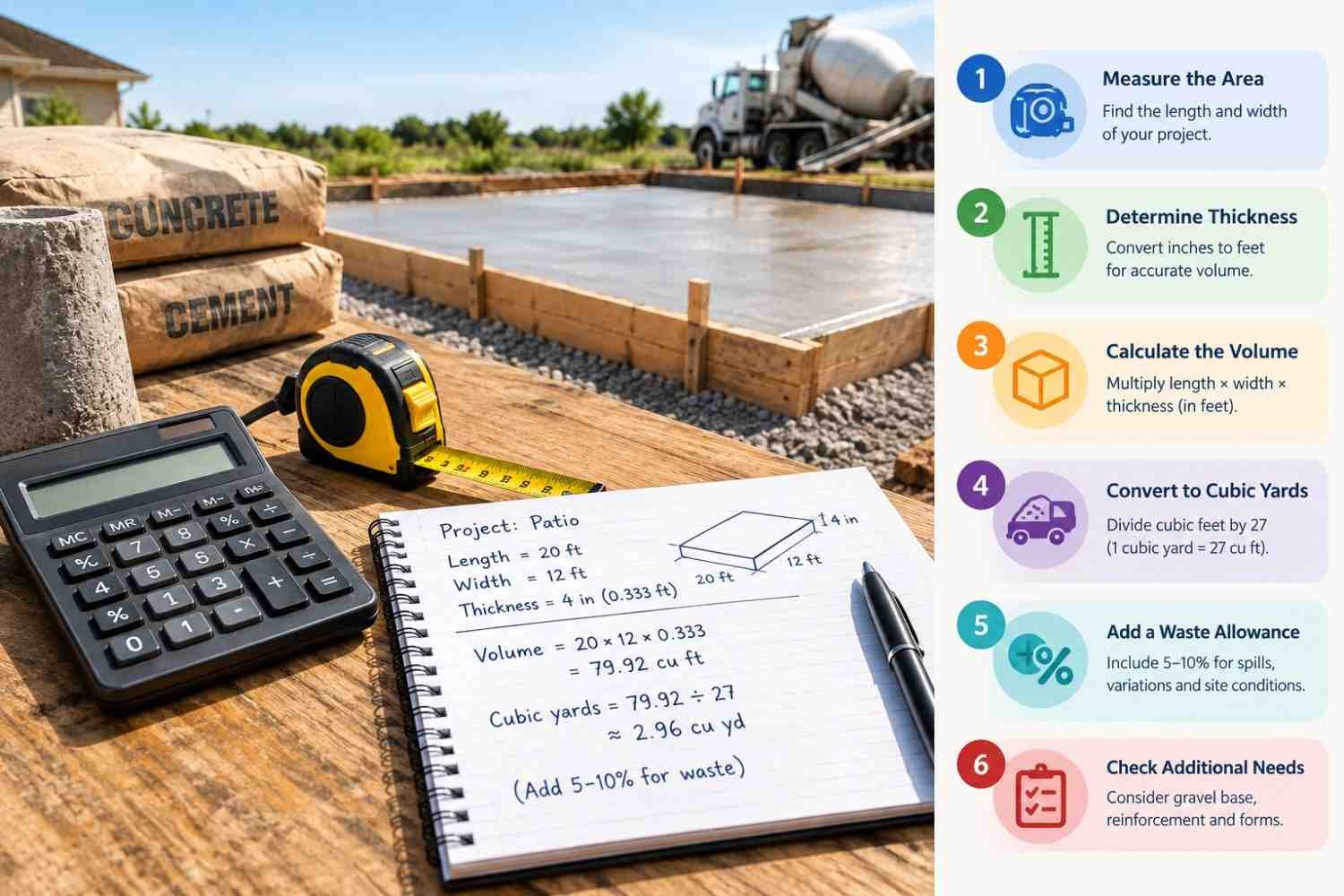
Imagine you are planning a patio that is 20 feet long and 12 feet wide.
First, calculate the surface area:
20 × 12 = 240 square feet
The patio therefore covers 240 square feet.
However, square footage alone is not enough to determine the amount of concrete. You also need to know how thick the slab will be.
Why Thickness Makes a Big Difference
Concrete thickness is often measured in inches, while volume calculations are usually performed in feet.
Suppose the patio will be 4 inches thick. Convert the measurement to feet:
4 ÷ 12 = 0.333 feet
Now multiply length, width, and thickness:
20 × 12 × 0.333 = 79.92 cubic feet
The project therefore requires approximately 79.92 cubic feet of concrete before allowing for waste or variations in the actual site.
This is why two projects with exactly the same surface area can require very different amounts of concrete. A thicker slab requires significantly more material.
Convert Cubic Feet to Cubic Yards
Ready-mix concrete is commonly ordered by the cubic yard.
One cubic yard contains 27 cubic feet. Therefore, divide the calculated cubic feet by 27:
79.92 ÷ 27 = 2.96 cubic yards
Our example patio would theoretically require about 2.96 cubic yards of concrete.
If you are unfamiliar with these conversions, an online concrete calculator can make the process easier by handling the calculations after you enter your measurements.
Add a Reasonable Allowance
Construction measurements are rarely perfect. The ground may have minor variations, the forms may not be completely uniform, and some concrete can be lost during transportation or pouring.
For that reason, it is generally sensible to include an additional allowance when estimating how much material to order.
For example, if your calculation produces 2.96 cubic yards, adding 5% would give:
2.96 × 1.05 = 3.11 cubic yards
A 10% allowance would give approximately:
2.96 × 1.10 = 3.26 cubic yards
The appropriate allowance depends on the project, site conditions, shape, and construction method. For larger or more complicated jobs, discuss the quantity with the concrete supplier or contractor.
What About Irregular Shapes?
Not every patio or slab is a perfect rectangle.
You might have an L-shaped patio, a driveway that becomes wider near the garage, or a walkway that changes direction. Trying to calculate the entire shape as one measurement can produce an inaccurate result.
A better approach is to divide the project into smaller sections.
For example, an L-shaped patio can be separated into two rectangles. Calculate the volume of the first rectangle, calculate the volume of the second, and then add the two results together.
This method can also work for projects containing several different sections with different dimensions.
For circular or curved areas, a different mathematical formula may be necessary. If a project has a complicated design, breaking it into simple geometric sections can make the estimate much easier.
Don't Forget Doors, Steps, and Other Areas
A concrete project may contain sections that do not require the same thickness.
For example, a patio might have a main slab plus a step. A driveway might have a thicker section near an entrance. A walkway may connect several areas with different widths.
Instead of treating the entire project as one calculation, measure each section separately.
For every section, determine:
Length × Width × Thickness = Volume
Then add the volumes together.
This approach gives you a clearer estimate and makes it easier to identify where the material is being used.
Think About the Materials Under the Concrete
Concrete is often only one part of a larger construction project.
Depending on the application and project specifications, a patio or driveway may require a prepared base beneath the concrete. This could involve gravel or another suitable aggregate material.
You may also need reinforcement, forms, edging, finishing materials, and other supplies.
Calculating the concrete quantity does not automatically determine the correct requirements for these other materials. Soil conditions, expected loads, drainage, local requirements, and construction design can all influence the appropriate setup.
If you're planning a project from scratch, it is useful to create a complete materials checklist rather than focusing exclusively on concrete.
Use a Calculator to Check Your Math
Manual calculations are useful because they help you understand the quantities involved. But online tools can make the process faster and provide another way to check your work.
A concrete volume calculator can be useful when converting measurements and calculating the amount of concrete required for a particular area.
This can be especially helpful when a project involves multiple sections or when measurements are given in different units.
An online calculator should be viewed as a planning tool rather than a substitute for accurate measurements or professional construction advice.
Double-Check Before Ordering
Before placing a concrete order, review your measurements carefully.
Check the length and width of every section. Confirm the planned thickness. Make sure inches have been converted correctly when the calculation requires feet. Then verify the final volume and conversion to cubic yards.
It can also help to have another person check the measurements, especially for a large or expensive project.
If the project includes structural elements, unusual soil conditions, significant loads, complicated slopes, or other technical considerations, consult a qualified professional.
A calculator can tell you how much concrete corresponds to a particular set of dimensions, but it cannot determine whether those dimensions are appropriate for your specific project.
A Simple Concrete Estimation Checklist
Before you order concrete, work through this checklist:
- Measure the length.
- Measure the width.
- Confirm the required thickness.
- Convert measurements into consistent units.
- Calculate cubic feet.
- Convert cubic feet into cubic yards.
- Add an appropriate allowance for waste and variations.
- Calculate separate sections individually if necessary.
- Consider the base, reinforcement, and formwork.
- Confirm the final quantity with your supplier or contractor.
Following these steps can reduce mistakes and make the project easier to plan.
Final Thoughts
Estimating concrete does not require complicated mathematics. The basic principle is straightforward: multiply length by width and thickness to determine volume, then convert the result into the unit used by your supplier.
The important part is taking accurate measurements and recognizing that real construction projects can involve waste, irregular shapes, varying thicknesses, and additional materials.
A concrete estimating tool can simplify the arithmetic and provide a useful second check on your calculations. Still, the final material order should take the actual project conditions into account.
Whether you're preparing a patio, driveway, walkway, or slab, spending a little extra time on measurements before construction begins can help prevent unnecessary delays, unexpected costs, and material waste.