How RFID ID Card Technology Supports Secure and Efficient Workplace Management
By Pinky Sharma 12-10-2026 15
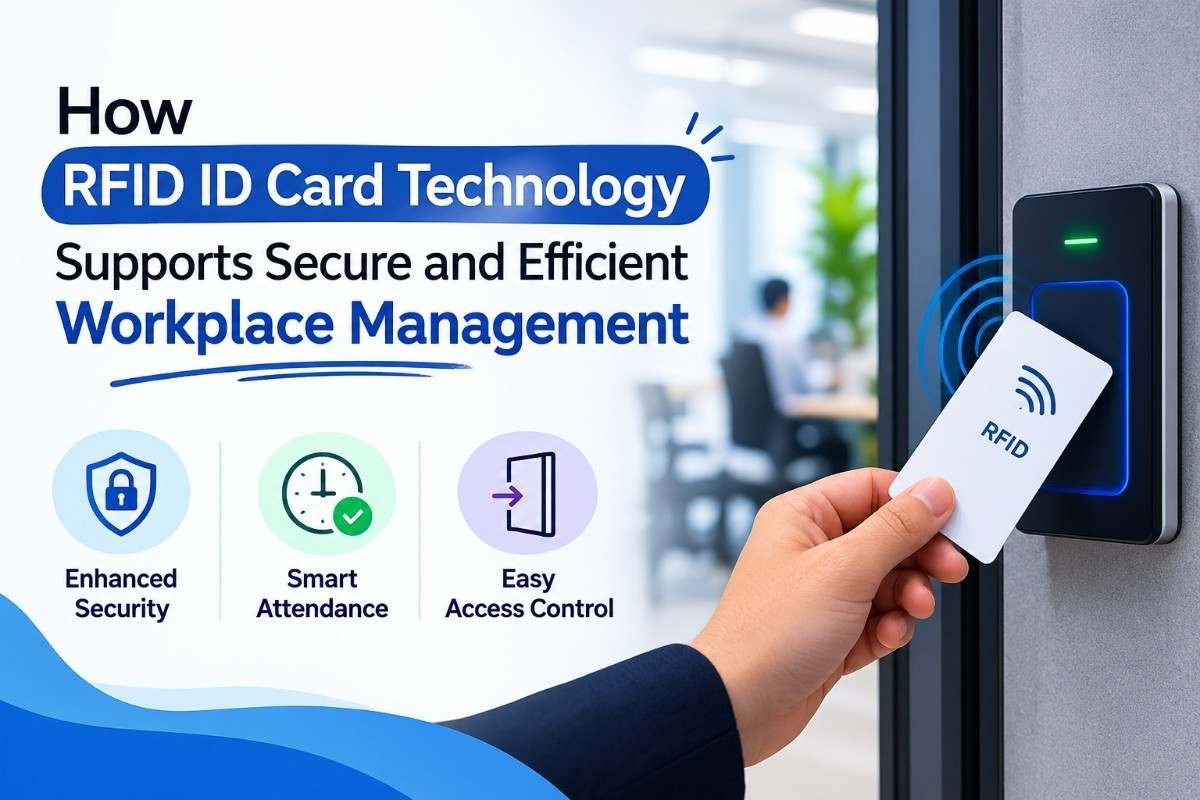
To ensure productivity in modern workplaces, it is crucial to have effective security systems and employee management processes. Businesses require solutions that streamline everyday activities and enhance the safety of people, information and physical assets while monitoring employee attendance and access to restricted areas. Typical identification techniques include manual methods which can be time-consuming and administrative.
That's where RFID ID card technology has a viable solution. RFID can be used to automate employee identification, enhance access control and improve attendance management. With the right software and security policies, RFID systems can contribute to providing safer and more structured workplaces.
So what is RFID ID Card Technology?
Radio Frequency Identification is an acronym that refers to a technology that employs radio waves to recognize and communicate with other RFID-compatible readers. In most cases, an RFID ID card will consist of a microchip and an antenna that is capable of communicating with the RFID reader when the ID card is presented within the range which the reader is capable of reading.
The components of a typical RFID identification system are the RFID cards, readers, antennas (as needed), and management software. The software can track attendance, confirm access rights and keep attendance logs, depending on the system.
Unlike cards used in traditional identification, which carry only an employee's name, photo and designation, an RFID-enabled card can be used to aid in automated identification. They can also minimize manual data entry and streamline business employee data management.
RFID can enhance workplace security in several ways.
Workplace security means to make sure that a certain area and resources within it can be accessed only by the authorized person. RFID technology can help achieve this goal in a number of ways.
Controlled Access to Restricted Areas
Access to server rooms, laboratories, warehouses, record rooms and administrative departments are often limited in a business. RFID access control systems are systems that enable employees to get access to certain areas with their assigned card and present it to a compatible reader.
The permissions can be set as per the job roles and responsibilities of the administrators. For instance, warehouse staff can be granted access to storage spaces and IT staff can be given permission to enter server rooms.
This approach lessens reliance on physical keys and simplifies the process of changing access controls when staff members depart from a unit or organization.
Real-Time Access Monitoring
Depending on the configuration of the installed system, the RFID system can record the events of card access, access attempts, card identification, and the time of the access. These records can be inspected by those with authorization for accountability of access activity and for investigation of security-related incidents.
Centralized monitoring can help ensure uniformity in security management across departments or facilities for organizations that have several of them. However, the monitoring skills are dependent on the readers, software, and access-control system used.
Less risk of unauthorized access.
Each employee can have his own credential to use with the RFID cards, making it easier to track which credential was used when someone accesses the system. In the event that someone lost a card or left the company, administrators can deactivate the credential without having to replace the physical key.
To provide increased security, companies can implement secure authentication methods, encrypted credentials (if applicable), and further authentication in sensitive zones. RFID cards are not inherently secure; if not used correctly, or if the technology or card is susceptible to compromise, then the card can be defeated.
Improved attendance and time tracking for employees.
Inaccurate timekeeping systems and manual attendance logs can cause unnecessary admin. The RFID based attendance system is a more systematic method of attendance.
Automated clock-in and clock-out.
When at the workplace, employees can tap or present their RFID ID cards to a reader to sign in or sign out of the site. The system captures the relevant times and passes this information to the attendance management software.
This process helps to minimize manual recordkeeping and make HR teams more efficiently manage attendance data. It can also be set up to accommodate shift-based attendance and multiple entry points depending on the system's configuration.
More Accurate Attendance Records
Automated attendance can minimise errors of handwritten, duplicate and manual data entry. The information gathered can be used by HR to create attendance reports and audit late arrivals or clockouts.
But, companies must have protocols for missed scans, corrections and exceptions. It is important to also examine the RFID attendance records in an appropriate manner; they cannot be assumed to be accurate in all cases.
Developing a simpler shift and workforce management solution.
For businesses with staff members working shifts, several departments, or a big team, it is useful to have a centralized record of attendance. Managers can audit working hours, establish an attendance pattern and schedule staffing needs.
If combined with an appropriate HR and payroll solution, the RFID attendance information can also be used to calculate payroll. Validations and approvals are still required to ensure salary processing is accurate, as appropriate.
The advantages of RFID ID cards for the workplace management are as follows:
Under appropriate business needs, the implementation of RFID technology has some operation advantages.
Better security: Permissions on access control can be used to limit access to authorized persons.
Faster identification: Identification is done without having to manually key by employee.
Less paperwork: Automated records lessen duplication of paperwork.
Digital stamps for attendance – simplified attendance reporting.
Improved record keeping: centralised logs to easily see access and attendance data.
Integrated systems: Compatible RFID solutions can integrate with access control, HR and attendance management systems.
These benefits can help businesses move forward in a more consistent way, and enable administrative teams to dedicate their time and resources to more meaningful tasks.
Yet another application of RFID ID Card in the Workplace.
RFID can be used to assist with a few additional functions in the workplace, in addition to employee identification and attendance.
Visitor and Contractor Management.
Businesses can create temporary RFID credentials for visitors, contractors and service providers. If the system supports it, these credentials can be set up to have limited access and expiration.
This enables organizations to handle the temporary access rights without giving visitors the same rights as permanent employees.
Track equipment and assets.
RFID can also be utilized to identify and track equipment, tools and other business assets that are tagged. With the integration of compatible RFID tags and readers, organizations can gain better visibility and streamline inventory processes.
Employee ID cards and asset-tracking tags are not the same and the right hardware and system configuration must be used for each application.
Cashless Cafeteria and Employee Services
The compatible RFID card can be used for the payment in the canteen, access to lockers and other services for staff. An organization could, for instance, link employee credentials with a prepaid cafeteria account or use the credentials to run electronic lockers.
These sorts of applications can take out the need for separate forms of identification and simplify the day to day use of the services within the workplace.
Conventional employee ID cards are challenged by RFID ID Cards.
Traditional employee ID cards can be used for visual identification and the provision of information, including names, photos and job titles. But they don't come with electronic access control or attendance tracking unless they are supported by other technology.
When combined with software and readers that are compatible, the RFID-enabled cards can do these things. They are especially helpful for companies with automated entry management, attendance tracking, or other work systems they wish to connect with.
This depends on the size of the business, security needs, budget, and infrastructure. A small office may will be able to take advantage of a printed ID card, but a bigger facility may be better suited to an identification card that is RFID enabled.
How to select the best RFID ID card system for your workplace
Choosing the right RFID solution is not an easy task.
To start, determine what the key objective of the system is, including employee identification, attendance tracking, access control or a mix of applications. Then, verify card frequency and compatibility of the current readers and software.
The quality of the card, in terms of durability and print quality, is also a key factor, especially if the staff member is frequently using the card. Organizations need to evaluate the security of the credentials, encryption options, administrative controls and the process for canceling lost credentials.
When choosing RFID ID card printing providers for employee identification and workplace access, you should consider providers like IVYPrints.
Lastly, do a comparison of initial costs, maintenance and integration options, and scalability before selecting the right solution.
This is a workshop that offers an overview of best practices for implementing RFID ID card technology.
distributing RFID cards isn't enough to make it a successful implementation. Individual credentials should be issued to individuals within an organization and access to resources should be determined by the role.
Access logs must be reviewed periodically by administrators and unused credentials be deactivated, and a clear procedure for reporting lost cards established. Staff should be trained on the correct usage of cards and the need for staff to protect their cards.
It is also crucial for businesses to review their data protection needs and only give access to authorized people. If the integration is done properly, and the system is tested and maintained as necessary, integrating RFID systems with existing software can enhance efficiency.
The problems and restrictions of RFID workplace system
Although there are benefits to the RFID, there are some drawbacks. There will be a cost in the initial implementation of the card, reader, software, and installation. Another potential compatibility issue is when new systems are plugged into an old system.
The security risks are based on the RFID technology, system configuration, and credential protection. Staff privacy is also an important factor to consider, especially with systems recording in detail who can access or move the staff.
Companies should have clear tracking rules, have proper security measures and follow any rules or regulations that govern the protection of data.
The Future of RFID ID Card Technology in Workplace Management
Even with the introduction of connected workplaces, RFID technology is still making its contributions. For organizations, it's important to integrate with smart building systems, as this enables them to better coordinate access control, facility operations and employee services.
A business can also integrate RFID credentials with other modes of ID, such as mobile ID, biometric verification, or other security measures as they see fit.
While workplace management is becoming increasingly digital, RFID devices can continue to support larger initiatives for efficiency and security of business assets.
Conclusion
RFID ID card technology is used by businesses to streamline their daily operations, attendance and workplace security. RFID tagging can help with manual labour reduction and record keeping, from access to restricted zones to automatic timekeeping, and assisting employee services.
But, the success of an RFID system relies on selecting the right technology, enforcing proper security measures, and having good policies in place. When organizations carefully consider their needs, they can implement RFID ID card systems to create a safer, more efficient and effective workplace.


















