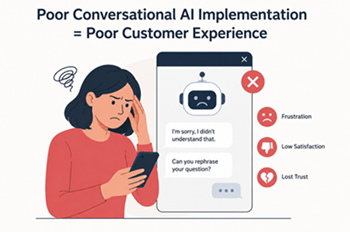
The systems failing in production are not failing because the underlying technology is flawed. They are failing because of avoidable deployment decisions. 91% of customer service leaders are under executive pressure to implement AI in 2026. That pressure accelerates timelines and creates conditions where the most consequential mistakes are also the most preventable.
The principles behind each mistake connect directly to how enterprise AI agents operate across voice, chat and digital channels. Understanding what goes wrong is inseparable from understanding what makes these systems deliver real customer experience.
Mistake 1: Deploying AI on the Wrong Query Types
The most common mistake is treating conversational AI as a universal handler for all inbound interactions. AI systems perform well on well-defined, high-volume categories: order status, account balance, appointment scheduling, FAQ resolution. They perform poorly on emotionally charged situations, multi-step problems and cases requiring regulatory judgment.
Deploying AI automation on query types it cannot handle reliably does not save cost. It generates escalations, callbacks and complaints that cost more than the interactions the AI was supposed to resolve in the first place.
The fix: classify interactions by complexity and emotional load before deciding what to automate. Start with the highest-volume, lowest-complexity categories and expand only as resolution rates validate it.
Mistake 2: Optimizing for Deflection Rate Instead of Resolution Rate
Deflection rate measures how many interactions the AI closes without escalating. First contact resolution measures how many are actually resolved. These are not the same metric, and optimizing for the wrong one is one of the most expensive mistakes in a conversational AI deployment.
An AI that deflects by ending a conversation without resolution has not saved money. It has deferred the cost to a callback or customer churn. The customer who calls back is more frustrated than they were the first time.
Measure first contact resolution, re-contact rate within 72 hours, CSAT and customer effort score alongside deflection rate. Those metrics together reveal whether the AI is resolving or merely deflecting.
Mistake 3: Breaking Context at Channel Transitions
Customers switch channels constantly. A customer who starts on chat and escalates to voice expects the agent to know what was already discussed. When context is not transferred, the customer experiences the transition as a failure of the entire system, not just a technical limitation.
This is the core argument for unified omnichannel AI operations, explored in our article on omnichannel customer engagement. The practical consequence is that context transfer must be designed into the system architecture before launch, not retrofitted after complaints arrive.
The fix: a shared customer data layer that all channels read from and write to in real time. When that layer exists, channel transitions are invisible to the customer.
Mistake 4: Treating Deployment as a One-Time Project
Products change. Policies update. Customer language evolves. An AI system not continuously trained on new interactions will gradually drift from current reality. The cost of rebuilding trust after a period of degraded AI performance consistently exceeds the cost of the ongoing optimization investment.
Teams that achieve sustained performance treat their AI the way they treat their human workforce with onboarding, regular training, performance review and continuous development. The technology requires the same operational discipline as the people it works alongside.
Mistake 5: Designing Escalation as a Failure State
Some organizations design their conversational AI systems to minimize escalation at all costs. The reality is that escalation is the AI working correctly recognizing an interaction it cannot resolve well and routing it to someone who can. Suppressing escalation means keeping customers trapped in a loop that never resolves.
The problem is escalation without context transfer. When a customer escalates and has to re-explain everything, the escalation becomes the negative experience. When the agent receives full conversation history, the transition is seamless.
Well-designed escalation paths are a competitive advantage, not an admission of limitation.
Mistake 6: Ignoring the Voice Channel's Specific Requirements
Many conversational AI deployments are built for chat and extended to voice as an afterthought. Voice has fundamentally different requirements that a chat-first system is not designed to meet.
Latency is the most critical. A response delay above 600ms on a voice call feels unnatural. Chat users tolerate two or three seconds between messages. Voice AI systems require sub-600ms responses and natural language understanding calibrated to spoken patterns — not written ones.
The channel-specific requirements of voice, chat and digital are explored in our primary article on how enterprise AI agents deliver real customer experience across all three.
Conclusion
The conversational AI systems delivering real results in 2026 are not more sophisticated than the ones failing. They are deployed with more discipline — right query types, resolution metrics not just deflection, context preserved across channels, ongoing management and escalation designed as a feature rather than a fallback.
These failure patterns appear consistently across industries. Avoiding them is less about technology selection and more about the operational decisions made before and after go-live.
Omvia by ResolX is built to help enterprises avoid these failure modes, with unified context management across voice, chat and digital, continuous learning infrastructure and escalation design built into the platform.
Visit resolx.ai/contact-us to see how it works in practice.