How Modern Entrance Systems Are Changing the Way Buildings Manage Access
By flap barrier 14-09-2026 14

Buildings today are no longer designed around the simple idea of opening a door and allowing people to enter.
Modern offices, industrial facilities, residential communities, hospitals, educational institutions, and commercial properties deal with a constant movement of employees, visitors, contractors, customers, and vehicles.
Managing this movement efficiently requires more than security guards and traditional locks. It requires systems that can identify, control, and organize access without unnecessarily slowing down everyday operations.
This is where modern entrance automation and security systems have become increasingly important.
Security Is No Longer Only About Preventing Entry
Traditional security often focuses on keeping unauthorized people outside. Modern security takes a broader approach.
It considers who is entering, where they are going, when they are arriving, and whether their access should be permitted.
This shift has increased the importance of technologies such as access control systems, turnstiles, flap barriers, automatic boom barriers, and other entrance management solutions.
Instead of treating every person or vehicle in the same way, organizations can create structured access procedures based on their specific requirements.
People and Vehicles Need Different Access Solutions
A building entrance and a vehicle entrance may serve completely different purposes.
Employees entering through a pedestrian gate may require controlled access using an access control system or turnstile. Visitors may need a separate verification process. Vehicles entering a parking area may require an automatic boom barrier to regulate movement.
Using the appropriate system for each type of movement allows facilities to maintain better control without creating unnecessary delays.
For this reason, modern entrance automation solutions are increasingly being considered as part of overall facility planning rather than as standalone security equipment.
Why Entrance Automation Matters
Manual access procedures can become difficult to manage when the number of people and vehicles increases.
During busy periods, security personnel may have to check credentials, monitor vehicle movement, operate gates, and maintain records simultaneously.
Automation can reduce some of this operational burden.
For example, an automatic boom barrier can regulate vehicle entry and exit, while access control technologies can help manage authorized pedestrian movement.
The objective is not simply to automate everything. The objective is to create a controlled environment where technology supports security personnel and makes routine movement more efficient.
Access Control Creates a More Structured Environment
An effective access control system does more than unlock a door. It establishes rules about who can access a particular area.
Employees may have access to regular workspaces, while restricted areas can remain limited to authorized personnel.
Similarly, contractors, visitors, and service personnel can be managed according to the requirements of the facility.
This structured approach becomes particularly valuable in large commercial buildings and industrial environments where different groups may require different levels of access.
Organizations looking for a reliable security systems manufacturer in India can consider how different technologies work together rather than selecting individual products in isolation.
Automatic Boom Barriers for Vehicle Management
Vehicle movement is another important part of modern facility security.
Parking areas, residential societies, commercial properties, factories, warehouses, and institutional campuses may experience hundreds of vehicle movements during a normal day.
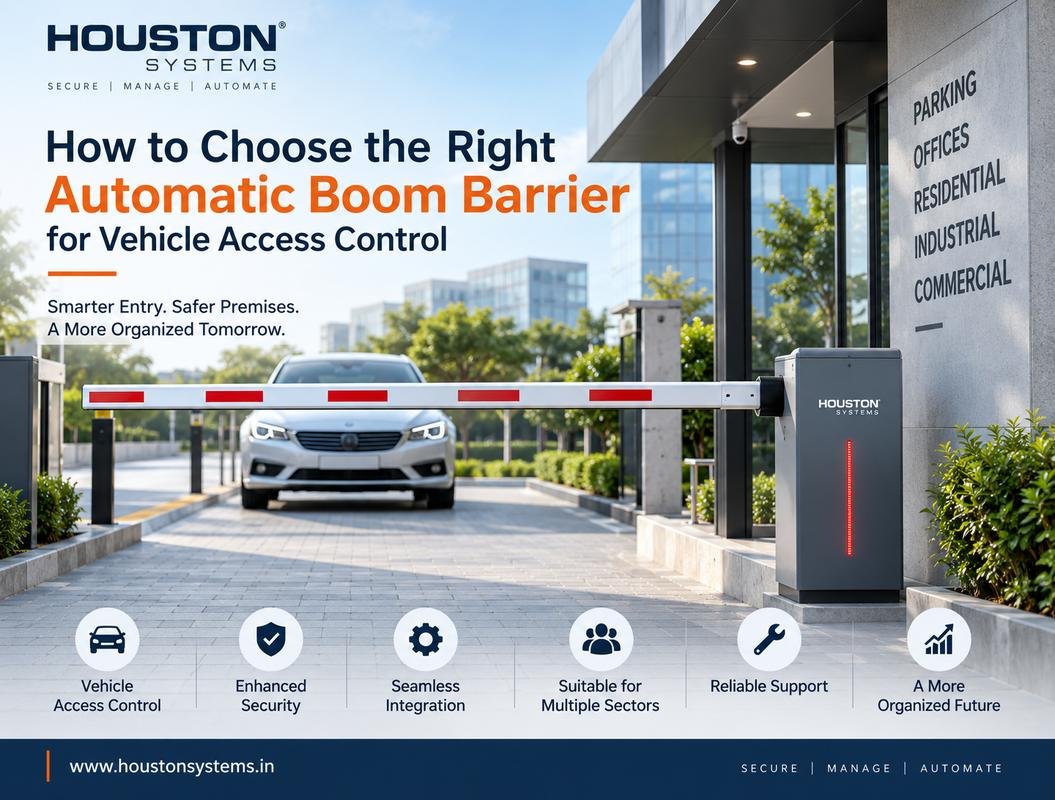
An automatic boom barrier can help regulate this movement at designated entry and exit points.
When integrated with suitable access control or vehicle identification technologies, the barrier can become part of a broader parking management system.
The result is a more organized approach to vehicle movement while reducing dependence on manual gate operation.
Turnstiles Help Manage Pedestrian Movement
Pedestrian entrances present a different challenge.
A facility may need to allow large numbers of authorized people to enter while preventing unauthorized access.
Turnstile systems can help create a controlled passage point.
Depending on the application, organizations may use tripod turnstiles, flap barriers, or full-height turnstiles.
The choice depends on factors such as security requirements, available space, expected traffic, and the type of facility.
Rather than selecting equipment simply because it is popular, organizations should consider how the system fits into their overall access strategy.
Security Systems Work Best as Part of a Larger Strategy
One security product rarely solves every access challenge.
A modern facility may require several technologies working together.
For example:
- Access control systems can manage authorized pedestrian entry.
- Turnstiles can regulate controlled pedestrian movement.
- Automatic boom barriers can manage vehicle access.
- Parking management systems can organize vehicle movement.
- Door frame metal detectors can support security screening.
- Other monitoring and identification technologies can provide additional layers of control.
The value comes from how these systems are planned and integrated.
A properly designed security environment considers the movement of people, vehicles, employees, visitors, and service personnel together.
Choosing the Right Security Technology
Every facility has different requirements.
A corporate office may prioritize employee access and visitor management.
An industrial facility may require stronger perimeter and vehicle control.
A residential complex may focus on parking and resident access.
A hospital may need efficient movement while maintaining controlled access to restricted areas.
This is why organizations should evaluate factors such as traffic volume, security requirements, available infrastructure, integration capabilities, and future expansion before selecting a solution.
A company such as Houston Systems can provide different security and entrance automation solutions according to the requirements of the facility.
The Future of Building Access
The future of access management is likely to become increasingly connected.
Security systems, entrance automation, parking management, identification technologies, and monitoring platforms can work together to create more organized environments.
The objective is not to make buildings difficult to enter. It is to make sure that the right people and vehicles can enter through the right points at the right time.
That distinction is becoming increasingly important as facilities become larger and more complex.
Final Perspective
Modern building security is no longer limited to locks, gates, or security personnel.
It is increasingly about creating a coordinated system for managing people and vehicles.
From access control systems and turnstile systems to automatic boom barriers and parking management solutions, different technologies can contribute to a more structured entrance environment.
The right solution ultimately depends on the facility, its users, and its operational requirements.
As organizations continue to prioritize security and efficiency, entrance automation will remain an important part of how modern facilities manage access.