If you're running a manufacturing operation and still managing production schedules on spreadsheets, chasing down inventory counts manually, or losing hours every week reconciling data across disconnected systems, I've seen this story before, and I know exactly how frustrating it gets.
Manufacturing ERP software was built to fix that. But here's the thing most people don't tell you upfront: not every ERP system is the same, and picking the wrong one can cost you more than the problem you were trying to solve.
In this article, I'll walk you through what manufacturing ERP software actually does, why it matters in a modern production environment, and most importantly, why the benefits of custom ERP software often outweigh going with a generic, one-size-fits-all solution. Whether you're a plant manager evaluating options or a business owner trying to make sense of the technology landscape, this guide will give you a clear, honest picture.
What Is Manufacturing ERP Software, Really?
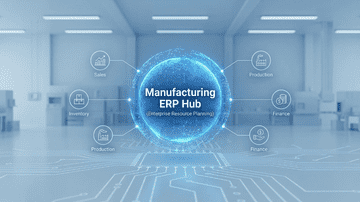
ERP stands for Enterprise Resource Planning. In a manufacturing context, it's a unified software platform that connects all your core business processes: production planning, inventory management, procurement, quality control, finance, and customer orders, into a single system that everyone in your organisation can use.
Think of it as the central nervous system of your factory. Instead of your production team working from one system, your warehouse team working from another, and your finance department using a completely separate tool, an ERP ties everything together in real time.
When a sales order comes in, the ERP automatically checks raw material availability, updates the production schedule, flags procurement if stock is low, and keeps your finance team informed, all without a single manual handoff.
That's the promise. And when it works well, it genuinely transforms how a manufacturing business operates.
The Core Functions You Should Expect From Any Manufacturing ERP
Before jumping into customisation or vendor selection, it helps to understand what capabilities a solid manufacturing ERP should cover as standard.
Production Planning and Scheduling: The system should help you build realistic production schedules based on machine capacity, labour availability, and material stock, not just theoretical timelines someone typed into a spreadsheet.
Inventory and Material Management : Real-time visibility into raw materials, work-in-progress, and finished goods is non-negotiable. Good ERP software eliminates the guesswork and reduces costly overstock or stockout situations.
Bill of Materials (BOM) Management: Manufacturing is built on precise BOMs. Your ERP should handle multi-level BOMs cleanly, including version control when product specs change.
Quality Control Integration: Whether you're ISO-certified or working toward it, quality checkpoints need to be embedded into the production workflow, not bolted on afterward.
Financial and Cost Tracking : Job costing, overhead allocation, and real-time profit visibility at the product or order level give management the data they need to make smart decisions.
If a system you're evaluating can't handle these five areas cleanly, keep looking.
Why Off-the-Shelf ERP Often Falls Short in Manufacturing
I've spoken to dozens of manufacturers over the years who bought a well-known ERP brand, spent 12 to 18 months implementing it, and still found themselves working around the system rather than with it.
Here's why that happens so often.
Generic ERP platforms are designed to serve a wide range of industries: distribution, services, retail, manufacturing. To do that, they make compromises. The production scheduling module might be brilliant for a discrete manufacturer but completely wrong for a process manufacturer running batch production. The quality module might work well for food and beverage but be awkward for precision engineering.
You end up paying for features you'll never use while missing the specific workflows your team actually needs. Customising a pre-built ERP to fit those gaps is possible, but it's expensive, slow, and often creates problems when the vendor releases updates.
That's where custom ERP software enters the picture.
The Real Benefits of Custom ERP Software for Manufacturers
Custom ERP isn't a luxury reserved for large enterprises. Increasingly, mid-sized manufacturers are investing in bespoke solutions, and the return on that investment is measurable.
It fits your actual process, not a theoretical one: A custom manufacturing ERP is built around how your factory actually runs. Your specific machine routing, your unique quality hold procedures, your supplier lead time quirks: all of it gets built into the logic of the system from the start. Your team spends less time working around the software and more time using it.
You own the roadmap: When your business grows or your process changes, you're not waiting for a vendor to prioritise your feature request in their next release cycle. You decide what gets built and when. That kind of control is genuinely valuable in a competitive market.
Integration is cleaner: Many manufacturers use a combination of specialist tools: CNC machine interfaces, warehouse management hardware, customer portals, supplier EDI systems. Custom ERP is built with your specific integration requirements in mind, which tends to produce far cleaner data flows than trying to connect a generic ERP to tools it was never designed to talk to.
Lower total cost of ownership over time: The upfront investment in custom development is higher than buying a licence for an off-the-shelf product. But strip away the ongoing licencing fees, the consultant charges every time you need a configuration change, and the cost of workarounds, and custom often wins on a five-year view.
Your team actually uses it : Adoption is the silent killer of ERP projects. When a system maps naturally to how people already work, they use it. When it forces them to learn an alien workflow, they revert to spreadsheets. Custom ERP systems consistently see higher adoption rates because they feel familiar from day one.
Signs Your Manufacturing Business Is Ready for an ERP Upgrade
Not every manufacturer needs a full ERP overhaul today. But these are the signals I see most often in businesses that are overdue for a change:
- Production delays are consistently traced back to information gaps or miscommunication between departments
- Inventory counts are unreliable and you regularly discover material shortages mid-run
- Management decisions are based on reports that are days or weeks out of date
- Your current systems require significant manual data entry to keep everything in sync
- You're growing and your existing tools are visibly struggling to scale
If three or more of those resonate, it's worth having a serious conversation about your options. (A conversation with an ERP consultant who specialises in manufacturing (not just generic software sales) is the right starting point.)
How to Evaluate Manufacturing ERP Options Without Getting Lost
The ERP market is noisy. Here's a practical framework I'd suggest when you're comparing options.
Start with your pain points, not the vendor's feature list. Document the specific problems causing the most friction in your operation right now. Use that list as your filter: does this system actually solve these problems, or just check boxes on a brochure?
Ask for a demo using your data, not their sample data. Generic demos always look polished. A vendor confident in their product should be willing to walk through your specific scenarios.
Talk to existing customers in similar manufacturing niches. Not the references the vendor selects for you. Dig for independent reviews and, where possible, find manufacturers of a similar size and type who are running the system today.
Understand the total cost clearly. Licencing, implementation, training, ongoing support, and customisation costs all need to be on the table before you can compare fairly.
And if you're considering custom development, work with a development partner who has demonstrable manufacturing domain knowledge, not just software skills.
Conclusion
Manufacturing ERP software, done right, gives you something genuinely valuable: clarity. You know where your materials are, what your production floor is doing, where your costs are running, and what your customers can expect, in real time, without chasing people for updates.
The off-the-shelf versus custom debate isn't about prestige or budget. It's about fit. Generic solutions work well for manufacturers with standard processes and the flexibility to adapt. Custom ERP software pays off when your operation has specific requirements that a packaged product can't serve cleanly.
My honest advice? Don't start with software. Start with a clear picture of your current process, your biggest operational frustrations, and where you want to be in three to five years. The right ERP (whether custom or commercial) will follow from that clarity.
Tags : Technology