How I Recovered 8 Years of Business Emails After an Exchange Server Crash Using DataVare OST to PST Converter
By Eliza Bell 13-06-2026 361
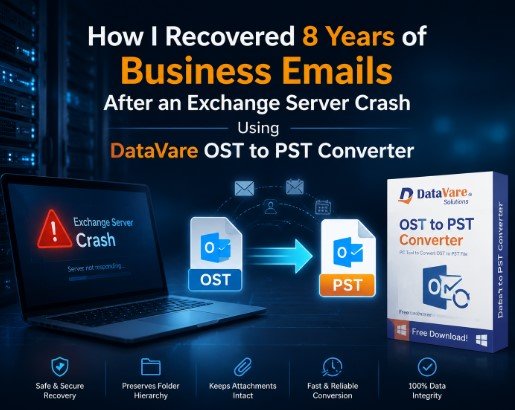
What Happened
I never thought that a single server crash could put eight years' worth of my business data (16 GB) at risk because I rely so largely on email for customer communications, project updates, invoices, contracts and internal conversations.
I arrived at work one Monday morning anticipating a typical workday. Instead, Outlook presented me with an error notice. Overnight, our Exchange server experienced a significant malfunction. I wasn't too concerned at first. I thought the IT staff would use backups to restore everything in a few hours.
Sadly, things weren't that easy.
As the day went on, it became evident that the server problem was more severe than anticipated. I became acutely aware of how much my career relied on those emails while the Exchange environment was being examined. It may have been unable to access years' worth of client communications, project documentation, quotes, payment confirmations and business contracts.
Panic began to set in at that point.
What Methods I Tried
I first tried every free technique I could find, just like other folks.
Examining Backup Copies
I started by looking for local backups. I discovered some PST files, but they were out of date and lacked several years' worth of crucial correspondence.
Rebuilding the Profile in Outlook
I then made a new Outlook profile in the hopes that the mailbox would reconnect.
No luck.
Outlook was unable to retrieve the lost mailbox data without access to the Exchange account.
Exporting Using Outlook
I also tried exporting data by hand. Outlook needed adequate mailbox connectivity, which was no longer accessible, which was the issue.
I had run out of options.
Finding the OST File Opportunity
I found something significant while conducting my investigation.
Outlook had kept an offline duplicate of my mailbox in an OST file on my local computer even while the Exchange Server was down.
Years' worth of synced email data were contained in that file.
OST files are directly linked to their original Exchange profiles, which presented a problem. Outlook was unable to open the file and grant access once the server connection was lost.
I required a means of independently extracting that data.
I began searching for a specialized OST-to-PST conversion option at that point.
Reasons for Choosing This Tool
I found DataVare OST to PST Converter after weighing my options.
I was first drawn to it because of its straightforward method.
The majority of recovery options I looked at appeared to be quite sophisticated and geared toward IT admins. My objective was only getting my emails back, not server management, thus I needed something useful.
The program promised to preserve mailbox structure, attachments, contacts and folders while converting inaccessible OST files into PST format.
I made the decision to try it after weighing the risks.
The software converted my 16 GB OST files in approximately 35 minutes.
Installation and Initial Thoughts
It merely took a few minutes to complete the installation.
I was already under a lot of stress, so it was comforting that the UI was clear and simple to use.
I opened the program, chose my OST file and let it scan the mailbox contents.
The preview option was one element that I liked right away.
My folders, emails and attachments were presented precisely as they had been in Outlook before I converted anything.
I felt confident for the first time since the server meltdown.
Process to Convert OST Files
The actual conversion procedure was very easy.
Step 1: Choose the OST file
I looked at the place where my offline mailbox file was kept by Outlook.
Step 2: Scan the mailbox
After analyzing the file, the program showed every item in the mailbox.
Step 3: Examine the Information
I looked over crucial directories, such as:
• The inbox
• Items Sent
• Projects for clients
• Contracts from the Past
• Accounting Documents
Everything seemed to be unaltered.
Step 4: PST conversion
I began the conversion after choosing PST as the output format.
Step 5: Reimport Outlook
I imported the PST file into Outlook after the conversion was finished.
Years' worth of emails were restored in a matter of minutes.
What Most Impressed Me
Data integrity is the most important issue in any recovery method.
I anticipated some folder problems, corrupted attachments or missing emails.
Fortunately, none of those issues arose.
The tool effectively preserved:
Content of emails
Attachments
The hierarchy of folders
Contacts
Entries in the calendar
Details about the sender and recipient
Timestamps
After looking through important folders for several hours, I was unable to identify any significant inconsistencies.
The recovery was successful because of this accurate conversion tool.
Performance While Recovering
I have a large OST file.
It took up many gigabytes of storage and held about eight years' worth of business correspondence.
Throughout the procedure, the conversion stayed constant regardless of the file size.
My Evaluations
Usability: 5/5
The UI was easy to use and didn't require any technical knowledge.
Conversion accuracy: 4.8/5
I didn't come across any corrupted attachments or missing emails.
Performance: 4.5/5
Processing time was inevitably needed for large mailbox files, although performance was consistent.
Stability: 4.9/5
Without stalling or crashing, the application finished the conversion.
Value for Money: 4.5/5
The price felt worth it.
Software Pricing
There were three main licensing options available when I bought the software.
Personal License
Created for certain users that require the program on a single system.
Business License
Created for small companies and commercial use.
Enterprise License
Created for large organizations and commercial use.
It's always a good idea to get the most recent information before making a purchase because software prices are subject to change.
Which License Should I Select and Why
The Personal License is what I chose.
Recovering my own mailbox data following the Exchange Server disaster was my simple objective.
I didn't require enterprise-level usage privileges or deployment across several platforms.
The Personal License gave me what I needed without charging extra for features I wouldn't utilize.
It seemed like the most sensible option.
Advantages
Easy to use interface
Fast installation
Precise conversion from OST to PST
Preserves the structure of the mailbox
Maintains information and attachments
Large OST files are supported.
Disadvantages
It may take some time to convert large mailboxes.
Individual users might not need advanced enterprise functionalities.
Premium plans could be pricey for infrequent use.
The prices for Mac users are high.
Final Decision
One of the most frustrating technological scenarios I've encountered was losing access to eight years' worth of business emails.
It was challenging to be uncertain. I was concerned about client information, financial paperwork, project history and business continuity in addition to emails.
Significant data loss could have ensued from what started out as a server disaster. Thankfully, I was able to recover access to information that I had assumed would be lost forever by converting the offline mailbox file.
In my own experience, the healing process was dependable, seamless and surprisingly simple to finish. Above all, it allowed me to access years' worth of company data when I most needed it.
Total Score: 4.8 out of 5
This method proved to be a reliable technique to retrieve crucial mailbox data without needless complication if you're dealing with an inaccessible OST file following an Exchange Server crash, profile corruption or account deactivation.









