How High-Volume Restaurants Handle Fresh Pita Production During Peak Hours
By James Maronn 26-05-2026 378
The operational science behind keeping flatbread fresh when 300 covers walk through the door
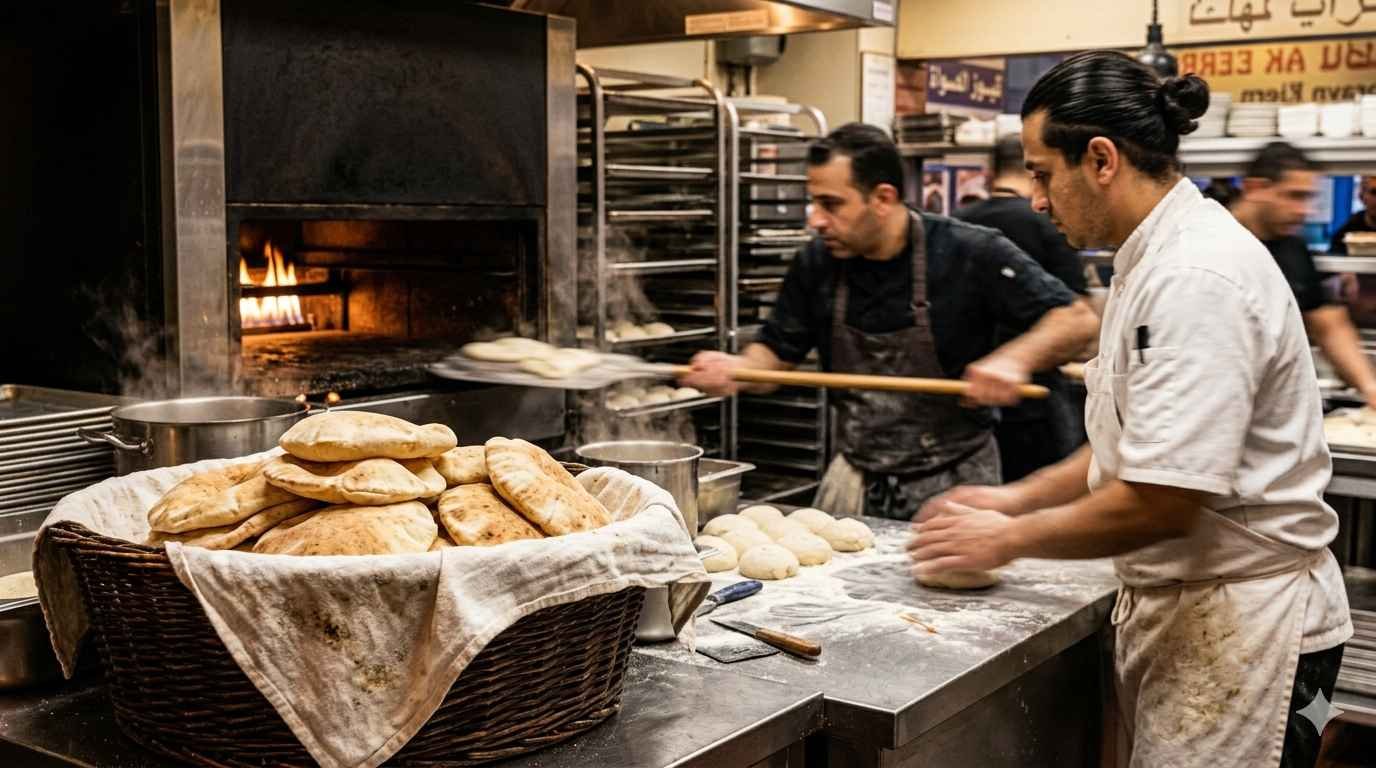
I've spent time talking to kitchen operators who run high-volume Middle Eastern and Mediterranean restaurants. The ones doing real numbers — 250 to 400 covers on a Friday night, catering runs on Saturday morning, a lunch rush that doesn't actually stop.
And the question I kept coming back to was this: how do you serve fresh pita at scale without either burning through labor or destroying quality?
It turns out the answer isn't what most people think. It's not a bigger oven. It's not more staff. It's not pre-baking and reheating — though plenty of places do that, and you can tell.
It's a production architecture problem. And the restaurants that have figured it out treat it less like cooking and more like systems engineering.
The Problem Nobody Talks About
Fresh pita has a brutally short service window.
A properly baked pita — puffed, soft, slightly charred — stays at peak quality for about 8 to 12 minutes after it comes off the heat. After that, the steam that created the pocket starts condensing. The bread goes from pillowy to chewy to tough in a timeline that's completely indifferent to your dinner rush.

So the challenge isn't baking pita. That part is straightforward. The challenge is baking the right amount at the right time, continuously, without gaps, without waste, and without a dedicated staff member doing nothing but watching bread.
Most kitchens fail at one of two things.
The first is batch baking. They make a large batch before service, stack it in a warmer, and serve from that. By cover 80, the pita is mediocre. By cover 200, it's basically crackers. Customers don't complain directly — they just don't come back.
The second is on-demand panic. They try to bake fresh for every table and fall apart during the 7:30pm surge when three tables are seated simultaneously, the grill station is backed up, and the person handling bread is also handling something else.
The operations that actually get this right have a third approach entirely.
The Rolling Production Model
The best high-volume pita operations use what I'd call a rolling production model. Instead of thinking in batches, they think in cycles.
Thirty minutes before service starts, they bake an initial buffer — enough to handle the first wave of covers without scrambling. Then every 8 to 10 minutes throughout service, a small fresh bake replenishes what's been served. Nothing is stockpiled. Anything sitting longer than 15 minutes gets pulled.
That last part is where most operators push back. Discarding pita feels wasteful. But the restaurants that refuse to discard are the ones serving bad bread by 8pm. The math actually works in their favor — wasting a dozen pitas per cycle is cheaper than losing a repeat customer who now associates your restaurant with stale bread.
The rolling model only works when someone owns it. Not "whoever has a free hand." One station, one rhythm, explicit responsibility. When it's everyone's job, it's no one's job, and that's when you find a stack of 40 cold pitas sitting under a heat lamp at 9pm.
Equipment Is the Constraint Most People Get Wrong
A conventional deck oven will bake pita. But it's not designed for the thermal recovery speed that rolling production demands. You need the baking surface back to temperature in under 90 seconds after a pull. Most standard deck ovens take 3 to 5 minutes. In a 400-cover service, that recovery gap compounds into a production hole you can't dig out of.
The restaurants that run rolling production without the 8pm quality collapse have moved toward dedicated flatbread equipment with faster recovery cycles and consistent surface temperature across the entire baking zone. The thermal specs matter more than raw BTU numbers — an oven designed specifically for continuous flatbread production handles the cycle differently than one adapted from another purpose.

One setup built around this kind of operation is the Spinning Grillers Pita Oven — a 30" natural gas unit designed for exactly this kind of continuous-cycle flatbread production. It comes up in these conversations not because of marketing but because the recovery speed and consistent deck temperature actually match what rolling production requires.
Equipment designed for the use case will always outperform equipment adapted to it.
Dough Management at Volume
Production architecture extends backward into dough, and this is where a lot of high-volume kitchens quietly fall apart.
Freshly made dough needs 1 to 2 hours of proofing — you can't make it to order. Cold refrigerated dough bakes inconsistently — the center doesn't cook at the same rate as the edge, and you end up with a flat pita or an undercooked pocket. The right state is proofed dough at room temperature, roughly 65 to 70°F, which bakes fast, puffs predictably, and gives you the char timing you want.

The kitchens that handle this well run three overlapping batches. The first is mixed 4 hours before service and fully proofed by the time doors open. The second is mixed 2 hours out as a backup supply. The third is mixed 30 minutes into service to carry you through the back half of the night. Three batches in rotation means you're never waiting for dough to catch up to demand. You're always pulling from a batch in its optimal window.
Some kitchens add a fourth batch for catering or event overflow. The system scales cleanly once it's in place.
What the Best Operators Actually Track
The restaurants that have genuinely cracked pita production track three things obsessively.
Cycle time — how long from raw dough to basket. If this creeps above 14 minutes consistently, something has broken down in the system. Either dough staging, oven recovery, or station ownership has slipped.
Waste per service — not as a cost metric, but as a quality signal. Too little waste means you're not discarding past-window pita. Too much means your cycle estimate is off for that service volume.
Complaint pattern — specifically whether bread complaints cluster in the first 30 minutes or in the last 90. These have completely different root causes and completely different fixes. Most kitchens track none of this, which is why they keep solving the wrong problem.
The Part That Surprises People
When I lay this out, the first reaction from operators is usually: this sounds like a lot of overhead for bread.
It is overhead. But so is every system that works.
The restaurants serving forgettable pita aren't cutting corners on ingredients. They're cutting corners on the production system — the cycling, the ownership, the dough staging, the discard discipline. The bread itself is often fine. The process around it isn't.
Fresh pita is a high-frequency customer touchpoint. It's on the table before the meal and throughout it. If it's good, it sets a quality signal for everything that follows. If it's mediocre, the entire meal gets graded on a lower curve — and nobody at the table can tell you exactly why.
That's a lot of leverage for something that takes 90 seconds to bake.
The operations that understand this don't treat pita as a side task. They treat it as a production system with the same rigor they'd apply to their main protein station or their expediting workflow.
It's just bread. Until it isn't.
If you work in a high-volume kitchen and have a pita production system that works differently — drop a comment below. I'd genuinely like to hear about it.