Month-end closing is one of the most critical processes in financial management, yet it is often one of the most time-consuming and complex tasks for finance teams. Organizations must gather financial data from multiple systems, reconcile accounts, eliminate intercompany transactions, and generate consolidated reports. When handled manually, this process can take weeks and consume significant resources. Today, many modern finance teams are dramatically reducing their close cycles by adopting Financial Consolidation Software that automates financial workflows and centralizes data management. Platforms like Result Lane help companies streamline the consolidation process, enabling finance departments to reduce month-end close time by as much as 50% while improving reporting accuracy and financial transparency.
Understanding the Month-End Close Process
The month-end close process involves reviewing, reconciling, and finalizing all financial transactions for a given reporting period. The goal is to produce accurate financial statements that reflect the organization’s financial performance and position.
Typical steps in the month-end close include:
- Collecting financial data from multiple departments and systems
- Reconciling accounts and verifying transactions
- Recording adjustments and journal entries
- Eliminating intercompany transactions
- Performing currency conversions for international entities
- Generating consolidated financial reports
For organizations with multiple subsidiaries or complex financial structures, this process can become extremely complicated.
Why Traditional Month-End Close Processes Are Slow
Many finance teams still rely heavily on spreadsheets and manual workflows to complete month-end close tasks. While spreadsheets provide flexibility, they introduce significant operational inefficiencies.
Common reasons why month-end close processes become slow include:
Manual Data Collection
Finance teams often need to gather financial data from multiple accounting systems, ERP platforms, and departmental reports. This process can take days or even weeks when performed manually.
Data Inconsistencies
Different departments may use different financial formats or reporting standards, requiring additional time to standardize and reconcile financial information.
Intercompany Reconciliation Complexity
Organizations with multiple subsidiaries frequently conduct transactions between entities. Identifying and eliminating these transactions manually is both time-consuming and prone to errors.
Currency Conversion Challenges
Global companies must convert financial data across multiple currencies while maintaining compliance with accounting standards.
Limited Real-Time Visibility
When financial data is stored in separate spreadsheets, finance teams lack real-time visibility into financial performance. This often results in last-minute adjustments during the close process.
These inefficiencies significantly extend the time required to complete the month-end close.
How Modern Finance Teams Cut Close Time by 50%
Organizations are dramatically improving the efficiency of their financial operations by implementing automated financial consolidation solutions. These systems streamline workflows, centralize financial data, and reduce manual intervention.
Several key strategies enable finance teams to reduce close cycles significantly.
- Automating Financial Data Integration
One of the biggest time-consuming steps in the close process is gathering financial data from multiple systems.
Financial consolidation platforms automatically integrate with ERP systems, accounting software, and financial databases. This allows financial data to flow directly into the consolidation system without manual data entry.
Benefits include:
- Faster financial data aggregation
- Reduced manual errors
- Improved consistency across financial reports
Automation ensures finance teams always work with the most up-to-date financial data.
- Centralizing Financial Data
When financial data is stored across multiple spreadsheets and systems, reconciling information becomes difficult and time-consuming.
Financial consolidation software centralizes financial data in a single platform, creating a unified source of truth for financial reporting.
This centralized data environment simplifies reconciliation processes and eliminates discrepancies between different reports.
- Automating Intercompany Eliminations
Intercompany transactions are common in multi-entity organizations. These transactions must be eliminated during financial consolidation to prevent double counting.
Manual reconciliation of intercompany transactions can significantly delay the close process.
Automated consolidation platforms detect intercompany transactions and perform elimination entries automatically during the consolidation workflow.
This reduces reconciliation workloads and accelerates the close cycle.
- Streamlining Multi-Currency Reporting
For organizations operating globally, financial data must be consolidated across multiple currencies.
Financial consolidation software automatically converts financial data using predefined exchange rates while maintaining compliance with accounting standards.
Automation ensures that currency conversions are applied consistently across financial reports, eliminating time-consuming manual calculations.
- Real-Time Financial Validation
Traditional close processes often involve reviewing financial data only at the end of the reporting period.
Modern consolidation platforms perform real-time data validation, identifying inconsistencies and errors as financial transactions occur.
This proactive approach reduces the number of adjustments required during the close process and accelerates financial reporting.
- Standardizing Financial Reporting Processes
Standardized financial workflows play a critical role in improving close efficiency.
Financial consolidation software provides standardized reporting templates and workflows that ensure all entities follow consistent reporting practices.
This standardization reduces confusion and simplifies financial consolidation.
- Real-Time Financial Reporting and Dashboards
One of the most significant advantages of modern financial consolidation platforms is real-time financial reporting.
Instead of waiting until the end of the reporting period to analyze financial data, finance teams can monitor performance continuously through dashboards and analytics tools.
Real-time reporting enables finance leaders to:
- Identify discrepancies earlier
- Monitor key financial metrics
- Make faster decisions based on current financial data
This proactive approach significantly shortens the close cycle.
Result Lane: Accelerating the Month-End Close Process
Result Lane provides a modern financial consolidation platform designed to help finance teams reduce reporting complexity and accelerate financial close cycles.
The platform combines automation, advanced analytics, and scalable cloud technology to streamline financial operations.
Automated Consolidation Workflows
Result Lane automates critical financial tasks such as:
- Financial data aggregation
- Intercompany transaction elimination
- Currency conversion
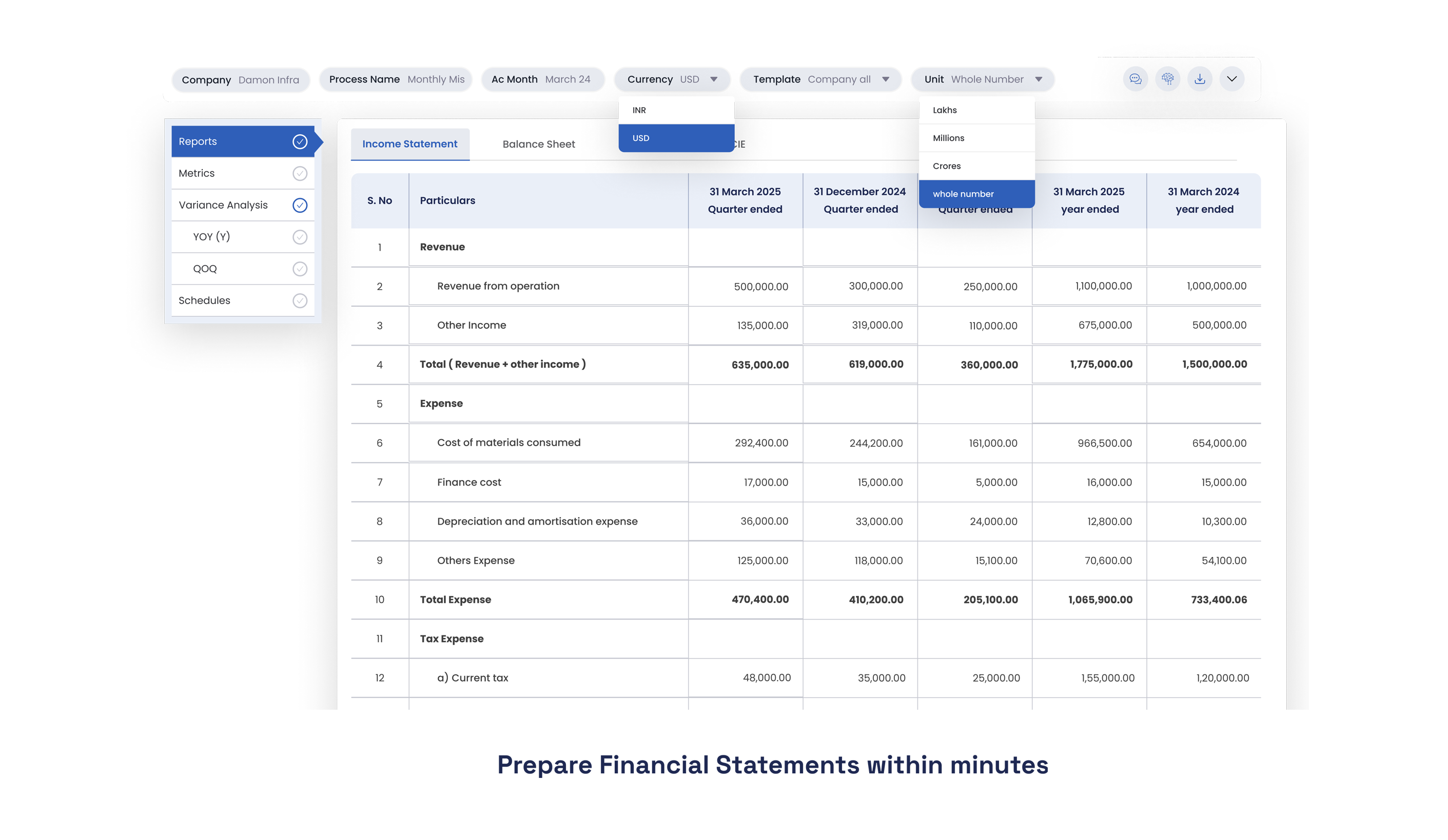
- Financial statement generation
These automated workflows significantly reduce the manual workload for finance teams.
Seamless Integration With Financial Systems
Organizations often use multiple financial systems across departments and subsidiaries.
Result Lane integrates with ERP systems, accounting platforms, and financial databases to automatically collect financial data.
This integration eliminates manual data transfers and ensures financial data remains consistent across systems.
Real-Time Financial Visibility
Result Lane provides interactive dashboards that deliver real-time insights into financial performance.
Finance leaders can monitor key metrics across the organization and identify potential issues before the close process begins.
Scalable Architecture for Growing Businesses
As organizations expand, financial operations become increasingly complex. Result Lane’s scalable architecture supports multi-entity organizations and global financial structures.
This ensures that the platform can continue supporting financial operations as the business grows.
Strategic Benefits Beyond Faster Close Cycles
Reducing month-end close time provides several strategic advantages beyond operational efficiency.
More Time for Financial Analysis
When finance teams spend less time on manual consolidation tasks, they can focus on financial analysis and strategic planning.
Improved Decision-Making
Real-time financial data enables executives to make faster and more informed business decisions.
Greater Financial Transparency
Automated reporting improves financial accuracy and provides stakeholders with clear, reliable financial insights.
The Future of the Financial Close Process
The future of financial operations is moving toward a continuous close model, where financial data is updated and validated in real time rather than only during periodic close cycles.
Emerging technologies such as artificial intelligence and machine learning are expected to further enhance financial consolidation by enabling predictive analytics, automated anomaly detection, and intelligent financial forecasting.
Organizations that adopt modern financial consolidation platforms will be better positioned to adapt to these changes.
Conclusion
The traditional month-end close process is often slow, manual, and prone to errors. However, modern finance teams are transforming their operations by adopting automated financial consolidation platforms.
By integrating financial data, automating reconciliation processes, and providing real-time financial insights, organizations can reduce their month-end close time by up to 50%.
Solutions like Result Lane enable finance teams to streamline reporting workflows, improve financial accuracy, and gain deeper visibility into financial performance. As financial operations continue to evolve, automation and advanced consolidation technology will play a critical role in helping organizations operate more efficiently and make smarter financial decisions.
Tags : .....