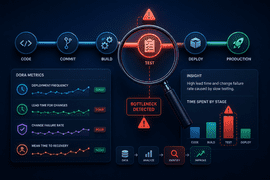
Most teams adopt DORA metrics to improve deployment speed and stability. The usual focus is on optimizing CI/CD pipelines, reducing lead time, and increasing deployment frequency. But in practice, many of the biggest bottlenecks are not in deployment at all—they are hidden inside testing.
If you look closely, DORA metrics don’t just reflect how fast you ship. They reveal how efficiently your testing strategy supports delivery.
The Common Misconception
When DORA metrics start to lag, the first instinct is often to blame the pipeline:
- “Our builds are too slow”
- “Deployments take too long”
- “We need better infrastructure”
But in many cases, the pipeline is only a symptom. The real issue lies in how testing is designed, executed, and maintained.
Where Testing Bottlenecks Hide
Testing bottlenecks are rarely obvious. Pipelines still run, tests still execute, and deployments still happen. But underneath, inefficiencies accumulate.
Common hidden bottlenecks include:
- Large test suites with slow execution times
- Flaky tests that require reruns
- Over-reliance on manual validation
- Poor test coverage in critical areas
- Tests that do not reflect real-world behavior
These issues gradually impact delivery performance.
How DORA Metrics Reveal Testing Bottlenecks
DORA metrics act as indirect signals. When testing becomes a bottleneck, it shows up across multiple metrics.
1. Lead Time for Changes Increases
Lead time is often the first indicator.
If testing is inefficient, you will see:
- Delays between code commit and deployment
- Long test execution cycles
- Waiting time for reruns due to failures
What appears as slow delivery is often slow validation.
2. Deployment Frequency Drops
Teams deploy less frequently when they do not trust their testing process.
This can happen when:
- Tests are unreliable or flaky
- Validation takes too long
- Failures require manual investigation
Reduced deployment frequency is often a confidence issue, not a tooling issue.
3. Change Failure Rate Remains High
A high failure rate in production usually points to gaps in testing.
This may include:
- Missing edge case coverage
- Incomplete integration testing
- Lack of validation for complex interactions
If tests are not catching issues early, failures will surface later.
4. Time to Restore Service Increases
When incidents occur, recovery time depends on how quickly teams can diagnose the problem.
Testing bottlenecks contribute to delays when:
- Failures are hard to reproduce
- Test coverage does not match real scenarios
- Debugging requires manual effort
Better testing leads to faster recovery.
5. Reliability Signals Inconsistent Testing
Reliability reflects how consistently the system performs in production.
If reliability fluctuates, it often indicates:
- Tests are not aligned with real usage
- Important scenarios are not validated
- System behavior is not fully understood
This is where testing quality directly impacts user experience.
Why Testing Becomes the Bottleneck
Testing becomes a bottleneck when it cannot keep up with the pace of development.
This typically happens when:
- Test suites grow without optimization
- Maintenance effort increases over time
- Tests rely on fragile or outdated assumptions
- Real-world complexity is not captured
Without continuous improvement, testing slows everything down.
Practical Ways to Fix Testing Bottlenecks
Once DORA metrics highlight the problem, the next step is to address it systematically.
1. Reduce Test Execution Time
Speed matters.
Teams can:
- Run tests in parallel
- Prioritize critical test cases
- Avoid running the entire suite for every change
This improves feedback cycles significantly.
2. Eliminate Flaky Tests
Flaky tests are one of the biggest hidden bottlenecks.
To fix them:
- Identify unstable tests through repeated failures
- Isolate dependency-related issues
- Remove or refactor unreliable tests
This restores trust in the pipeline.
3. Improve Test Coverage Where It Matters
Coverage should focus on impact, not volume.
Teams should:
- Prioritize critical workflows
- Test integration points thoroughly
- Include edge cases and failure scenarios
This reduces production failures.
4. Align Tests with Real-World Behavior
A major source of bottlenecks is the gap between test scenarios and actual system usage.
Some approaches address this by capturing real interactions. For example, tools like Keploy record API traffic and convert it into test cases. This helps teams validate realistic scenarios and reduces the need for constant test maintenance.
5. Continuously Optimize Test Suites
Test suites should evolve alongside the system.
This includes:
- Removing redundant tests
- Updating outdated scenarios
- Monitoring execution performance
This keeps testing efficient over time.
Real-World Perspective
In real-world systems, testing is often the slowest part of the pipeline. Not because of tooling limitations, but because of accumulated inefficiencies.
Teams that use DORA metrics effectively:
- Identify testing bottlenecks early
- Improve feedback loops
- Increase deployment confidence
- Deliver more consistently
This shifts the focus from optimizing pipelines to improving testing.
Practical Takeaways
To use DORA metrics to uncover testing bottlenecks:
- Treat metrics as signals, not just targets
- Investigate delays in lead time and deployment frequency
- Focus on test reliability and speed
- Align testing with real system behavior
- Continuously refine testing strategies
These steps help ensure that testing supports, rather than slows down, delivery.
Conclusion
DORA metrics are often seen as deployment-focused, but they provide much deeper insights. They reveal how effectively testing supports the entire delivery process.
By using these metrics to identify and fix testing bottlenecks, teams can improve both speed and reliability. In modern systems, optimizing testing is often the key to improving overall engineering performance.