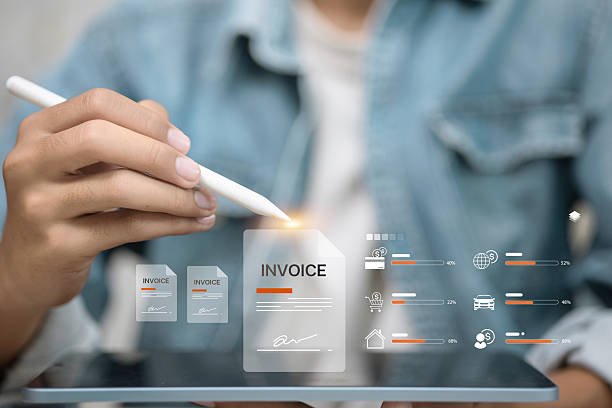
The shift towards electronic invoicing is the key element of business in Saudi Arabia due to the transition of the country towards digital financial processes. The companies are required to issue invoices which are precise, designed, secure and in tandem with the demands of Zakat, Tax and Customs Authority (ZATCA). This is where ZATCA-compliant e-invoicing software helps businesses simplify invoice creation and management. Businesses can also use automated systems to create invoices, compute VAT, validate information, and control electronic records instead of using manual systems and verifying the details of the tax separately on each invoice. Companies that are seeking e-invoicing software Saudi Arabia will be able to gain insights into the functioning of these systems and the capabilities that will aid them in compliant invoicing.
The current e-invoicing software does much more than a digital copy of a paper invoice. It links sales, accounting, customer and inventory data to generate electronic invoices in a structured manner. The system can also be used to validate invoices, clearance invoices, reporting, security features and storage of electronic records depending on the type of invoice and requirements. Automation saves time and effort spent on redundant administrative tasks, and assists businesses ensure the integrity of invoice data. In businesses that have a high volume of transactions per day, this may enable them to invoice more quickly, systematically and monitor the invoices easily.
What Is ZATCA E-Invoicing?
ZATCA e-invoicing is the electronic invoice generation, processing and storage of invoices in line with the e-invoicing requirements in Saudi Arabia. Companies that will be bound to these regulations will have to employ appropriate electronic tools to design and store invoices.
The typical types of invoices are:
Tax invoices of transactions like business-to-business sales.
Business to consumer transactions are usually simplified tax invoices.
The credit and debit notes to make allowable adjustments in past invoices.
The requirements and process may vary based on the type of invoice and transaction.
How Does E-Invoicing Software Generate Compliant Invoices?
1. Captures Transaction Details
When a sale is registered by a business, the process starts. The software gathers data about the details of the seller, buyer, invoice number, date of transaction, product or service, quantity, price, discount, VAT and total amount.
This information can be automatically transferred when linked to an ERP or accounting system, and helps to minimize repetitive data entry.
2. Adds Required Invoice Information
The software adheres to the predetermined invoice designs in order to incorporate pertinent compulsory details. Fields that require identification of the business, VAT, invoice reference, transaction values and others can be filled automatically.
This will eliminate mistakes due to information being missed or typed wrongly.
3. Calculates VAT Automatically
An electronic invoice generation entails the calculation of VAT. Depending on the rules and the specified rules, the system will compute the amount of the taxable amount, VAT due, discounts, subtotal and the final value of the invoice.
Manual arithmetic errors can be minimized by automated calculations and it will offer more consistency between invoices.
4. Creates Structured Electronic Data
An electronic invoice is not a mere PDF or scanned file. The data must be in a systematic format, which is electronic and can be handled by the systems.
ZATCA-compliant e-invoicing software organizes invoice information into the appropriate electronic structure , allowing the data to be processed and exchanged electronically .
5. Applies Required Security Features
E-invoicing solutions may supplement various features (e.g., cryptographic stamps, unique invoice identifiers, QR codes of relevant invoices, etc.) based on the requirements and is applicable.
These are mechanisms that assist in invoice authenticity, integrity and verification.
6. Validates the Invoice
The software is able to scan the information in an invoice before it goes through the relevant electronic process to identify possible mistakes. It can detect the absence of fields, inaccurate totals, invalid references or problems with calculation of VAT.
Validation assists companies to detect issues at an earlier stage rather than detecting them once an invoice has been issued or sent.
7. Supports ZATCA Clearance or Reporting
In the case of relevant transactions, the system will be capable of the necessary electronic communication with ZATCA. The tax invoices can be subject to clearance and the simplified tax invoices are typically subjected to the relevant reporting procedure.
A lot of this workflow can be automated by an integrated solution and information about the status of invoice processing can be provided.
8. Stores Electronic Records
Once invoices have been created, companies should keep relevant electronic records. E-invoicing software has centralized storage where invoices may be searched by customer and date, invoice number, amount and status.
This enables management of records to be more efficient and it may assist in accounting reviews and audits.
Benefits of Automated ZATCA E-Invoicing
Greater Accuracy
Standardized invoice templates and automated calculations minimize typical errors of manuals.
Faster Processing
Transactions are immediately recorded, enabling invoices to be generated swiftly, minimizing administrative delays.
Reduced Workload
Employees save on the time they take to fill customer information, compute VAT and write the individual invoices.
Better Financial Management
Sales, VAT, receivables, and transaction records visibility can be enhanced by integrating it with accounting and ERP systems.
Easier Record Keeping
Historical invoices are easier to search, access and manage using digital storage.
Business Scalability
Automation enables business to cope with the growing volumes of invoices without having to fully depend on further manual operations.
Features to Consider When Choosing E-Invoicing Software
Enterprises ought to consider the ability of the system they have adopted to accommodate their working and regulatory needs. Important features include:
ZATCA-related compliance capabilities
Automated VAT calculations
Formatted computer-generated invoices.
Invoice validation
QR code and security where necessary.
Credit and debit note management
Integration of ERP and accounting.
Electronic invoice storage
Invoices tracking and reporting.
Regular software updates
Proper setup is also essential since compliance can be determined by the system implementation and usage.
Conclusion
E-invoicing software that is compatible with ZATCA is used to create electronic invoices by following a sequence of automated processes such as transaction data capture, the addition of necessary information, calculation of VAT, the creation of structured invoice data, verification of the information and facilitating the process of clearance or reporting as per ZATCA. It can also assist companies to handle security facilities and store electronic invoice documents in a centralized location.
For Saudi businesses, adopting ZATCA-compliant e-invoicing software can make invoicing more accurate, efficient, and organized while reducing repetitive administrative tasks . A business is advised to choose a solution, which should suit transaction volume, accounting, and integration requirements, and the requirements of ZATCA. Automated e-invoicing can form a significant component of an effective and scalable financial management system with proper set up and frequent maintenance.
Tags : ZATCA E-Invoicing