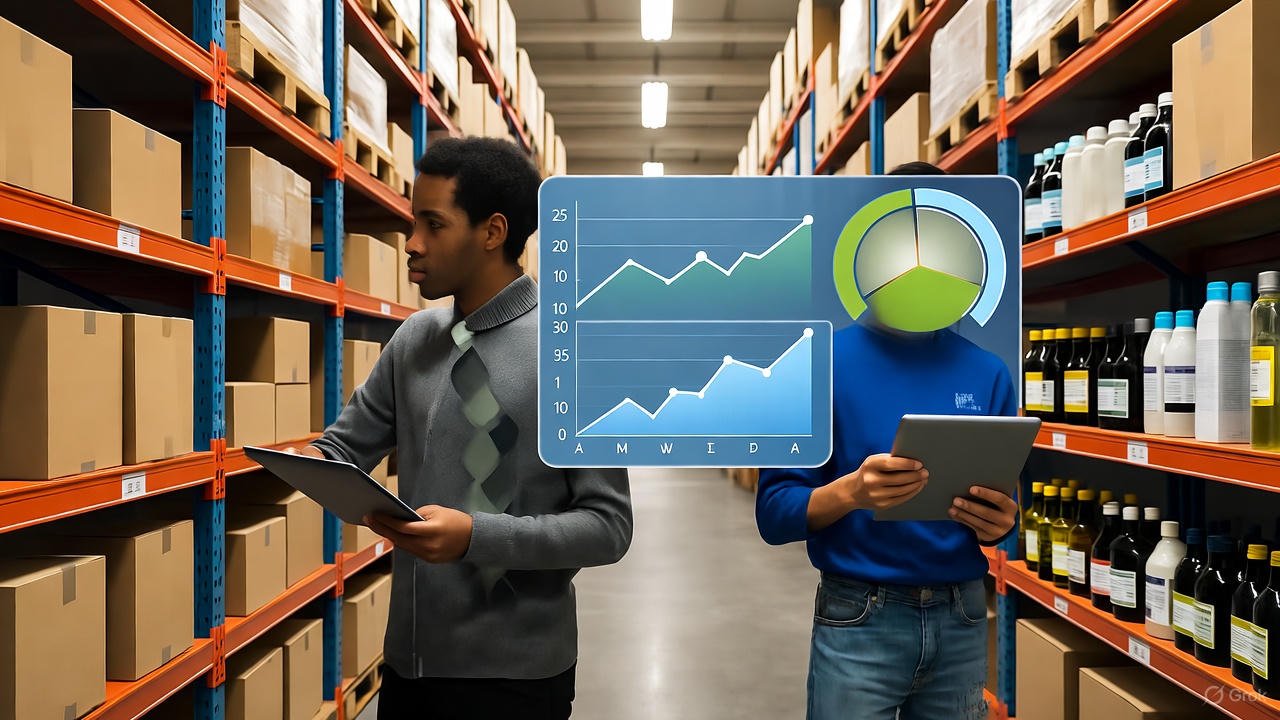
You know how it hurts when merchandise is short or oversupplied. Demand changes, the supplier procrastinates, and the forecast becomes inaccurate. That is expensive in terms of finances and reputation. This is corrected by data analytics, which transforms signals into trusted actions.
In this guide, I will explain how demand forecasting and inventory forecasting improve decision-making. After reading this guide, you will know which demand planning models to use, how to forecast inventory, and which supply chain forecasting methods truly move the needle.
Why accurate forecasting matters
All supply decisions are founded on forecasts. Unsuccessful forecasts generate stockouts and overstocks. Both lower margins. Demand forecasting provides you with anticipated sales. Inventory forecasting presents the amount of inventory to have. They jointly manage scheduled inventory and purchases. Use analytics to shift plans based on guesses to data-based plans. That reduces the carrying costs and enhances the fill rates.
Business case evidence demonstrates that analytics can minimize forecast error and inventory by percentages. With systems in place, you should get improved levels of service and predictable cash flow.
Types of demand forecasting
There are several types of demand forecasting. Each serves a different purpose.
- Qualitative forecasting uses expert opinion. It helps when you lack data.
- Time series forecasting involves the use of historical sales to forecast the demand in the future. Retail forecasting tends to do so.
- Causal models refer to demand being linked to such external drivers as price or weather. They suit seasonal SKUs.
- Complicated patterns in a large number of variables are detected by machine learning models. They enhance manufacturing predictions when you are operating with huge datasets.
Choose a type that fits your data and business cycle. For fast-moving retail, time series and ML hybrids often work best. For new product launches, blend qualitative input with scenario modeling.

Demand planning models that actually work
Good demand planning models are methods that are combined. Initiate with basic exponential smoothing baseline forecasting. Next, superimpose causal factors as appropriate. Also, train machine learning models of items with complicated patterns. Have a human-in-the-loop at all times to detect anomalies.
In building models, forecast accuracy should be measured with MAPE or RMSE. Look at track bias to determine whether you are systematically under- or over-forecasting. The forecast value added (FVA) should be used to make sure that every step enhances the outcome. When a model fails to add value, quit using it.
Supply chain forecasting methods for better stock
Aggregate planning, SKU-level forecasting, and distribution center demand forecasting are the methods of supply chain forecasting. All the methods deal with a varying scope. Use a combination approach to establish production goals. Operating planned inventory and reorder points SKU level. In the case of distribution networks, zonal forecasts allow for minimizing safety stock.
Also, use scenario planning. Simulate supplier delays and demand spikes. Then adjust safety stock rules. That prevents costly surprises.
How to forecast inventory step by step
- Clean your sales and returns data. Remove promotions and one-offs where appropriate.
- Segment SKUs by demand pattern. Separate fast movers, slow movers, and intermittent items.
- Choose a forecasting method per segment. Use time series for stable SKUs and intermittent models for sporadic demand.
- Convert demand forecasts into inventory targets. Factor lead time and service level to calculate safety stock.
- Automate replenishment triggers. Use periodic review or continuous review policies as suits your supply chain.
- Monitor and adjust. Reforecast weekly for volatile lines and monthly for stable lines.
This approach standardizes how to forecast inventory and removes guesswork.
Inventory forecasting software: what to look for
Modern inventory forecasting software should do these things.
- Handle multiple demand planning models.
- Integrate sales, returns, and supply data.
- Simulate stock levels and service outcomes.
- Offer visual dashboards and alerts.
- Provide version control for forecasts and assumptions.
When evaluating software, test on real SKUs. Measure the accuracy improvement against your current process. The right tool should reduce time spent on spreadsheets and increase forecast reliability.

Practical example: retail forecasting in action
A mid-size apparel retailer used demand forecasting and inventory forecasting methods to trim seasonal overstocks. They segmented SKUs by demand pattern and switched models per segment. They reduced planned inventory by 12% while improving on-shelf availability. The change freed cash for marketing and new product development.
This example shows how combining analytics with simple rules delivers measurable gains.
Data practices that increase forecast quality
Good forecasts depend on reliable data. Here are core practices:
- Keep master data clean. Accurate SKU, lead time, and supplier records matter.
- Capture point-of-sale and e-commerce data in real time.
- Record promotions and price changes. These are common forecast disruptors.
- Store historical lead-time variability. Use it to set realistic safety stocks.
Use these data habits to build trust in your models. Teams adopt analytics faster when they see consistent results.
Advanced approaches that drive improvement
Respond to short-term changes using demand sensing. Demand sensing uses a combination of base forecast and real-time signals. It minimizes error on short horizons. Add it to the planning jointly. Previews of shares with suppliers and retailers. Cooperation minimizes the bullwhip effect and decreases the safety stocks in the network.
The other developed strategy is dynamic safety stock. Set safety stock in accordance with the uncertainty of the forecast. Entering uncertainty, buffer up. Upon falling, issue inventory at a lower cost.
At this stage, think about packaging and fulfillment. When you are selling perishable or delicate goods, use packaging that keeps the goods safe and ensures fewer returns. As an example, some producers keep their products fresh and predictable when in storage and transit by using specialized products such as personalized mushroom mylar bags.
How often should I reforecast demand?
The volatility on which reforecast frequency relies. In stable items, monthly reforecasting usually does the trick. Volatile SKUs or promotions are reforecasted weekly or daily. Reduced cadence is required in short horizons.
What is the best inventory forecasting method?
There is no single best. Stable demand with Time series. Apply the intermittent or Creston technique to sporadic items. Integrate causal models where external drivers are important. Hybrid models are usually more effective than uni-method models.
Which KPIs prove forecasting success?
Track forecast accuracy (MAPE), forecast bias, inventory turnover, and service level. Also monitor stockouts and overstocks. Improvements across these KPIs show real value.
Can small businesses benefit from advanced models?
Yes. The first beneficiaries of segmentation and simple time series models are small businesses. With the increase in data, add ML and demand sensing. Begin with automation tools and increase in size.
Summarizing
Forecasting and inventory management are no longer processes of guesswork but rather the operations that can be predicted with the help of data analytics. The choice of demand planning models, the appropriate application of inventory forecasting techniques, and investment in quality data and software can reduce costs and enhance service. Begin with segmentation, select models that suit each of them, and automate replenishment. Measure, scale, and repeat. Do this, and you will find planned inventory work as it should.
A strong forecasting practice protects cash, supports growth, and gives your team confidence to act fast.
Tags : .....