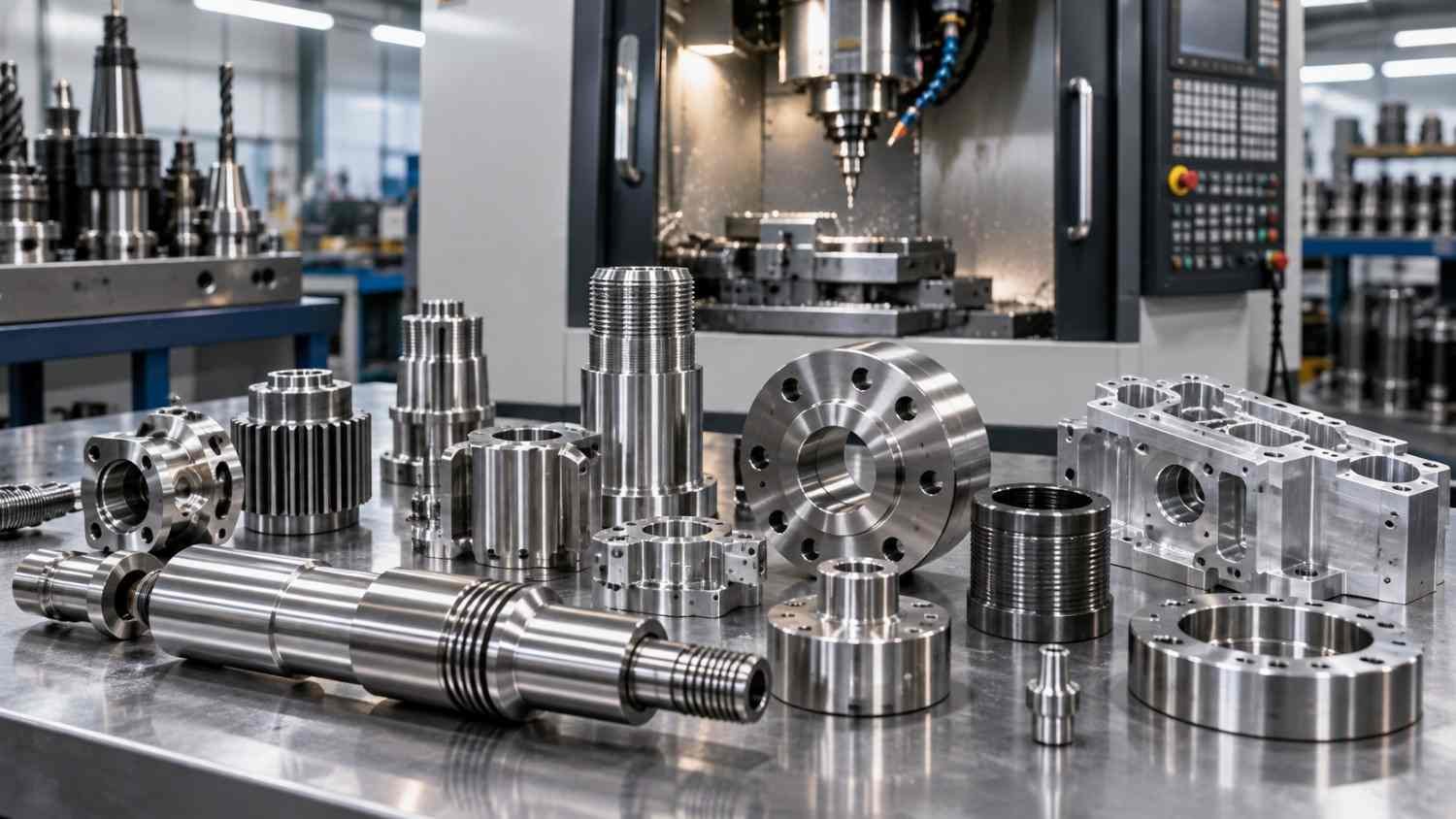
An equipment manufacturer was able to track a customer complaint about unbalanced wear on a rotating assembly to one root cause: in that assembly, the internal cylindrical component was machined 0.04mm out of centre, too fine to see with the eye but enough to create unbalanced forces over thousands of revolutions. The idea behind CNC machining is to eliminate precisely these sorts of engineering flaws that don‘t show up until the product has been cast, forged, melted or assembled. For automakers, machine tool builders and OEM part producers, quality is decided long before final assembly at the machining process.
Where CNC Precision Actually Shows Up in the Final Product
Although buyers look at finished parts for fit, function, and finish, they rarely investigate how the machining process affects those attributes in the individual components inside.
Concentricity and Balance
Cylindrical components used in rotating assemblies depend on concentricity — how precisely the part's axis aligns with its intended centreline — and even a small deviation compounds into vibration, noise, or premature bearing wear at operating speed. This is a detail most buyers never ask about on a drawing, focusing instead on outer diameter alone.
Repeatability Across Symmetrical Geometries
Symmetrical components used in multi-point assemblies need matching dimensional accuracy across every mating feature, not just the primary bore or shaft diameter. A part that's correct on the feature everyone checks can still be inconsistent on the ones nobody does.
How Better Machining Translates Into a Better Finished Product
Here's what actually improves downstream when CNC machined components are held to tighter, verified tolerance.
Reduced vibration and noise in rotating assemblies means fewer field complaints traced back to a component nobody thought to question. Consistent concentricity extends bearing and seal life, cutting warranty costs that would otherwise get blamed on the wrong part of the assembly. Repeatable tolerance across symmetrical features reduces assembly-stage rework, because parts fit correctly the first time instead of needing hand-fitting on the line. Custom manufacturing to your full drawing — including GD&T callouts most suppliers skim past — means your design intent survives production instead of getting quietly simplified. And in-house centerless grinding after turning delivers OD control that turning-only processes can't match, protecting fit tolerance at the customer's end, not just yours.
That's product quality traced to its actual source, not assumed at final inspection.
Sourcing Quality-Focused CNC Machining From India
Leading CNC machined components suppliers in India cluster around a handful of industrial regions, and that concentration affects more than shipping — it affects whether a supplier can sustain tight tolerance control under bulk order pressure. A manufacturer positioned near major freight corridors can scale production without the transit delays that smaller, scattered vendors face. For automotive and industrial machinery manufacturers under pressure to hold quality steady across reorders, working with CNC machined components manufacturers in India close to your facility reduces the risk that quality drifts the moment volume increases.
About Us
We're Easco Fasteners, and we've been manufacturing precision CNC machined and centerless-ground components since 2013. We check concentricity and roundness on every cylindrical component batch, not just outer diameter, because that's the measurement most competitors skip to save inspection time. In 2018, a machine builder flagged vibration in a rotating assembly built around our component — we pulled the batch, found a fixture wear issue nobody had caught internally, and replaced the fixture before shipping another unit. We told the client exactly what happened instead of quietly reworking the parts and staying silent.
Conclusion
Product quality in a finished assembly is only as good as the CNC machined components hidden inside it, and most of those components fail silently long before a customer notices. Buyers who ask about concentricity, repeatability, and geometric tolerance — not just outer diameter — catch problems that would otherwise surface as a warranty claim months later. That's the difference a machining partner who measures the whole drawing actually makes.
FAQs
How do CNC machined components affect the quality of a finished assembly?
Concentricity and dimensional repeatability directly affect vibration, wear, and fit at the assembly stage, often in ways that aren't visible until the product is in operation. We've traced more than one field complaint back to a machining tolerance nobody checked at incoming inspection.
What should I ask leading CNC machined components suppliers about quality control?
Ask whether they measure concentricity and roundness on every batch, not just outer diameter and length. Suppliers focused only on headline dimensions are missing the geometry that actually affects performance.
Can Easco manufacture cylindrical and symmetrical components to full GD&T specifications?
Yes, we quote against the complete drawing including geometric tolerance callouts, not just the primary dimensions. Complex GD&T requirements may add a few days to our quoting process while we confirm tooling feasibility.
How do I evaluate CNC machined components manufacturers in India for a long-term contract?
Exactly how does one request concentricity and repeatability data across symmetrical features, as opposed to just a single headline dimension? And it the same conversation, how do you even find dimensional drift during the run? A manufacturer that waits until the part is totally finished is too late.
Do CNC machined components manufacturers in India offer centerless grinding for tighter tolerance?
Quality manufacturers do, and it‘s measurable difference on OD control over just a turning process. Find out if grinding takes place in house or is farmed out to a specialist as that‘s where chances of tolerances moving become increased.