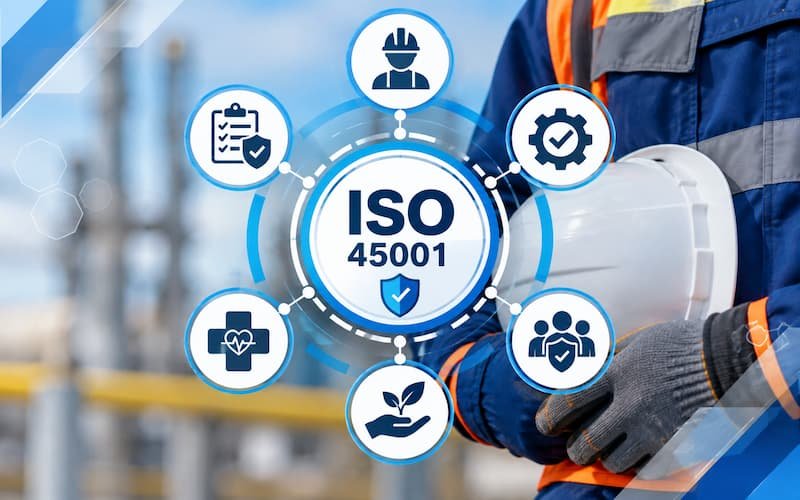
Getting employees ready for an ISO 45001 Audit doesn't just involve looking through the documents just before the audit. It is essential for organisations to make sure their employees are properly aware of the occupational health and safety requirements, follow procedures, keep records and actively participate in safety initiatives. Having a well-prepared staff can feel confident when interacting with auditors and be able to show that the safety management system is effective in everyday activities in the organization.
Effective preparation also helps organisations that are looking to achieve ISO 45001 certification by making them more aware of the hazards in the workplace, risk controls, emergency procedures and employee responsibilities. If safety practices are more than just an audit exercise, it will be easier for teams to show compliance and continuous improvement during the audit process, as the organization's culture is more likely to support the practices.
Create ISO 45001 Awareness of Requirements:
The first step is to make employees familiar with the purpose and key requirements of ISO 45001. Training should include the organization's occupational health and safety goals, policies, procedures for identifying hazards, conducting risk assessments, emergency plans, and reporting procedures. Employees need not be familiar with all the terms and conditions, but they should have an understanding of the relationship of the standard to their duties.
Provide Role-Specific Training
There are various roles and duties for different workers in an OHMS. Managers may need training in leadership, objectives, compliance responsibilities and performance monitoring, and operational personnel should be trained on workplace hazards, safe working procedures, PPE and incident reporting. Customised training will enable employees to give clear and relevant answers in an ISO 45001 Audit.
Review Workplace Procedures
Before the audit, organisations should check their safety procedures to make sure that the documented procedures are consistent with their workplace practices. Employees should know how to deal with risks and report unsafe conditions, how to act in an emergency, and how to implement the operational controls. If procedures have changed, there should be appropriate communication and training of teams so that there is no gap between the documentation and the implementation of the procedures.
Perform Internal Audits and Mock Interviews.
Internal audits can be used to highlight improvements that need to be made prior to the external assessment. Mock interviews with the auditor can also be carried out with realistic questions and answers with regard to the responsibility for safety, hazards in the workplace, emergency response and reporting incidents. This way, the employees can start to get used to answering questions correctly without having to memorize their answers.
Strengthen Employee Participation
ISO 45001 focuses on the involvement of workers and consultation into occupational health and safety management. Workers should be encouraged to identify hazards, make suggestions for safety, attend risk assessment if appropriate and discuss concerns without repercussions. Evidence of actual employee engagement can enhance the overall safety culture of the organisation.
View Records and Evidence
Teams need to be aware of the need to have continuity in safety evidence. Training attendance, risk assessments, incident reports, inspection results, emergency drills, corrective actions and safety meeting records are examples of relevant records. Those who keep such records should make sure that the records are accurate, up-to-date, readily available and reflect the actual practices.
Communicate Audit Expectations
The management should communicate with the employees about what to expect during the audit. Such employees have been informed that they can be contacted directly by the auditors, activities on the workplace can be observed, and evidence of the occupational health and safety processes can be viewed. Teams should answer in an honest and clear manner, rather than trying to come up with answers that they think the auditor will want.
Preemptive measures to address gaps before the audit.
Where possible, weaknesses observed from the internal audit, inspection, employee feedback, and/or management review should be rectified prior to the external assessment. The focus of corrective actions should be on the root cause, not just on the issue. Tracking actions to completion also provides useful evidence of the organization's commitment to continual improvement.
Conclusion
Preparing teams for an ISO 45001 Audit should not be a last minute job, it should be a continuous activity. Role-specific training, review, audit, employee involvement and safety record keeping are all tools that can help organizations be more prepared. If employees are aware of their duties and diligently apply appropriate controls, then the audit places them in a position to showcase good safety management practices.
A well-prepared staff also assists the organization to support good occupational health and safety standards beyond the assessment. There is a continuous cycle of identifying risks, closing gaps, engaging employees and enhancing workplace processes that will help to create a sustainable safety culture while supporting their long term ISO 45001 Audit readiness.