How Can Business Automation Improve Productivity Without Increasing Costs?
By TechForce Services 14-08-2026 83
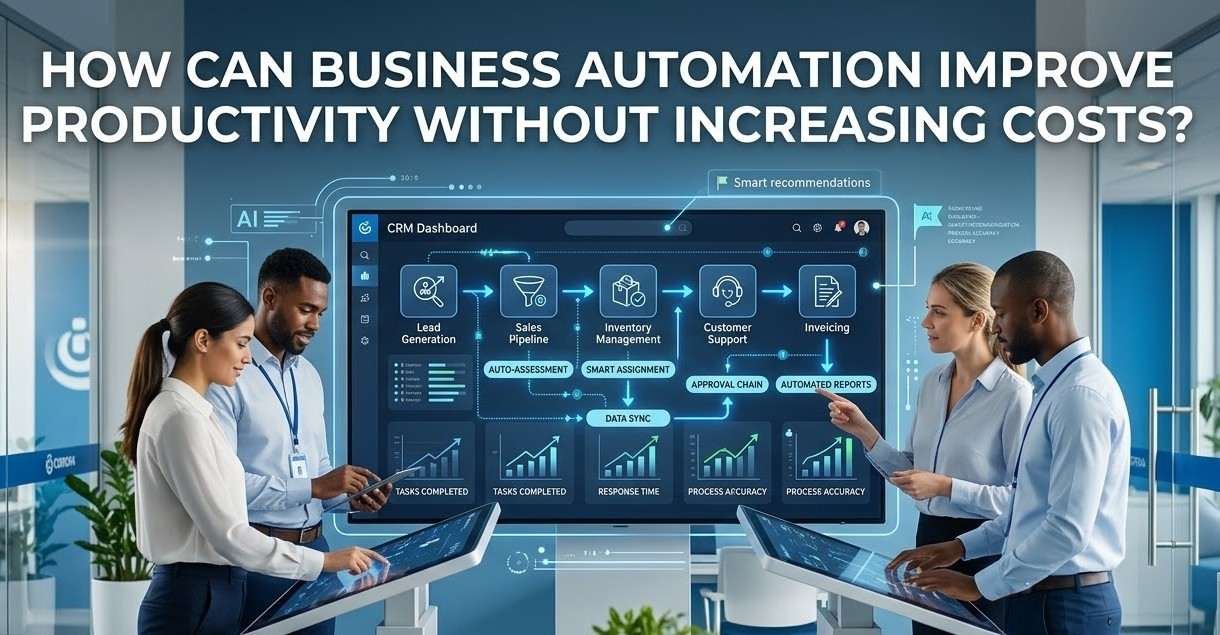
How Can Business Automation Improve Productivity Without Increasing Costs?
Businesses are under constant pressure to improve output while keeping operating costs under control. Hiring more people can solve capacity problems, but it also increases salaries, training expenses, management requirements, and other overheads.
Business automation offers another option, particularly for repetitive work that consumes employee time without requiring much human judgement.
The goal is not to automate everything. It is to identify the processes where technology can remove unnecessary manual effort while allowing employees to focus on work that requires experience, communication, and decision-making.
Where can automation create productivity gains first?
Repetitive administrative work is often a good starting point. Data entry, customer notifications, record updates, approvals, scheduling, reporting, and routine follow-ups can consume significant amounts of time when handled manually.
Automation allows these activities to happen according to predefined rules. Employees can then spend more time dealing with customers, solving unusual problems, or improving business processes.
Salesforce has increasingly connected automation with its wider CRM and AI capabilities. Its platform allows businesses to use flows and automated actions to update records and trigger processes, while CRM Analytics can also turn insights into actions within the Salesforce environment.
This matters because productivity is not simply about completing more tasks. It is about reducing the amount of employee time required to complete low-value work.
Can automation reduce costs without reducing the workforce?
It can, particularly when automation is used to increase the capacity of an existing team.
A customer service department, for example, may receive hundreds of routine requests each week. If employees manually categorise cases, update records, send standard messages, and route requests, much of their working day can disappear into administration.
Automated workflows can handle predictable steps while employees remain responsible for decisions that require judgement. This creates a more useful relationship between people and technology.
TechForce Services positions Salesforce automation alongside broader CRM capabilities, including integration and managed services. Businesses considering Salesforce migration and data transition support may also need to review how their existing data and workflows will support automation after moving to a new environment.
The financial benefit comes from increasing capacity without requiring the same increase in labour costs.
Why does clean data matter to automation?
Automation depends on reliable information. If records are incomplete, duplicated, or stored inconsistently, automated workflows can produce the wrong outcome at a much faster rate.
That makes data quality an important part of any automation strategy. Salesforce's CRM Analytics platform is designed to connect data from multiple sources and provide actionable insights, predictions, and recommendations within the flow of work.
Businesses can therefore benefit from considering analytics alongside automation. TechForce Services' Salesforce analytics capabilities are relevant to organisations looking to connect data, reporting, and decision-making with their wider CRM strategy.
Conclusion: What should businesses remember about automation?
Automation works best when it solves a clear operational problem. Businesses do not need to automate every process to improve productivity. A few well-designed workflows can remove hours of repetitive work, reduce errors, and give employees more time for activities that directly contribute to growth.
The strongest approach is to measure the time and cost involved before automation, then track what changes afterwards.
When technology increases the capacity of an existing workforce without creating unnecessary complexity, productivity gains can become a practical way to control costs while continuing to grow.