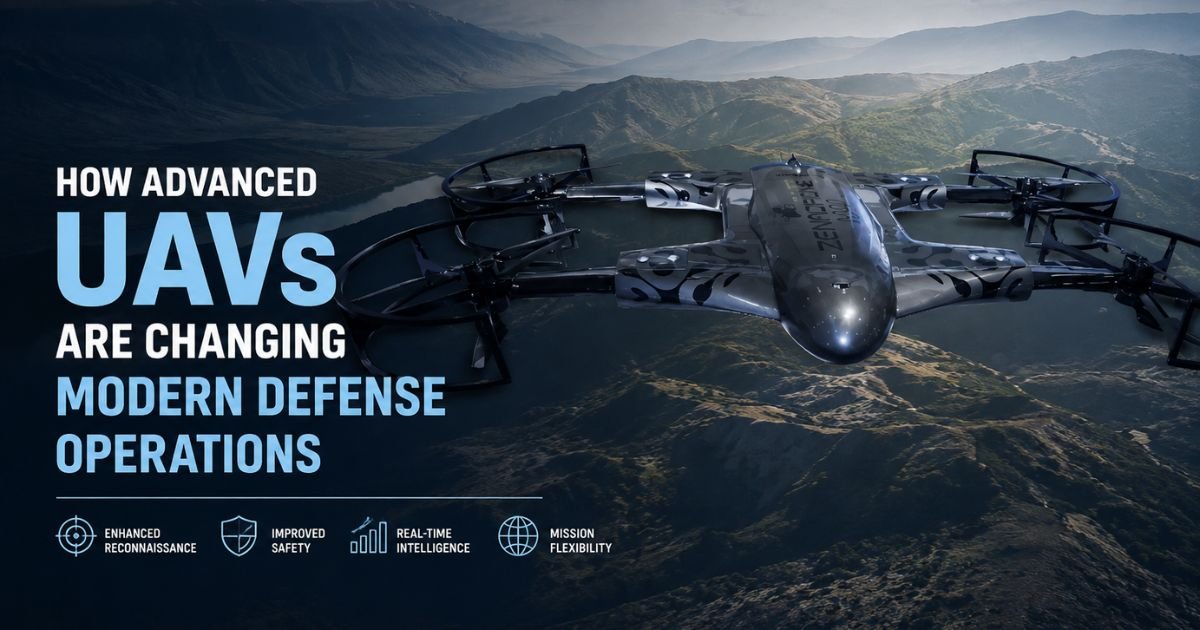
Modern defense operations increasingly depend on speed, accurate information, and the ability to make decisions without unnecessarily putting personnel in dangerous environments. Military Drones have become an important part of this shift, providing defense teams with aerial visibility, reconnaissance capabilities, and real-time data across challenging environments.
Unlike early unmanned aircraft that were primarily designed for basic observation, today's UAV systems can combine advanced sensors, automated flight capabilities, high-resolution imaging, and data-processing technologies. This article explores how these systems are changing defense operations, where they provide the most value, and what their growing role means for the future of military aviation.
How Military Drones Support Modern Defense Operations
The value of Military Drones extends beyond simply putting a camera in the sky. Modern UAV platforms can support several operational tasks while reducing the need to expose personnel to certain hazardous environments.
Improved Aerial Reconnaissance
One of the most important applications of UAV technology is reconnaissance. An aircraft equipped with high-resolution optical, thermal, or other specialized sensors can provide teams with aerial information from areas that may be difficult or dangerous to access directly.
This capability can help personnel understand terrain, monitor activity, and identify changes over time. Instead of relying solely on ground-based observations, commanders can receive information from an elevated perspective and use it alongside other intelligence sources.
Persistent Surveillance
Traditional aircraft may require significant resources to operate continuously. UAV systems can offer a more flexible approach to monitoring specific areas, depending on the platform's endurance and mission requirements.
For example, an unmanned aircraft can be used to observe infrastructure, border regions, or other designated areas for extended periods. Continuous aerial observation can help teams recognize developing situations rather than relying only on occasional inspections.
How Advanced UAVs Improve Situational Awareness
Effective defense operations depend heavily on having reliable information at the right time. Advanced UAVs can contribute to situational awareness by collecting aerial data and transmitting relevant information to operators.
High-Resolution Sensors
Modern platforms can carry different types of sensors depending on their intended mission. High-resolution cameras can capture detailed visual information, while thermal sensors can help identify heat signatures in low-light conditions.
Multisensor capabilities are particularly useful because different technologies can reveal different aspects of an environment. Combining these sources can give operators a more comprehensive understanding of an area.
Real-Time Data Collection
Aerial information becomes more valuable when it can reach decision-makers quickly. Depending on the system and communications infrastructure, UAVs can collect and transmit data to personnel who need it.
This reduces dependence on delayed reports and can support faster assessment of changing conditions. In complex environments, timely information can be just as important as the quality of the imagery itself.
The Role of Military Drones in Safer Operations
Reducing unnecessary exposure to hazardous environments is another significant advantage of unmanned aircraft. When an aerial observation task can be performed remotely, personnel may not need to enter certain locations simply to gather information.
This does not eliminate operational risks, but it can change how those risks are managed. UAVs can be deployed for preliminary observation, terrain assessment, infrastructure monitoring, and other tasks before personnel are sent into an area.
The result is a more flexible approach in which unmanned systems can complement rather than completely replace traditional aircraft and human teams.
How Automation Is Changing UAV Capabilities
Automation is becoming an increasingly important component of advanced UAV systems. Automated navigation, flight planning, obstacle-awareness technologies, and intelligent data processing can reduce the amount of manual work required for certain operations.
More Efficient Mission Planning
Advanced flight-control systems can help operators plan routes according to mission objectives, geographic conditions, and operational limitations. Automated functions can also support repeatable missions where consistent coverage is required.
This can improve efficiency while allowing trained personnel to focus more heavily on interpreting information and making operational decisions.
Smarter Data Analysis
Collecting large amounts of aerial imagery is only useful when teams can efficiently identify important information within it. Artificial intelligence and machine-learning technologies are increasingly being explored for tasks such as object detection, image classification, and change detection.
These capabilities can help filter large datasets and bring potentially relevant findings to an operator's attention. Human oversight remains essential, particularly when information may influence significant operational decisions.
Military Drones and the Future of Defense Technology
The development of Military Drones is closely connected to broader advances in artificial intelligence, communications, sensors, batteries, and autonomous systems. As these technologies mature, UAV platforms are likely to become more capable and adaptable.
Future systems may place greater emphasis on interoperability, allowing unmanned aircraft to exchange information with other platforms and command systems. Smaller and more efficient UAVs may also expand the range of missions that can be supported from the air.
However, technological capability alone does not determine operational effectiveness. Training, cybersecurity, communications reliability, regulatory requirements, maintenance, and responsible human oversight all remain critical components of successful UAV deployment.
Conclusion
Advanced UAV technology is changing modern defense operations by improving aerial reconnaissance, surveillance, data collection, and situational awareness. Military Drones can provide valuable information while helping organizations manage personnel exposure and respond more efficiently to changing environments.
As sensors, automation, and data-processing technologies continue to develop, unmanned aircraft will likely play an increasingly important supporting role across defense operations.
Organizations exploring next-generation UAV capabilities should evaluate platforms based on mission requirements, sensor capabilities, reliability, autonomy, and operational integration. Explore advanced UAV solutions and discover how modern aerial technology can support safer, smarter, and more efficient operations.