Online shopping has transformed the retail landscape but it hasn't solved one persistent, costly problem: product returns. Return rates for e-commerce hover between 20–30%, compared to just 8–10% for brick-and-mortar stores. The gap exists for one fundamental reason: customers can't touch, try, or truly see what they're buying.
3D product visualization is changing that. By giving shoppers an immersive, accurate view of products before purchase, it directly attacks the root causes of returns and the data backs it up.
Understanding of 3D Product Visualization?
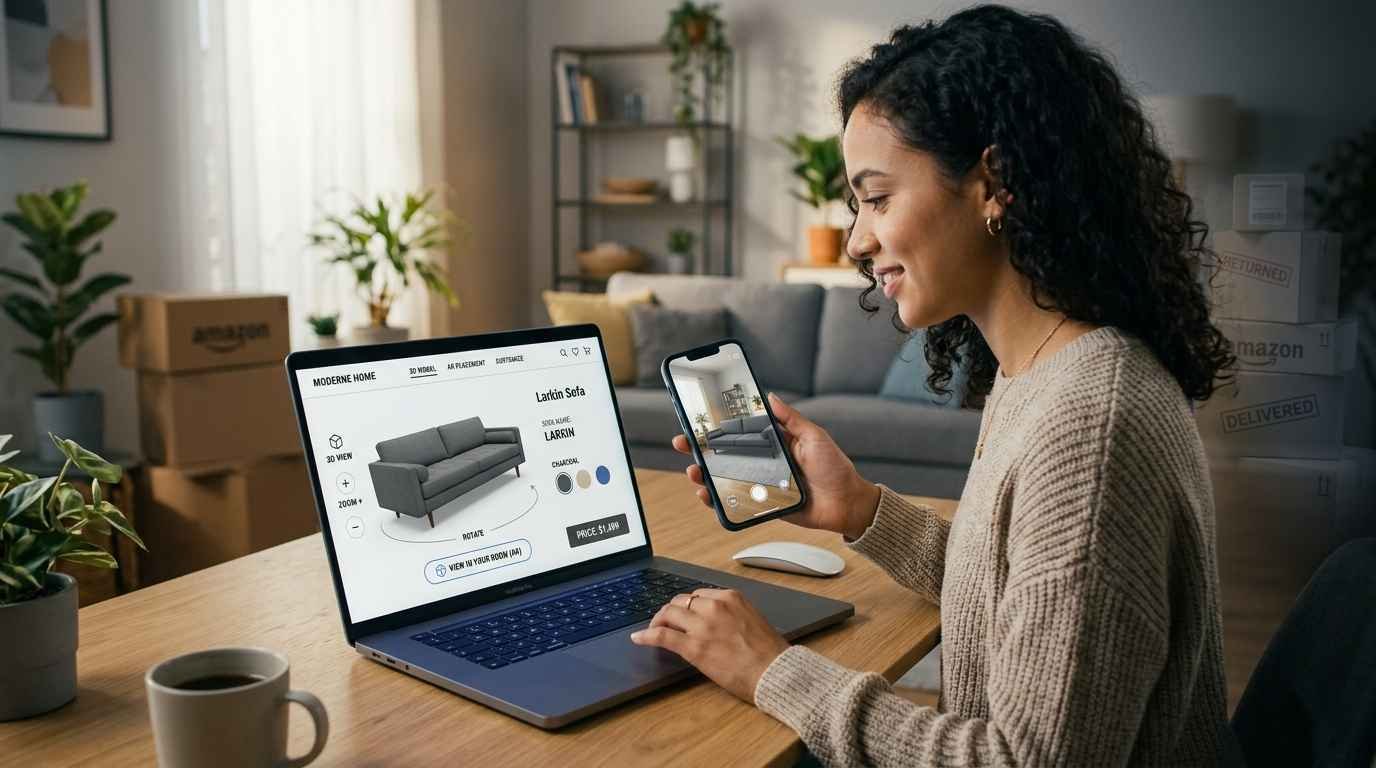
3D product visualization is the process of creating interactive, three-dimensional digital models of physical products that customers can rotate, zoom, examine from all angles, and sometimes place in their own environment using augmented reality (AR).
Unlike flat product photography which captures a product from two or three fixed angles under controlled lighting 3D product visualization delivers:
360° rotation: view every surface, edge, and detail
Zoom and pan controls inspect: texture, stitching, hardware, or finish up close
Color and variant switching: see exactly how the product looks in the chosen option
AR placement: view the item in the customer's actual room or on their body
Exploded views and animations help understand how parts fit together or how a product functions
The result is a shopping experience far closer to handling the product in person.
How 3D Visualization Fixes Each Reason
To understand why 3D product visualization reduces returns, we first need to look at why returns happen.
1. "It Looked Different Online" The Expectation Gap
This is the #1 driver of returns. A product arrives, and it looks nothing like it did in the listing photo. The color is slightly off. The size feels wrong. The texture isn't what the customer imagined.
Flat photography is inherently deceptive, not intentionally, but structurally. Lighting, angle, and camera lenses distort reality. A sofa photographed in a bright studio looks different from the same sofa in a customer's living room.
How 3D visualization solves it:
Physically-based rendering (PBR) replicates real-world material properties how fabric absorbs light, how metal reflects and how leather creases
AR features let customers project the product into their actual space, under their actual lighting
Multiple dynamic angles eliminate the "bad angle" problem entirely
Shoppers who can rotate, zoom, and see a product from every perspective develop accurate mental models of what they're buying and are far less surprised when it arrives.
2. Wrong Size or Fit
Sizing is the dominant return driver in fashion and furniture. A customer orders a dining table, and it overwhelms the room. A jacket looks oversized on the model but the customer assumes it will fit differently. It doesn't.
How 3D visualization solves it:
AR room placement lets shoppers virtually place furniture in their home with accurate dimensions before buying
Virtual try-on tools in fashion allow customers to see garments on avatars that match their own measurements
Interactive scale references (showing products next to everyday objects) set realistic size expectations
IKEA's AR app, for example, has been cited repeatedly as reducing returns by letting customers verify that furniture actually fits their space before purchasing, a direct application of 3D product visualization.
3. Color and Finish Confusion
Online color rendering is notoriously inconsistent. Screen calibration, ambient light, and compression artifacts mean a "forest green" can look teal on one screen and olive on another. Customers order based on what they see and are disappointed by what arrives.
How 3D visualization solves it:
High-fidelity 3D models rendered with accurate color profiles reduce the gap between screen and reality
Real-time material and color switchers let customers see variants rendered consistently, not across different photoshoots with different lighting conditions.
Some platforms now include environment lighting controls so customers can preview the product in warm, neutral, or cool light.
4. Functional Misunderstanding
For complex products furniture, electronics, luggage, tools customers often don't fully understand how something works, opens, folds, or assembles until it's in their hands. This leads to returns driven purely by confusion.
How 3D visualization solves it:
Animated 3D models can demonstrate mechanisms a bag's zipper system, a chair's reclining function, a lamp's adjustable arm
Exploded views show how components connect
Hotspot annotations highlight features customers would otherwise miss
A shopper who has watched a suitcase open and understands its compartment layout is far less likely to return it out of disappointment.
The Numbers: What the Research Shows
The business case for 3D product visualization is well-supported by industry data:
Shopify has reported that products with 3D/AR experiences see up to a 40% reduction in return rates compared to products with standard photography alone
Vertebrae (now part of Snap) found that 3D and AR shopping experiences led to a 25% decrease in returns across retail categories
Google research shows that AR-enabled product views drive 90% higher conversion rates and higher-confidence purchases predictably lead to fewer returns.
In furniture and home décor, IKEA Place users reported significantly fewer sizing surprises upon delivery.
Fashion brands using virtual try-on technology have reported return rate reductions of 20–40% depending on category
The mechanism is straightforward: informed purchase decisions produce fewer regrets.
Industry Applications: Where 3D Visualization Is Working Right Now
Fashion & Apparel
Virtual try-on powered by 3D avatars and body-scanning technology helps customers visualize fit, drape, and proportion. Brands like Zara, ASOS, and Ralph Lauren have invested heavily here. Return rates in fashion are among the highest of any category (often 30–40%), making this one of the highest-ROI applications of 3D product visualization.
Furniture & Home Decor
This is arguably the most mature vertical. AR room-placement tools are now standard for Wayfair, IKEA, and many DTC furniture brands. The ability to verify that a sofa fits a specific wall in your actual apartment eliminates the most common return reason in this category.
Footwear
Shoe brands are deploying AR try-on that overlays shoes onto a live camera feed of the customer's feet. Nike, Gucci, and Warby Parker (eyewear) have all deployed similar experiences with measurable return rate impacts.
Consumer Electronics
For gadgets, cameras, and audio equipment, interactive 3D models allow customers to examine ports, buttons, dimensions, and design details that product images rarely capture well.
Automotive Accessories & Parts
3D visualization lets customers confirm fit compatibility before purchasing a particularly high-stakes category, where a wrong fitment means a guaranteed return.
The Hidden Cost of Returns (Why This Matters More Than You Think)
Before dismissing 3D product visualization as a nice-to-have, consider the full cost of a return:
Direct costs: Return shipping, restocking, inspection, repackaging
Indirect costs: Customer service labor, refund processing, lost potential revenue from damaged or unsellable returned goods
Environmental costs: Returns contribute significantly to carbon emissions and landfill waste a growing concern for both consumers and brands under regulatory scrutiny
Industry estimates suggest the average return costs a retailer $25–$50 per item when all costs are factored in. For a brand processing thousands of returns monthly, reducing the return rate by even 10–15% through 3D product visualization translates into millions of dollars in recovered margin.
Objections: Is 3D Visualization Worth the Investment?
"It's expensive to produce."
This was truer five years ago. The cost of creating 3D product models has dropped significantly. Photogrammetry (3D scanning from photographs) and AI-assisted modeling pipelines mean brands can now digitize large catalogs at a fraction of earlier costs. For high-SKU categories, the cost-per-model has become commercially viable.
"Our customers won't use it."
Consumer AR adoption has accelerated dramatically. Snap, Instagram, and TikTok have normalized AR filters. The Shopify data showing 40% return reductions didn't come from a narrow demographic. It came from mainstream online shoppers.
"We already have good photography."
Good photography reduces returns compared to bad photography but it doesn't eliminate the expectation gap. 3D product visualization addresses problems that even exceptional photography cannot: scale verification, color accuracy across varied lighting conditions, and functional understanding of complex products.
Implementing 3D Product Visualization: A Practical Framework
For retailers considering the shift, here's a phased approach:
Phase 1: High-Impact SKUs First
Start with your highest return-rate products. Run a controlled test: add 3D visualization to those SKUs and compare return rates against the control group over 60–90 days. Let the ROI data make the case for broader rollout.
Phase 2: Select the Right Technology Partner
Key vendors in the space include:
Threekit: enterprise 3D/AR platform for complex product configuration
Sketchfab: 3D model hosting and embedding
HexaCoder: Custom 3D Software
Zakeke: 3D product customization for e-commerce
Adobe Substance 3D: material and rendering pipeline
Phase 3: Integrate With Your E-Commerce Stack
Most platforms (Shopify, Magento, WooCommerce, BigCommerce) have native 3D/AR support or third-party integrations. Ensure the viewer is mobile-optimized the majority of online shopping now happens on phones.
Phase 4: Measure and Iterate
Track return rates, return reasons, conversion rates, and time-on-page by SKU. Use this data to prioritize future 3D model investments and refine the experience.
The Future: AI + 3D Visualization
The next evolution of 3D product visualization is AI-powered personalization:
Generative AI will allow customers to see products in custom colors, patterns, or configurations that don't physically exist yet, enabling made-to-order commerce that eliminates returns structurally
Body-scanning via smartphone will make virtual try-on accurate enough for size-sensitive categories
Real-time material synthesis will let shoppers see how a product looks with their specific skin tone, in their specific room, under their specific lighting narrowing the expectation gap to near zero.
Brands that invest in 3D product visualization infrastructure today are building the foundation for this future and gaining a competitive advantage in an era where return rates are increasingly treated as a brand trust and sustainability metric, not just a logistics cost.
Conclusion
3D product visualization doesn't just make product pages look more impressive. It solves a fundamental information problem in online shopping. When customers can truly see a product from all angles, verify its size in their space, understand how it works, and trust that the color on screen matches reality, they make better decisions. Better decisions mean fewer regrets. Fewer regrets mean fewer returns.
For retailers, the math is compelling: lower return rates, higher customer satisfaction, reduced logistics costs, and a smaller environmental footprint all from investing in a richer product experience. In a competitive e-commerce landscape where differentiation is hard and margins are thin, 3D product visualization has moved from innovation to essential infrastructure.
The question is no longer whether it works. The question is how quickly you implement it.