How 3D Architectural Visualization Is Transforming the Way Properties Are Designed, Presented, and Sold
By 3D Visions Build 18-09-2026 13
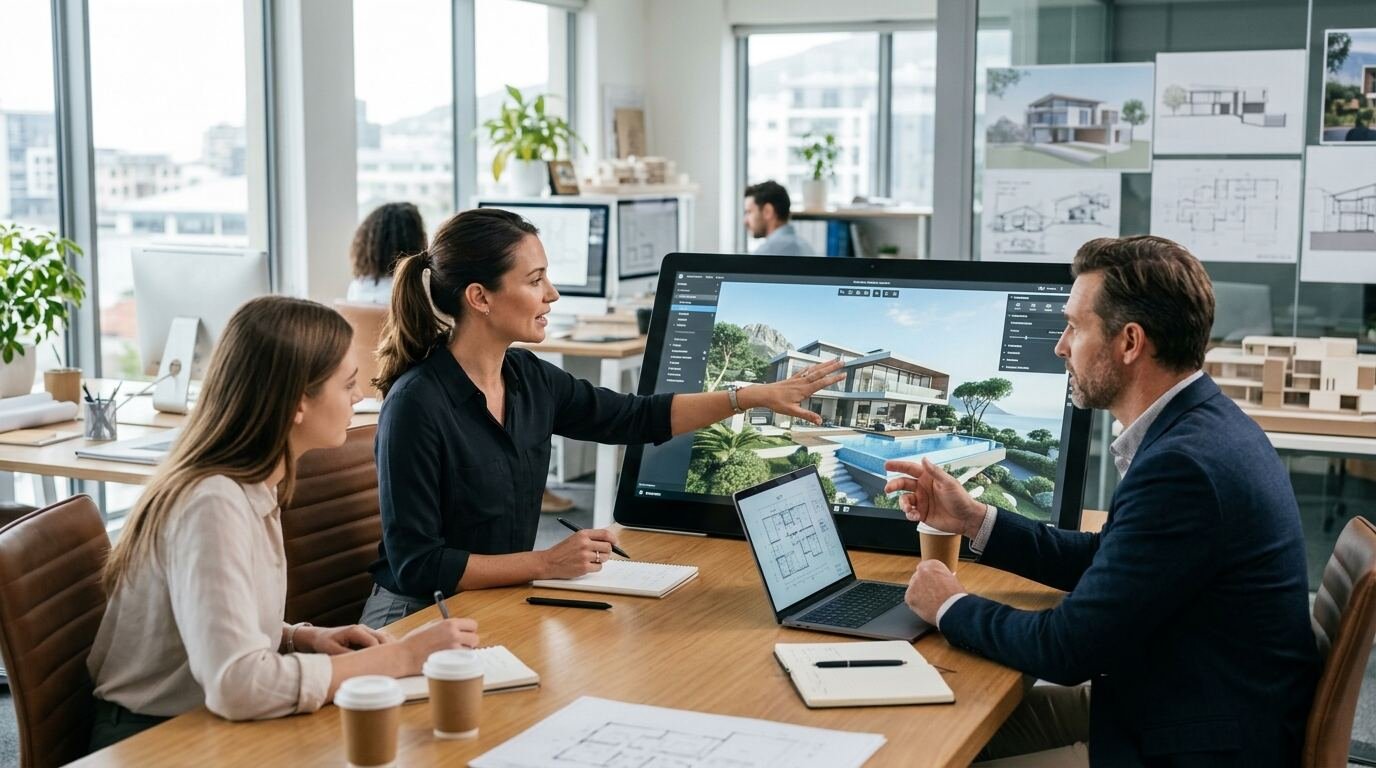
A buyer stands in a sales office looking at a screen. The tower behind them doesn't exist yet. No foundation, no steel, nothing but a fenced lot two blocks away. But they can see their unit. The light coming through the west windows at 5pm, the finish on the kitchen counters, the view from the 14th floor. That's 3D architectural visualization rendering doing its job, and it's now a standard part of how buildings get designed, approved, and sold before a single brick goes down.
What 3D Architectural Visualization Actually Is
People confuse this with a basic CAD render, and the two aren't close.
A CAD drawing shows geometry. Walls, dimensions, structural elements. It's a technical document. Useful for engineers and contractors, meaningless to a buyer standing in a sales office.
3D architectural visualization takes that geometry and builds a photorealistic scene around it. Lighting, materials, landscaping, furniture, sky, atmosphere. The goal isn't accuracy of measurement. It's accuracy of feeling. Does the space read as warm or cold? Does the ceiling height feel generous or cramped? Does the facade look premium or does it look like every other mid-rise built in the last five years?
Modern architectural visualization work typically runs through tools like 3ds Max, V-Ray, Lumion, or Twinmotion, depending on the studio and the project's needs. Real-time engines like Unreal have also moved into this space, which is part of why walkthroughs and VR tours became affordable for mid-size projects instead of just flagship developments.
How It's Changing the Design Phase
This is the part most people outside the industry don't see.
Before visualization became standard, a lot of design flaws didn't surface until construction was underway, or worse, until the building was occupied. A hallway that felt fine on paper but claustrophobic in person. A window placement that flooded a room with glare every afternoon. Once you're pouring foundation, fixing that costs real money.
3D rendering catches a lot of this earlier.
- Spatial problems become visible before anyone breaks ground, because a client can actually walk through a rendered space instead of interpreting a floor plan
- Facade revisions happen in a design review, not after the cladding is ordered
- Client sign-off gets faster, because approving a photorealistic render is a different decision than approving a technical drawing nobody outside the firm can fully read
- Iteration is cheap. Changing a render take days. Changing a built structure takes months and a change order
I've seen an architect revise a facade three times after a client saw the render and said the massing felt heavy. That's a conversation you want to have on a screen, not on a job site.
How It's Changing Presentation
Static renders were the entry point. The category has expanded a lot past that.
Walkthrough animations let a buyer move through a space the way they'd actually experience it, room to room, rather than looking at a single frozen angle.
Virtual staging furnishes an empty unit digitally. Cheaper than physical staging, and infinitely more flexible, since you can restage the same unit for a different buyer profile without moving a single couch.
Day and night, seasonal renders show the same property under different light conditions. This matters more than people think. A unit that looks flat at noon can look completely different at golden hour, and buyers respond to that.
VR and AR are the newest layer, and they're genuinely useful for larger developments, less so for a single listing. Strapping a buyer into a headset for a $400,000 condo purchase is overkill. For a 200-unit pre-construction tower, it can justify the cost.
How It's Changing Sales
This is where the money argument gets made, and it's a fair one.
Pre-construction and off-plan sales depend entirely on the buyer's ability to picture something that doesn't exist. Before quality architectural visualization became affordable and common, developers sold off-plan using floor plans, artist sketches, and a lot of verbal persuasion. That's a much harder sell.
A developer I worked with was selling units in a mid-rise building before groundbreaking. The sales center had exactly one physical model and a stack of floor plans. Once they added a full walkthrough animation and unit-specific interior renders, buyer questions shifted from "what does this actually look like" to specific finish and layout preferences. That's a meaningfully different conversation, and it moves faster toward a signed contract.
Listing performance on completed or near-completed units tends to benefit too. Photorealistic renders next to real photography give a listing more visual weight, especially for units still under construction with nothing to photograph yet.
Static Render vs. Walkthrough vs. VR Tour
Format | Typical cost | Best for |
|---|---|---|
Single exterior/interior render | $150 to $800 per image | Marketing materials, listing photos, single-unit sales pages |
Full walkthrough animation | $3,000 to $15,000+ depending on length and complexity | Sales centers, pre-construction video marketing, investor presentations |
VR/interactive tour | $5,000 to $20,000+ | Large developments, flagship units, international buyers who can't visit in person |
Prices swing hard based on scene complexity, revision rounds, and whether furniture and landscaping are custom-modeled or pulled from asset libraries.
Real Costs and Turnaround
A single high-quality exterior render usually runs somewhere between $150 and $800, depending on the studio, the market, and how much revision is included in the price. Turnaround for a single still is typically one to two weeks once the 3D model itself is built, which is often the longer part of the process.
A full walkthrough animation is a bigger undertaking. Budget anywhere from $3,000 to $15,000 or more, with turnaround running four to eight weeks depending on length and how many spaces are involved.
These numbers move a lot based on region and studio reputation. A well-known visualization studio working on a flagship tower charges differently than a freelancer doing renders for a single-family home listing. Both can produce good work. Price alone isn't the signal to watch.
What to Look for When Hiring
Look at lighting first. Bad lighting is the single biggest tell of amateur work. If everything in a portfolio looks slightly flat or slightly too bright, that's a studio that hasn't mastered the software's lighting engine.
Check for repeated furniture and landscaping assets across a portfolio. Every studio reuses some assets, that's normal. But if you see the exact same tree, the exact same sofa, in six unrelated projects, ask how much customization you're actually getting.
Ask about revision rounds up front. Two to three rounds is standard. Unlimited revisions in the base price is usually a sign the price was padded to cover open-ended time.
Red flags:
- No before/after or model-to-render comparison in the portfolio
- Renders that look suspiciously perfect with no material imperfection or texture variation
- No clear file deliverable list, meaning you don't know if you're getting source files or just flattened images
- Turnaround promises that seem too fast for the complexity of the scene
Where the Limits Are
Visualization can't fix a bad floor plan. It can make a bad floor plan look better on a screen for about as long as it takes a buyer to walk the actual unit, and then the trust damage is worse than if you'd never shown a render at all.
I've also seen developers use visualization to paper over real problems. An awkward site line hidden by a camera angle that would never occur in real life. Landscaping shown mature and full when the actual planting will take five years to look like that. That's not marketing, that's misleading a buyer, and it tends to come back on the developer in reviews and complaints once units close.
A render should represent what will realistically exist. Not what might exist under ideal, cherry-picked conditions.
Your Next Step
If you're considering 3D architectural visualization for a project, start with one thing: ask a potential studio for a portfolio piece that shows the raw 3D model next to the finished render. That single comparison tells you more about their actual skill than any polished showcase reel. If they can't or won't show you that, keep looking.