GCC Professional & Managed Security Services Market Outlook and Digital Security Trends
By johnryan 26-02-2026 221
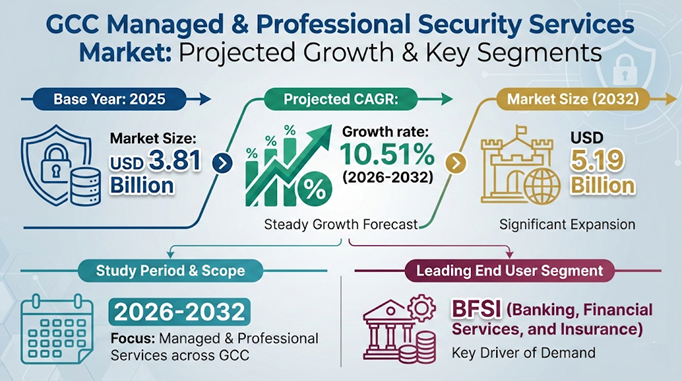
There is a swift and unprecedented digital transformation initiative that is picking up pace in the Gulf Cooperation Council (GCC). With the introduction of cloud computing, IoT ecosystems, fintech systems, and smart city technologies by governments and businesses, cybersecurity is now more of a strategic consideration, rather than a technical one. It is in this regional setting that the GCC Managed and Professional Security Services Market is experiencing a consistent growth witnessed by the increase in the complexity of threats and regulation requirements.
Increasing Cyber Threat Environment creating Demand
Ransomware attacks, phishing cases, and sophisticated persistent threats directed to the banking, oil and gas, healthcare and government sectors have increased remarkably in the GCC region. The threat surfaces are growing as the digital infrastructure is growing. Companies are increasingly outsourcing the services of managed security service providers (MSSPs) and professional consulting firms in efforts to reduce risks, have real-time network monitoring capabilities and business continuity.
Security services use of monitored Security Operations Center (SOC) in addition to threat intelligence, vulnerability management, and incident response are becoming part of the enterprise IT strategy. Regulatory frameworks also are maturing in the region with the relevance of professional services like risk assessment, compliance advisory and security architecture design.
Market Growth Perspective and Structural trends
The study released by Markntel Advisors shows that the GCC Managed and Professional Security Services Market will show significant growth in the forecast period owing to the growing digital usage and cybersecurity expenditure in the major economies of the GCC.
The UAE and Saudi Arabia are on the lead of making investments in cybersecurity, which is consistent with national digital transformation visions. With the greater pace of cloud migration, businesses are also demanding hybrid security frameworks that would integrate both in-house and outsourced skills. This has increased the need to have endpoints protection, monitoring network security, and cloud security.
The market ecosystem has international cybersecurity companies and local service providers. In the GCC, companies in the managed services portfolio are actively growing, including IBM, Cisco Systems, Palo Alto Networks, and regional integrators. The use of strategic partnerships and localized SOC rollouts is becoming a major competitive strategy.
Cloud Migration and Regulatory Requirement
The use of clouds is transforming the cybersecurity structure of the region. As businesses continue to offload workloads to the public and hybrid cloud platforms, the models of security management should also change. To meet these threats in transformation, managed security services are providing cloud-native products, zero-trust systems, and continuous monitoring.
At the same time, regulatory requirements of data protection and critical infrastructure security are increasing. The requirement to comply with the frameworks, including the national cybersecurity standards and the regulations of the financial sector, makes the enterprises invest in professional advisory services. This has made risk governance and compliance management to be part of the core growth segments of the wider market.
Patterns of Sector-Wise Adoption
Financial institutions have continued to be one of the biggest users of managed security services because they are exposed to fraud, data breach, and vulnerability to digital payments. Industrial cybersecurity is also an area where oil and gas industry invests to ensure secure operation technology (OT) networks and critical assets.
Cybersecurity is becoming a national digital agenda of government bodies. The implementation of smart cities and e-government solutions need ongoing threat monitoring and frameworks of secure data exchange. All these reasons explain why 24/7 managed detection and response (MDR) services have long-term demand.
Shortage of Talents and Dynamics of outsourcing
The lack of cybersecurity professionals is one of the structural forces that have led to the GCC managed security services market. The development of own cybersecurity teams with the specific knowledge of threat hunting and forensic analysis is not simple. Consequently, businesses are flocking towards outsourcing to managed service providers who have the capacity to provide scalable and cost effective solutions.
Outsourcing also enables companies to switch to capital expenditure (CapEx) to operational expenditure (OpEx) models and makes cybersecurity investment less uncertain and economical.
Innovation and Competitive Landscape
The competitive environment has been marked by a constant technological change. Threat analytics (based on artificial intelligence) and automated incident response, as well as predictive security modeling are changing the way in which service providers create value.
Local security monitoring capabilities and regional data centers are also becoming significant because of the data sovereignty issue. The providers are looking at regional expansions to conform to national compliance.
Digital infrastructure growth, enterprise cloud usage, and regulatory issues will all be closely related to market expansion as noted in research findings by Markntel Advisors in GCC economies.
Future Outlook A Strategic Security Ecosystem
In the future, the GCC Managed and Professional Security Services Market will become a more integrated and coordinated system that consists of technology, expertise and regulatory harmony. The movement towards active cybersecurity measures, that is, focusing more on threat intelligence and real-time analytics, suggests that the current defense mechanisms have shifted its focus to proactive security planning.
With the intensification of digital transformation efforts in the various sectors, cybersecurity will stay one of the building blocks of economic resilience. The managed and professional security services are therefore not just services to be supported with, but as strategic facilitators of secure digital development in the GCC region.