Full Height Turnstile: A Complete Guide to Secure Pedestrian Access Control
By sunilkumar housysgroup 08-10-2026 34
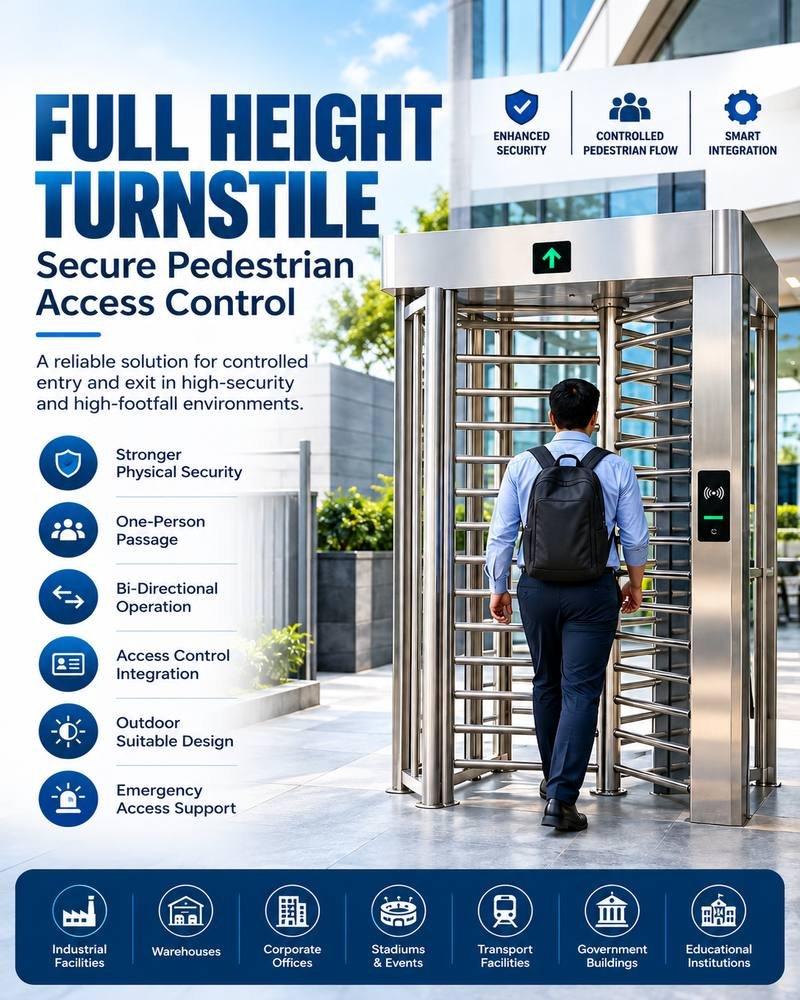
Managing pedestrian entry becomes more challenging when a facility needs stronger physical security, controlled movement, and reliable access authorization. Offices, factories, warehouses, industrial sites, stadiums, transportation facilities, and other restricted premises may require more than a conventional entrance gate.
A Full Height Turnstile provides a floor-to-ceiling pedestrian access solution designed to create a controlled passageway. Its enclosed structure makes unauthorized climbing or bypassing more difficult while allowing authorized users to enter through a defined access point.
What Is a Full Height Turnstile?
A Full Height Turnstile is a security gate that extends from the floor to approximately the full height of the passage. It uses rotating sections to control pedestrian movement through a designated lane.
Unlike waist-height turnstiles, the full-height design creates a more enclosed physical barrier around the passage. This makes it particularly useful for locations where perimeter security and controlled pedestrian access are important.
The turnstile can be connected with different authorization technologies, such as RFID cards, biometric readers, QR-based systems, or other access-control devices, depending on the installation requirements.
How Does a Full Height Turnstile Work?
The basic operation is simple:
- A person approaches the controlled entrance.
- The user presents an authorized credential.
- The access-control system verifies the authorization.
- The turnstile releases the appropriate direction.
- The person passes through the rotating section.
- The mechanism returns to its controlled position.
This process helps maintain an organized entry system while limiting access to authorized users.
Key Features of Full Height Turnstiles
1. Full-Height Physical Barrier
The floor-to-ceiling structure provides a stronger physical barrier compared with conventional waist-height pedestrian gates.
It can help reduce attempts to climb over or pass underneath the access point.
2. Controlled One-Person Passage
The rotating mechanism is designed to control pedestrian movement through a defined passage. This can help organizations maintain better control over who enters and exits a secured area.
3. Bi-Directional Operation
Depending on the configuration, a Full Height Turnstile can support controlled movement in one or both directions.
This makes it suitable for facilities where both entry and exit need to be managed.
4. Access-Control Integration
Full Height Turnstiles can be connected with access-control technologies such as:
- RFID card readers
- Biometric systems
- QR-code readers
- Smart credentials
- Access-control controllers
- Visitor management systems
The appropriate integration depends on the organization's security requirements.
5. Outdoor Suitability
Certain Full Height Turnstile configurations are designed for outdoor or semi-outdoor environments. Material selection, protective construction, and environmental specifications should be considered before installation.
6. Emergency Access
Security should not compromise emergency movement. Depending on the model and configuration, emergency release or fail-safe functions can be incorporated to support safe evacuation procedures.
Where Are Full Height Turnstiles Used?
Industrial Facilities
Factories and manufacturing facilities often have controlled employee entrances. A Full Height Turnstile can help manage access between public areas and restricted production zones.
Warehouses
Warehouses may use full-height access gates to control movement around storage and operational areas.
Corporate Campuses
Large business campuses can use turnstiles at employee entrances, service areas, and restricted sections.
Stadiums and Sports Facilities
Stadiums experience high pedestrian volumes during events. Full Height Turnstiles can help organize controlled entry and exit points.
Transportation Facilities
Railway facilities, metro-related premises, and other transportation environments may use controlled pedestrian gates where access management is required.
Government and Restricted Facilities
Government buildings and sensitive facilities can use full-height pedestrian barriers as part of a broader physical security arrangement.
Utility and Infrastructure Sites
Power facilities, communication sites, and other infrastructure locations may require controlled perimeter access where stronger physical barriers are preferred.
Benefits of Using a Full Height Turnstile
Enhanced Physical Security
The full-height construction creates a substantial physical barrier around the pedestrian passage.
Better Access Control
Integration with an electronic authorization system allows organizations to control who can enter or exit.
Reduced Unauthorized Bypass
The enclosed design makes common bypass methods such as climbing over or passing underneath more difficult.
Organized Pedestrian Movement
A defined passageway helps direct people through specific entry and exit points.
Suitable for Unmanned Entrances
Full-height turnstiles can be particularly useful at entrances that require controlled access without continuous manual supervision.
Scalable Security
The system can be integrated with other technologies as the organization's security requirements develop.
Full Height Turnstile vs Waist-Height Turnstile
The main difference is the level of physical enclosure.
A waist-height turnstile provides a compact access-control solution and is often suitable for indoor environments such as office reception areas, commercial buildings, and controlled lobbies.
A Full Height Turnstile creates a much taller physical barrier around the passage. It is generally considered when stronger perimeter control is required, particularly at industrial, outdoor, restricted, or less-supervised entrances.
The right option depends on the site's security objectives, available space, pedestrian traffic, environment, and access-control requirements.
What Should You Consider Before Buying?
Before selecting a Full Height Turnstile, organizations should evaluate several factors:
- Single or dual-lane configuration
- Entry and exit direction
- Expected pedestrian volume
- Indoor or outdoor installation
- Construction material
- Passage dimensions
- Access-control integration
- RFID or biometric compatibility
- Emergency release requirements
- Power requirements
- Maintenance requirements
- Warranty and service support
- Installation conditions
Selecting equipment based on the actual site requirements can provide better long-term performance than choosing a system based only on price.
Full Height Turnstile and Access Control Integration
A turnstile becomes more effective when it works as part of an integrated access-control system.
For example, an organization can connect a Full Height Turnstile with an RFID reader for employee access. A biometric reader can be used where identity-based authentication is required. QR-based access can also be considered for temporary users or visitors.
The access-control system can determine whether a person is authorized before the turnstile permits passage.
This approach can help create a structured relationship between authentication, physical access, and pedestrian movement.
Maintenance and Service Considerations
Regular maintenance is important for equipment that operates continuously at busy entrances.
Organizations should consider:
- Mechanical inspection
- Cleaning of moving components
- Sensor and reader checks
- Electrical inspection
- Access-control testing
- Emergency-release testing
- Periodic servicing
- Availability of technical support
A planned maintenance program can help identify operational issues before they affect daily access management.
Choosing a Full Height Turnstile Manufacturer
Choosing the right Full Height Turnstile Manufacturer is an important part of a security project.
Organizations should evaluate the manufacturer's experience, product construction, available configurations, integration capabilities, installation support, warranty terms, and after-sales service.
The supplier should also understand the site's pedestrian volume, security objectives, installation environment, and access-control requirements before recommending a suitable configuration.
Conclusion
A Full Height Turnstile provides a practical solution for organizations that require stronger physical control over pedestrian entry and exit.
Its full-height construction, controlled passage mechanism, access-control integration, and suitability for different environments make it useful across industrial facilities, warehouses, campuses, stadiums, transportation facilities, infrastructure sites, and other restricted premises.
Before selecting a system, organizations should consider the installation environment, pedestrian volume, lane configuration, access-control technology, emergency requirements, maintenance, and service support.
A properly selected Full Height Turnstile can become an important part of a broader security infrastructure while helping organizations maintain controlled and organized pedestrian movement.