From Suburban Streets to Downtown Cores: How to Transition from North York Driving to Core Toronto Traffic
By tony jay 18-05-2026 98
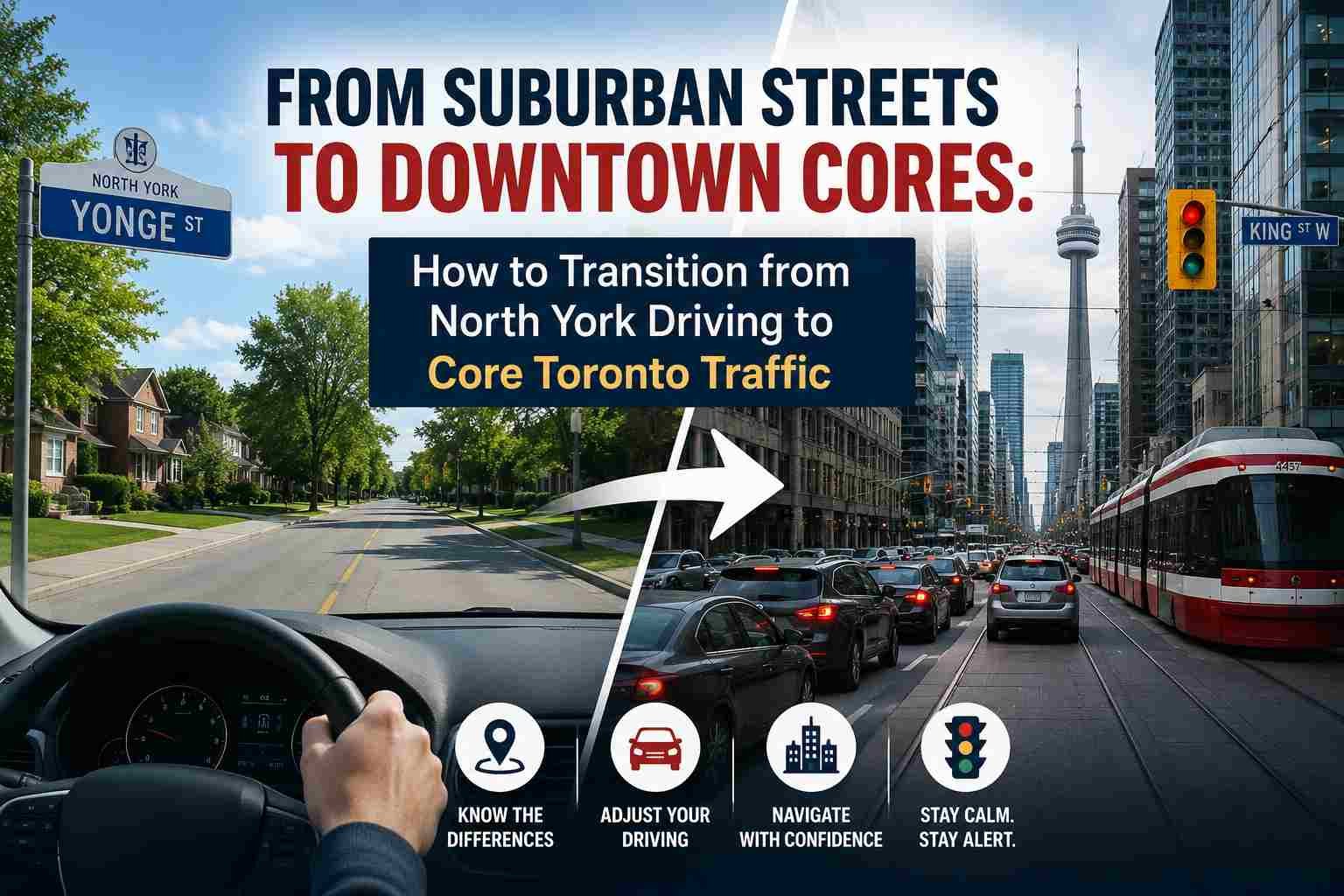
Driving in North York is already a great masterclass in handling heavy commuter traffic. Navigating multi-lane arterials like Finch, Sheppard, or the Don Mills corridor requires sharp reflexes and solid defensive driving skills.
But heading south past Eglinton and dropping into the downtown Toronto core? That is an entirely different beast.
Downtown driving isn’t just about managing cars; it’s a high-stakes game of spatial awareness where you share tight asphalt with streetcars, delivery trucks, aggressive cyclists, and massive surges of pedestrians. If you are used to the wider, more predictable roads of North York, here is your strategic playbook for transitioning smoothly to the chaotic heart of the GTA.
1. Decode the Streetcar Rules (The Ultimate Shift)
In North York, your biggest transit obstacle is usually a TTC bus pulling out from a bay. Downtown, it’s the streetcar network, and the rules are non-negotiable.
- The 2-Meter Rule: On streets like Queen, College, or Dundas, if a streetcar stops and does not have a dedicated, raised passenger island, you must stop 2 meters behind the rearmost doors. Passing an open streetcar door while passengers are stepping onto the road is a massive safety hazard and comes with severe penalties.
- Respect the Tracks: Streetcar tracks get incredibly slick when it rains or snows. Never try to drive perfectly parallel on top of them; your tires can catch or slide. When you need to cross them to change lanes or turn, do it at a sharp angle (closer to $45^\circ$) to maintain traction.
2. Master the Downtown Left Turn (The "Squeeze")
Left turns in North York usually feature a dedicated green arrow and a wide, forgiving intersection. Downtown, advanced green arrows are a luxury you rarely see.
- Creeping the Intersection: To turn left on busy downtown grids, you often have to edge your vehicle into the intersection on a green light, wait for a tiny gap in oncoming traffic, and complete the turn just as the light transitions to yellow or red.
- The Pedestrian Wall: Even if oncoming traffic clears, a wave of pedestrians crossing the side street will often block your path. You must stay calm, wait for the pedestrian countdown to clear, and execute the turn safely before the cross-traffic gets a green light.
3. Right Turns vs. The "Green Paint"
While North York features plenty of dedicated right-turn channels and slip lanes, downtown right turns require 360-degree vision due to Toronto's extensive cycling infrastructure.
- Check Your Blind Spot Twice: Toronto’s bike lanes (often painted bright green) run parallel to the driving lanes. Before making any right turn, you must look over your right shoulder. Cyclists and scooter riders going straight have the right of way, and they move fast.
- Watch for the Red Light Bans: A massive number of downtown intersections explicitly ban right turns on red lights to protect heavy pedestrian traffic. Always scan the signposts before you automatically creep forward to turn.
4. Adjust Your Spatial Awareness
In North York, lanes are wide and lanes are clear. Downtown, the lanes are incredibly narrow, and the obstacles are constant.
- The Delivery Squeeze: Delivery couriers, food drop-offs, and rideshare vehicles regularly use the right-hand lane as a temporary parking spot. Instead of watching just the car in front of you, look half a block ahead so you can anticipate these blockages and merge early.
- One-Way Webs: Major downtown arterials like Richmond and Adelaide are fast-moving, multi-lane one-way streets. Missing a turn means driving blocks out of your way in heavy traffic. Map out your route early and get into your turning lane at least two blocks in advance.
The Ultimate Downtown Mantra: Predict, Don't React
The secret to graduating from driving school in North York to North York roads to downtown traffic comes down to vision. In the suburbs, you can afford to focus primarily on the vehicles around you. Downtown, you must read the entire ecosystem: the pedestrian locking eyes with their phone near the curb, the cyclist hovering in your blind spot, and the brake lights of a streetcar three blocks ahead.
By slowing down your pacing, upgrading your observation skills, and keeping your cool, you will be navigating the core like a seasoned Toronto pro in no time.
Tags : .....