Flap Barrier Gate: How It Improves Pedestrian Flow in Modern Buildings
By sunilkumar housysgroup 07-10-2026 30
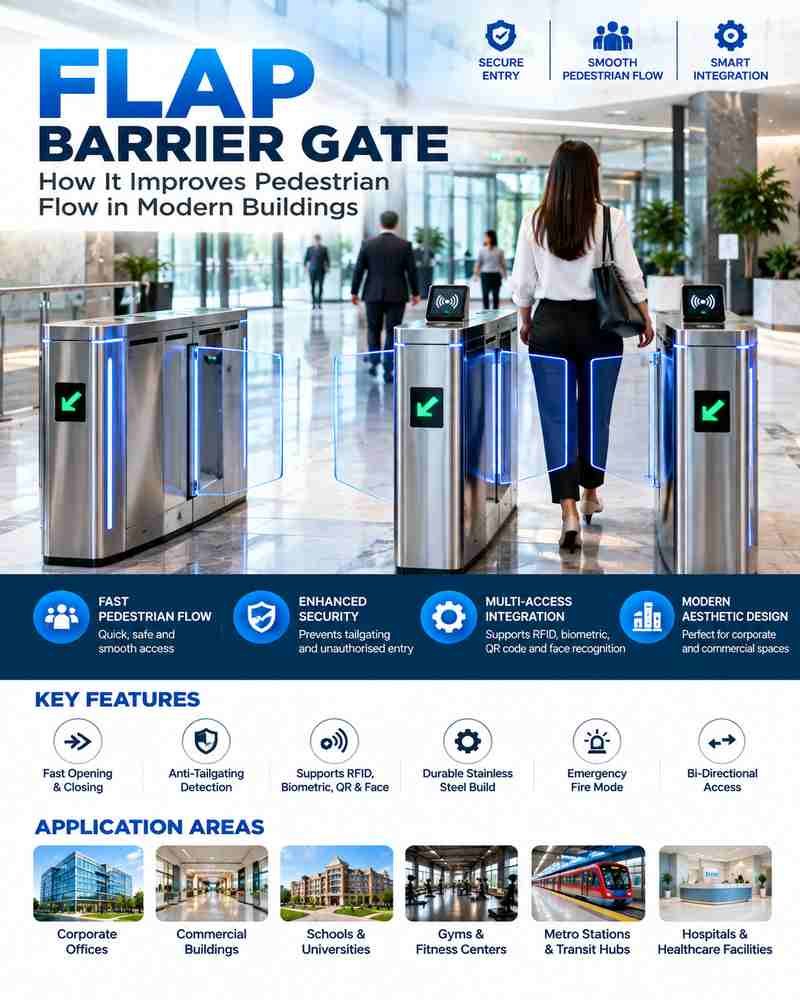
Modern buildings often have to manage a large number of people moving through the same entrance. Offices, factories, schools, colleges, gyms, metro stations, commercial properties, and residential communities all need a practical way to organize pedestrian movement.
A flap barrier gate provides a compact and efficient solution for this requirement. It uses electronically operated panels to regulate movement through a designated lane and can work with several identification technologies.
With RFID cards, QR codes, biometric readers, and electronic controllers, flap barrier systems can be configured for different types of buildings and operating requirements.
What Is a Flap Barrier Gate?
A flap barrier gate is an electronic pedestrian gate that uses movable panels to control movement through a passage.
The panels normally remain closed. When an authorized credential is verified, the controller sends a signal to the barrier and the panels open.
After the person moves through the lane, the panels return to their normal position.
This creates a clearly defined route for pedestrians and helps maintain an organized entrance.
How Does a Flap Barrier Gate Work?
A typical system includes:
- Barrier housing
- Movable panels
- Electronic controller
- Sensors
- Reader or scanner
- Power supply
- Safety mechanism
The basic operation is:
Person Approaches → Credential Check → Approval → Panels Open → Person Passes → Panels Close
The verification device can be selected according to the needs of the building.
Common options include RFID cards, QR codes, fingerprint readers, facial recognition devices, proximity cards, and mobile credentials.
Why Use a Flap Barrier Gate?
A traditional doorway may not provide enough control when a large number of people use an entrance every day.
A flap barrier gate creates a dedicated pedestrian lane and can connect the entrance with an electronic verification system.
This can help organizations:
- Organize pedestrian movement
- Reduce manual checking
- Manage registered users
- Improve entrance monitoring
- Support electronic verification
- Handle busy entrance areas
The actual results depend on the model, installation, controller, and operating environment.
Key Features of Flap Barrier Gates
Automatic Panel Operation
The panels can open and close automatically after receiving the appropriate signal from the controller.
RFID Support
RFID readers can identify registered cards and credentials before allowing passage.
Biometric Support
Compatible fingerprint and facial recognition devices can be connected to the system.
QR Code Support
QR scanners can be used for visitors, temporary users, event participants, and other approved users.
Sensor Technology
Sensors can detect movement through the lane and coordinate panel operation.
Two-Way Movement
Depending on the model and configuration, the system can regulate movement in both directions.
Emergency Operation
Suitable emergency functions can allow the panels to open when quick movement is required.
Applications of Flap Barrier Gates
Corporate Offices
Flap barriers can be installed near reception areas and employee entrances to manage daily staff movement.
Factories
Manufacturing facilities can create dedicated pedestrian lanes for employees and approved visitors.
Educational Institutions
Schools, colleges, and universities can use flap barrier gates at selected entrances.
Gyms and Fitness Centers
Fitness centers can connect flap barriers with membership systems and electronic verification devices.
Metro Stations
Busy transit locations can use multiple lanes to organize pedestrian movement.
Commercial Properties
Business centers and commercial buildings can use flap barriers as part of their building management setup.
Residential Communities
Residential properties can use electronic pedestrian gates at selected entry points.
Flap Barrier Gate and RFID Technology
RFID is one of the most commonly used technologies with electronic pedestrian gates.
A registered RFID card can be presented to the reader installed near the barrier. The reader communicates with the controller, which checks the credential.
After approval, the panels open and the user can move through the lane.
This type of setup can be useful in:
- Offices
- Factories
- Schools
- Colleges
- Gyms
- Corporate campuses
- Residential properties
Flap Barrier Gate With Biometric Verification
Biometric technology provides another option for user verification.
A compatible fingerprint or facial recognition device can communicate with the flap barrier controller.
This arrangement can be useful for organizations that want to connect pedestrian movement with employee, student, member, or visitor records.
Flap Barrier Gate vs Tripod Turnstile
Both systems can be used to organize pedestrian movement, but their mechanisms are different.
A flap barrier uses movable panels, while a tripod turnstile uses rotating arms.
A flap barrier can be a suitable choice for modern offices, commercial buildings, gyms, and other locations where a streamlined appearance and quick movement are important.
A tripod turnstile can be a practical option where a compact rotating-arm design is preferred.
The final choice should be based on pedestrian volume, available space, building design, verification technology, and project requirements.
How to Choose a Flap Barrier Gate
Before purchasing a flap barrier gate, buyers should review several factors.
User Volume
Estimate the expected number of users during normal and peak periods.
Available Space
Measure the entrance area and determine the required lane width.
Verification Method
Decide whether RFID, QR, biometric, mobile, or another technology will be used.
Installation Environment
Determine whether the equipment will be installed indoors or in a suitable protected area.
Safety Functions
Review sensor operation, emergency functions, and power-failure behavior.
Software Compatibility
Confirm compatibility with attendance, visitor management, membership, or building management software.
Service Support
Consider warranty, installation assistance, spare parts, and maintenance support.
Flap Barrier Manufacturer in India
When searching for a flap barrier manufacturer in India, buyers should compare construction quality, panel movement, reader compatibility, installation support, customization options, warranty, and after-sales service.
Houston Systems provides pedestrian movement and security solutions for offices, factories, educational institutions, commercial buildings, gyms, and other locations.
The appropriate flap barrier model can be selected according to pedestrian volume, available space, verification technology, installation environment, safety requirements, and software compatibility.
Conclusion
A flap barrier gate provides a modern method for organizing pedestrian movement in offices, factories, educational institutions, commercial properties, gyms, metro stations, and other busy locations.
Its automatic panels, electronic controller, sensor technology, and compatibility with RFID, QR, and biometric systems make it adaptable to different requirements.
Before purchasing a flap barrier gate, organizations should evaluate user volume, available space, verification technology, installation conditions, safety functions, software compatibility, warranty, and maintenance support.
A properly planned flap barrier installation can help create a more organized and efficient pedestrian entry environment.