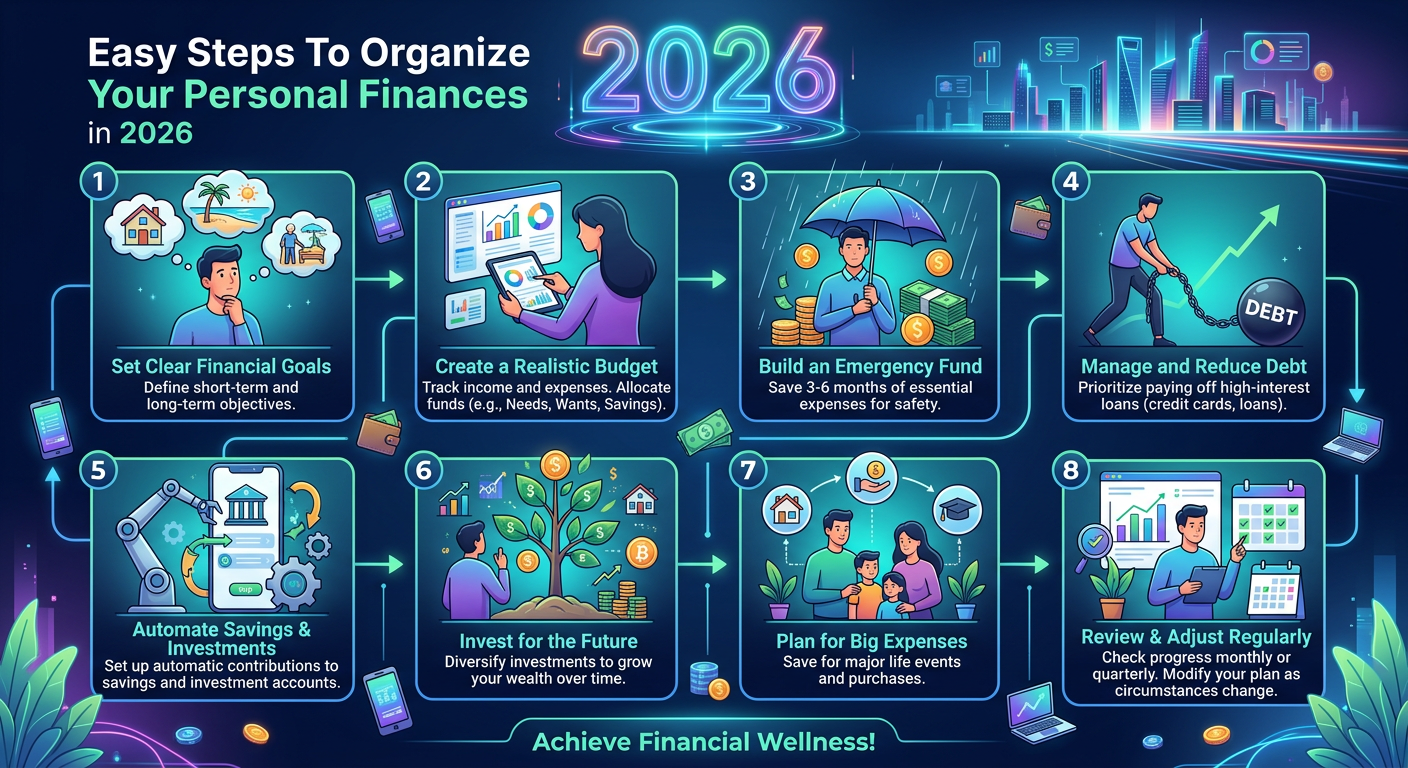
It doesn't have to be hard to keep your money in order. Here's a step-by-step plan for dealing with those stacks of paperwork.
Personal finance is a word that includes saving, investing, and managing your money. It includes making a budget, banking, getting insurance, getting a mortgage, investing, planning for retirement, paying taxes, and arranging for your estate.
Being organized helps overwhelmed beginners and young professionals who have become financially independent to make good choices. And get ready for unforeseen costs or crises.
Many people are unable to manage their personal finances as they face troubles, such as credit card debt with high interest rates, limited income, student loan debt, a low credit score, and spending too much.
The goal for now is to keep the financial mess under control and put some structure in place so that setting up a file system is easier.
These are the four most crucial things you need to do to start getting your money in order:
Why Personal Finance Is Important
Meeting your own personal financial goals is what personal finance is all about. These goals could be anything, like having enough money for short-term requirements, planning for retirement, or investing for your child's college education.
It depends on how much you make, how much you spend, how much you save, how much you invest, and how you protect yourself (via insurance and estate planning).
Many Millennials and Gen Z have gotten into a lot of debt, mostly in the US, because they don't know how to handle their money or be responsible with it.
The Federal Reserve Bank said that household debt has gone up by $3.8 trillion from December 2019, before the recession, in the third quarter of 2024. Also, the following balances went up from the second quarter of 2024 to the third:
- Home equity line of credit: $7 billion more
- Credit card debt has gone up by $24 billion.
- Debt on cars: $18 billion more
- Debt for students: $21 billion more
- Debt from mortgages has gone up by $75 billion.
How to start organizing your finances- 4 Easy Steps
1: Make a plan for your money
The first step to getting your personal finances in order is to make a budget. Sticking to a reasonable budget will not only help you protect your own money.
But it's also the first step toward being able to handle your own money in a responsible way.
To make a budget, you should first figure out how much you spend each month and then identify strategies to manage and cut back on that spending.
2. Get rid of credit card debt
If you have any credit cards with money on them, make it your goal to pay them off. Research suggests that the average interest rate on credit cards is 16%.
Also, you should look over all of your open credit cards and bank accounts. It's usually better to keep credit cards open even if you don't use them. This way, you can build up your credit history.
But if you don't use a credit card much and it has an annual charge, you might want to think about closing it.
3. Use your savings to the fullest
You need to understand how to manage your money. Money management means more than just spending less than you make.
Being able to save enough to live comfortably in the short and long term is a true measure of financial skill.
You can do personal finances in four steps:
Store your money
First of all, put extra money in a high-yield savings account to start building an emergency fund. If the worst happens, you should have enough money to cover your living needs for six months.
Always start small if that seems too big. A $500 savings goal is a wonderful place to start.
Put money into
Think about putting some additional money into your future. Put money into a 401(k) or IRA to get ready for retirement.
So, if you want to invest more after that, you can think about opening a brokerage account.
Pay off your debts
You might have to pay off some debt, like a loan or a credit card statement that is coming due.
Further, look for ways to save money so you can pay off your debt faster.
To protect your credit score, always make at least the minimum monthly payments and always pay on time.
Do it again
Finally, keep putting money into your personal finances into your emergency fund, your retirement account, and paying off your debts.
4. Make a schedule
Financial organization should be a healthy habit that becomes second nature, just like cleaning your teeth every night (we hope you do!).
The ideal way to do things is to plan out three important days, like the ones we showed you below:
- Check your credit score and change your budget on July 1st.
- Pay all of last month's bills on July 20th using your checking account.
- July 31st: Move any extra money to your savings account.
The Bottom Line
Personal Finances can be hard to deal with, especially if you don't know what you're doing or you're in a lot of debt.
But following the steps above to take responsibility for your money can be a terrific approach to get your finances in order.
At first, it will take some work and self-control, but once you get into the swing of things, things will get simpler.
Tags : Personal Finances