Custom ERP Systems Explained: Costs, Risks, and When They Actually Make Sense
By Nusrat Jahan Mim 06-06-2026 97
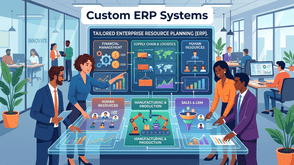
I've sat across the table from founders and operations directors who built the wrong ERP system. Not because they made stupid decisions. They were smart people. The problem was that nobody gave them an honest picture before they signed the contract.
So let me be that person for you.
This guide covers what custom ERP systems actually are, when they make sense over ready-made platforms, what a realistic ERP implementation looks like, and the specific traps that turn a promising project into a money pit.
What Is a Custom ERP System, Really?
ERP stands for Enterprise Resource Planning. At its core, it's software that connects the different moving parts of your business: inventory, finance, HR, procurement, sales, and production, all into a single system with a shared database.
An off-the-shelf ERP like SAP, Oracle, or Microsoft Dynamics gives you a pre-built version of that system. You configure it, maybe customise a few modules, and go.
A custom ERP system is built specifically for your business. Your workflows, your data structures, your terminology, your edge cases. Nobody else runs the same software.
That distinction matters more than most consultants will admit upfront.
When a Custom ERP System Actually Makes Sense
Here's the honest answer: not always.
Off-the-shelf ERPs have matured enormously over the past decade. For most small-to-mid-sized businesses with fairly standard processes, a well-configured SAP Business One or NetSuite will outperform a custom build in both functionality and total cost.
Custom ERP development starts making real sense when:
Your processes are genuinely unique. If you run a specialist manufacturing operation, a multi-jurisdiction logistics network, or an industry with unusual compliance requirements, standard platforms often force you to work around the software rather than with it. That friction adds up fast.
You've already tried the alternatives. I'd be suspicious of anyone telling you to build custom before you've seriously evaluated what's available. But if you've used two or three platforms and kept hitting the same walls, that's meaningful data.
You have the internal capability to own it long-term. Custom software isn't a product you install and forget. It needs ongoing development, maintenance, and someone internally who understands it deeply. If you don't have that, or can't build it, custom ERP will become a liability.
Your volume justifies the investment. Custom builds typically start at £80,000 to £250,000 for a genuine business-wide system, and that's before maintenance. For a £2M-turnover company, that math rarely works. For a £20M+ operation with complex processes, it can pay back quickly.
The Real Cost of ERP Implementation
This is where projects go wrong most often. Not in the technology, but in the budget assumptions.
I've seen companies budget for the build and completely forget about:
Data migration. Moving years of messy legacy data into a new system is almost always harder, slower, and more expensive than anyone expects. Budget at least 15 to 20% of your total project cost for this alone.
Integration work. Your ERP won't exist in isolation. It needs to talk to your CRM, your e-commerce platform, your accounting software, your warehouse management system. Each integration is a mini-project.
Training and change management. Software is only as useful as the people using it. If your team doesn't understand the system or trust it, they'll find workarounds, and then you've spent a fortune on software nobody uses properly.
Post-launch stabilisation. The first three to six months after going live are almost always rougher than expected. You'll find gaps, bugs, and workflow assumptions that don't match reality. Budget for a stabilisation phase before you consider the project closed.
A rough working rule: whatever the development cost is quoted at, plan to spend 40 to 60% more across the full implementation lifecycle. If that number doesn't work for your business case, the project doesn't work.
How ERP Implementation Actually Runs (And Where It Derails)
A well-run custom ERP implementation typically follows a few recognisable phases: discovery and requirements gathering, architecture design, phased development, user acceptance testing, data migration, go-live, and stabilisation.
The word "phased" is doing a lot of work there. Almost every project that goes badly wrong tried to do everything at once.
The biggest ERP implementation mistakes I see repeatedly:
Scope creep disguised as requirements. Discovery sessions are meant to define what the system needs to do. But in practice, they often become wishlists. Every department wants everything. Without a strong product owner who can say "that's phase two," you end up with a massively over-engineered system that takes twice as long and costs three times as much.
Choosing a development partner based on price alone. The cheapest quote is cheap for a reason. ERP development requires deep domain knowledge, structured project management, and the ability to push back when your internal teams ask for things that don't make sense architecturally. Cheaper shops often lack the experience to do any of that.
Going live on a hard deadline regardless of readiness. Some businesses set a go-live date and treat it as non-negotiable: a financial year end, a product launch, a merger close. I understand the pressure. But going live with critical functionality still broken, or with data that hasn't been properly migrated, causes downstream damage that takes months to recover from. A two-month delay is almost always better than a broken launch.
Underestimating user resistance. People are attached to how they work. A new ERP system changes processes they've followed for years. Without proper training, genuine involvement during the design phase, and strong senior sponsorship, you'll face passive resistance that quietly kills adoption.
Choosing the Right Development Partner
If you've decided custom ERP is the right path, who you build it with matters as much as what you build.
Look for a partner who has built ERP-class systems before, not just bespoke web apps or simple databases. The complexity is genuinely different. Ask to speak with two or three of their previous ERP clients, and specifically ask those clients what went wrong and how the partner handled it. Every project has problems. The question is how the vendor responds to them.
Be wary of partners who agree with everything in the sales process. The best development shops will challenge your requirements, ask difficult questions about your processes, and sometimes tell you something isn't a good idea. That friction in the early stages is valuable.
Also look for partners who can demonstrate experience with change management and training, not just technical development. The system is only half the project.
A Faster Alternative Worth Considering
Before committing to a full custom build, it's worth exploring platform-based customisation: taking an established ERP platform and extending it significantly to match your needs.
This approach gives you a proven core system (financial management, basic inventory, user management) while allowing deep customisation of the workflows and modules specific to your industry. It's typically faster, cheaper, and lower-risk than building from scratch, while still giving you far more flexibility than standard configuration.
It's not right for everyone. But if your unique requirements are concentrated in two or three specific areas rather than across the entire system, it's often the smarter move.
What Good Looks Like: Measuring ERP Success
Before you start, define what success actually means and make it measurable.
Not "the system is live" or "users are trained." Real metrics: reduction in time to close monthly accounts, decrease in inventory discrepancies, reduction in order processing time, fewer manual data entry errors. These numbers should come from your current operations and form the baseline you measure against 12 months post-launch.
Without this, you'll never know whether the investment was worth it, and you'll have no objective basis for making decisions about phase two.
The Bottom Line
Custom ERP systems can transform how a business operates. I've seen them unlock growth that simply wasn't possible when teams were held back by software that didn't fit. But they're complex, expensive, and unforgiving of poor planning.
If you go in with realistic expectations about cost, timeline, and the internal commitment required, and you choose the right partner, a well-built custom system pays back significantly.
If you're still weighing whether custom or off-the-shelf is right for your situation, the next step is an honest requirements audit of your current processes. That exercise alone often clarifies the decision more than any amount of vendor presentations.
Tags : technology