Complete Guide to Selecting a Servo Stabilizer for Industrial and Commercial Use
By Edryn 29-06-2026 48
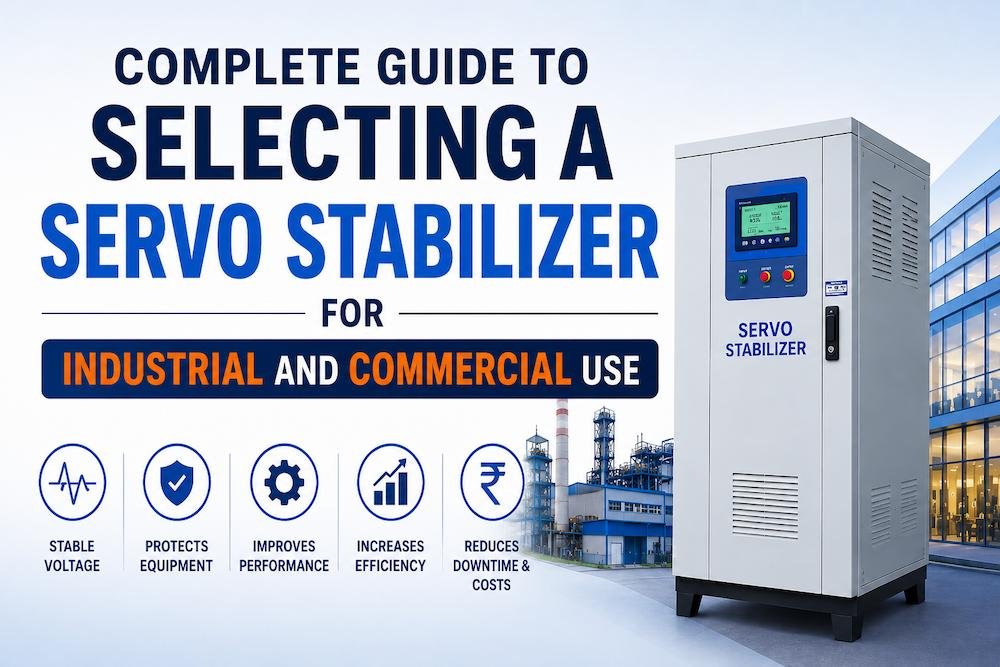
Power fluctuations are a common challenge across residential, commercial, and industrial environments. Voltage instability can damage sensitive equipment, reduce efficiency, and lead to costly downtime. This is where servo stabilizers play a critical role. However, choosing the right servo stabilizer for your specific application requires careful evaluation of multiple technical and operational factors. This guide will help you understand how to select the most suitable solution for your needs.
Understanding What a Servo Stabilizer Does
A servo stabilizer, also known as a servo voltage stabilizer, is an advanced voltage regulation device designed to maintain a stable output voltage despite fluctuations in the input supply. It uses a servo motor mechanism coupled with a buck-boost transformer to automatically correct voltage variations with high precision.
Unlike conventional stabilizers, servo stabilizers offer faster response time, higher accuracy, and better efficiency, making them ideal for sensitive and high-value equipment used in industries, hospitals, data centers, laboratories, and manufacturing units.
Step 1: Identify Your Application Requirements
The first and most important step is understanding where and how the stabilizer will be used. Different applications demand different specifications.
- Industrial applications require high-capacity stabilizers capable of handling heavy loads and continuous operation.
- Commercial environments such as offices, malls, and hotels need stabilizers for HVAC systems, elevators, and IT equipment.
- Medical and laboratory settings demand extremely precise voltage regulation to protect critical instruments.
- Residential or small business setups may need compact stabilizers for limited equipment.
Clearly defining your application helps narrow down the right category of servo stabilizer.
Step 2: Calculate the Load Capacity Accurately
Selecting the correct kVA rating is crucial. Under-sized stabilizers can overload and fail, while over-sized units increase costs unnecessarily.
To calculate capacity:
- List all connected equipment.
- Note their power ratings (in watts or kVA).
- Add a safety margin of 20–25% for future expansion and starting current.
Always consult a reliable servo voltage stabilizer manufacturer for precise load assessment, especially for complex industrial setups.
Step 3: Understand Input Voltage Range
Different locations experience different levels of voltage fluctuation. Some areas face minor variations, while others experience extreme highs and lows.
Choose a servo stabilizer with an input voltage range that matches your local power conditions. Common ranges include:
- 140V–260V (single phase)
- 300V–460V or wider (three phase)
A wider input range ensures uninterrupted operation even during severe fluctuations.
Step 4: Choose Between Single Phase and Three Phase
The choice between single-phase and three-phase stabilizers depends on your power supply and equipment type.
- Single-phase stabilizers are suitable for small loads and residential or light commercial applications.
- Three-phase stabilizers are essential for industrial machinery, large motors, and centralized power systems.
Incorrect phase selection can cause imbalance issues and equipment damage.
Step 5: Accuracy and Response Time Matter
One of the biggest advantages of servo stabilizers is their high accuracy, typically within ±1%. This precision is vital for sensitive equipment such as CNC machines, medical imaging devices, and testing instruments.
Faster response time ensures voltage correction happens instantly, minimizing the risk of voltage-related failures. Always verify these parameters when comparing products from different servo stabilizer suppliers.
Step 6: Look for Protection and Safety Features
A good servo stabilizer should do more than just regulate voltage. Essential safety features include:
- Over-voltage and under-voltage protection
- Overload and short-circuit protection
- Thermal protection for transformers and servo motors
- Phase failure and phase reversal protection (for three-phase units)
These features enhance equipment safety and extend stabilizer lifespan.
Step 7: Build Quality and Components
Quality of construction directly impacts performance and durability. Look for stabilizers with:
- High-grade copper windings
- Robust transformers
- Reliable servo motors
- Advanced control circuitry
Partnering with an experienced servo voltage stabilizer manufacturer ensures compliance with industry standards and consistent performance under demanding conditions.
Step 8: Energy Efficiency and Operating Costs
Energy efficiency is often overlooked but plays a major role in long-term operating costs. High-efficiency stabilizers reduce power loss and heat generation, resulting in lower electricity bills and maintenance expenses.
Ask manufacturers about efficiency ratings and operational losses before making a purchase decision.
Step 9: After-Sales Support and Service Availability
Servo stabilizers are long-term investments, and after-sales service is critical. Before finalizing your purchase:
- Check service coverage in your region
- Confirm availability of spare parts
- Understand warranty terms
- Evaluate technical support responsiveness
Reputable servo stabilizer suppliers provide installation support, regular maintenance services, and prompt troubleshooting assistance.
Step 10: Customization and Compliance
Every application is unique. In many cases, standard stabilizers may not fully meet specific operational needs. Leading manufacturers offer customized solutions based on load profile, voltage conditions, and environmental factors.
Additionally, ensure the stabilizer complies with relevant quality and safety standards such as ISO and industry-specific certifications.
Making the Right Choice
Choosing the right servo stabilizer is not just about price—it’s about performance, reliability, and long-term value. By understanding your application requirements, selecting the correct capacity, ensuring adequate protection features, and partnering with trusted servo voltage stabilizer manufacturers and servo stabilizer suppliers, you can safeguard your equipment and ensure uninterrupted operations.
A well-chosen servo stabilizer not only protects your assets but also improves efficiency, reduces downtime, and delivers peace of mind in an environment where power stability is critical.