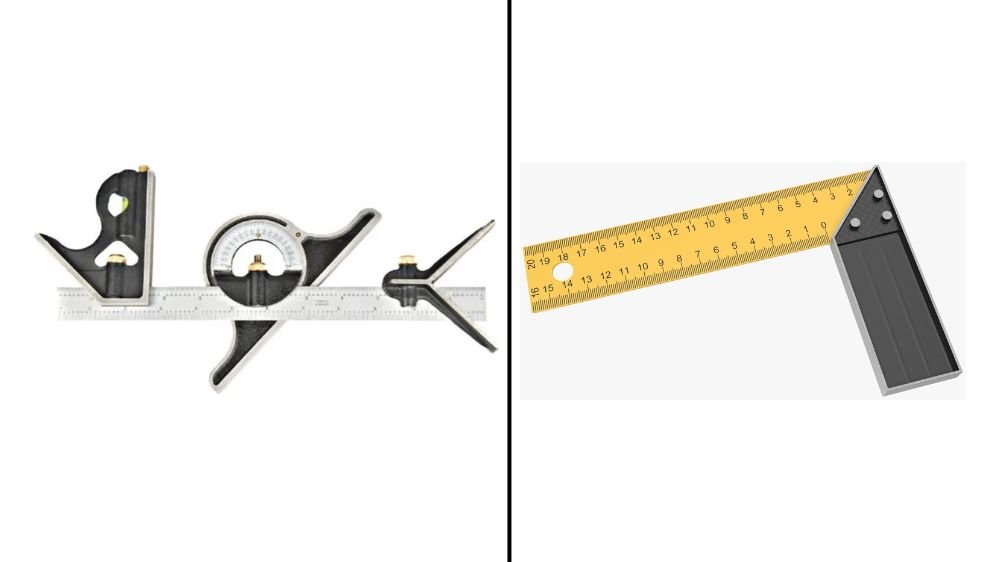
Combination Square and Try Square differences show that adjustable models offer versatility while fixed blades ensure maximum precision. Precision tools are at the center of woodworking, metalworking, and machining because getting an angle wrong by half a degree ruins assemblies. Both tools examine angles and measures, but knowing the Combination Square vs Try Square differences helps you choose the correct instrument instead of grabbing whatever is close by. Try squares match fixed blades that give tight 90-degree accuracy for conventional carpentry. Combination squares feature a sliding head that can be adjusted to allow you to measure depths, check fluid levels and mark 45-degree and 90-degree angles in a snap. You choose the correct model, and your fabrication job is completely accurate.
Understanding the Difference Between a Combination Square and a Try Square
A try square consists of two fixed parts: a wooden or metal handle (the stock) and a steel blade set permanently at 90 degrees. Nothing on it slides, rotates, or adjusts. That rigidity is its strength. Once calibrated at the factory, a try square holds its angle for years of shop use, provided it never gets dropped or bent.
A combination square works differently. The blade slides through an adjustable head, and that head often includes a spirit level, a scriber, and interchangeable attachments such as protractor or center-finding head. This adjustability turns a single tool into several. A fabricator can check 90-degree and 45-degree angles, measure depth, mark parallel lines, and find the center of round stock, all without swapping instruments. The trade-off is more moving parts, which means more opportunities for wear to creep into the joint between blade and head over time.
Feature Comparison: Combination Square vs Try Square
Measurement capability favors the combination square outright. Its ruled blade doubles as a standard scale, so a user gets linear measurement and angle checking from one device. A try square only confirms squareness; it carries no usable scale for length.
Angle checking tells a different story. A try square checks one angle, 90 degrees, and does it with less flex and fewer parts to loosen. A combination square typically ships with 90-degree and 45-degree faces on the head, adding versatility but introducing a small amount of play at the sliding joint.
Marking accuracy leans toward the try square for pure right-angle work, since a fixed blade cannot shift out of true during use. For layout tasks that mix depth gauging, center marking, or protractor readings, the combination square's built-in scriber and adjustable head save repeated tool changes.
Adjustable versus fixed design is the core distinction. Fixed tools resist accidental misalignment. Adjustable tools trade some of that rigidity for flexibility across tasks. Versatility, unsurprisingly, goes to the combination square, while ease of use for quick, repetitive 90-degree checks often goes to the try square, since there's no locking screw to tighten or loosen.
Which Tool Offers Better Precision for Different Applications?
Woodworkers marking cross-cuts on framing lumber or checking cabinet corners tend to favor the try square. Its rigid blade holds a line steady against rough-sawn or dusty wood surfaces where a sliding mechanism might catch debris.
Metal fabrication and machining work push toward the combination square. Shops cutting sheet metal, setting up mill vises, or checking weld fit-up need depth readings and 45-degree miter checks alongside standard right angles. When evaluating Combination Square vs Try Square for precision measurement in a metalworking context, the combination square's added functions usually outweigh its slightly higher tolerance stack from the moving head.
General workshop tasks, where speed matters more than multi-function capability, often suit the try square better. A quick check on a door frame or a shelf bracket doesn't need a scriber or a level vial.
Inspection and layout work in a tool room or quality department leans back toward the combination square. Inspectors marking reference lines, checking squareness against a surface plate, and verifying multiple angles in one setup benefit from a single instrument that handles all three.
Factors to Consider Before Choosing Between the Two
The type of project drives most of the decision. A one-off carpentry job rarely justifies the cost of a combination square set, while a fabrication shop running mixed jobs daily benefits from the added functions.
Required accuracy matters too. Precision ground blades on either tool can hold tolerances suitable for machine shop work, but a combination square's sliding head introduces a variable that a rigid try square avoids.
Frequency of use affects durability concerns. Tools used dozens of times a day wear faster at moving joints, so shops with heavy daily use should inspect a combination square's locking mechanism regularly.
Material being measured plays a role as well; softer materials like wood tolerate more surface contact from a wider stock, while metal fabrication benefits from a square that resists nicking on sharp edges. Budget rounds out the decision, since a quality try square costs less than a full combination square set with multiple heads.
When Should You Use a Combination Square Instead of a Try Square?
Reach for a combination square when a job calls for more than a right-angle check. Setting up a table saw fence, finding the center of a round bar, checking depth in a milled pocket, or confirming a 45-degree miter all call for the combination square's added functions. Any workflow that mixes measurement types benefits from having one tool that covers them.
A try square remains the simpler, faster option for straightforward squareness checks. Framing carpenters, quick shop verifications, and situations where a tool might take a hard knock all favor the try square's fixed, forgiving design.
Conclusion
Choosing between these two tools comes down to what the work demands. A try square delivers dependable, no-fuss squareness checks with minimal risk of drift. A combination square trades some of that simplicity for measurement range, angle flexibility, and layout functions that suit varied fabrication and machining tasks. Buyers evaluating precision gauges for their workshop, including options available through Kristeel, should match the tool to the job rather than the job to the tool, since the right choice depends entirely on the accuracy, versatility, and durability a project actually requires.