Cloud vs On-Premise Radio & TV Broadcasting Software: Which is Better?
By Sachin Agrawal 28-09-2026 8
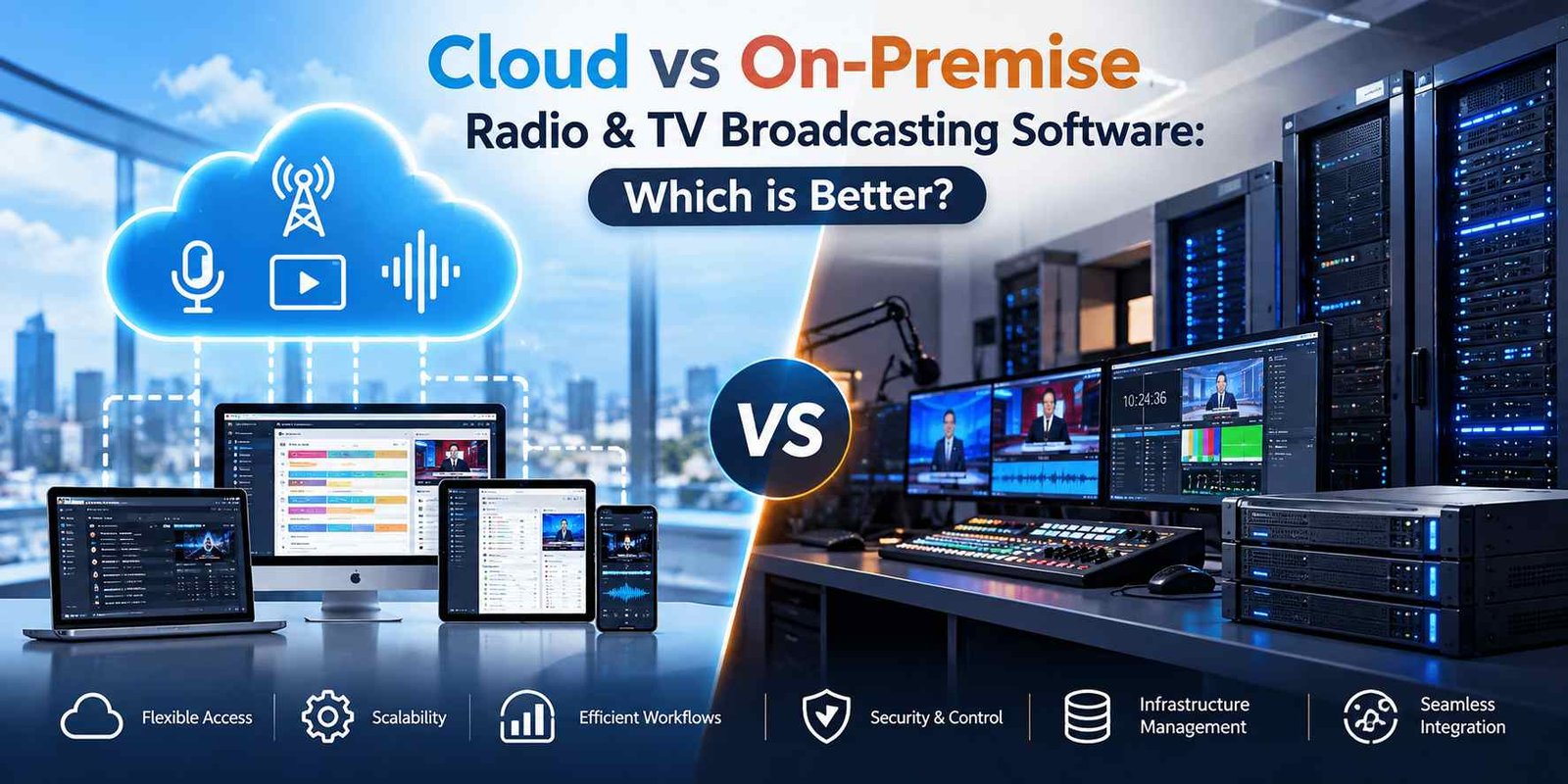
Radio and television broadcasters rely on technology to manage programming, scheduling, advertising, content, workflows, and distribution. As broadcasting operations become more connected, choosing the right Radio & TV Broadcasting Software has become an important technology decision.
Two deployment models are widely used in the broadcasting industry: cloud-based and on-premise systems. Both approaches can support core broadcasting workflows, but they differ in infrastructure, accessibility, maintenance, scalability, and system management.
Understanding these differences can help media organizations select a broadcasting platform that aligns with their operational requirements.
What Is Cloud-Based Broadcasting Software?
Cloud-based broadcasting software is hosted on remote infrastructure and accessed through an internet connection. Instead of maintaining all application servers and supporting infrastructure within a broadcasting facility, organizations use a hosted environment to operate their broadcasting workflows.
Cloud-based Broadcast Solutions can support activities such as programming, scheduling, content management, advertising operations, reporting, and workflow coordination.
For radio organizations, Cloud-based Radio Broadcasting can provide centralized access to scheduling and station management functions. Television organizations can similarly use Cloud-based TV Broadcasting platforms to coordinate programming, content, advertising, and operational workflows.
Cloud deployment can also support distributed teams because authorized users can access the system from different locations.
What Is On-Premise Broadcasting Software?
On-premise broadcasting software is installed and operated on infrastructure owned or managed by the broadcasting organization. Servers, databases, applications, and related components are maintained within the organization's environment.
With on-premise Radio and TV Broadcasting Software, the broadcaster generally manages the underlying infrastructure, software installation, system updates, backups, security controls, and hardware requirements.
This deployment model provides organizations with direct control over their technology environment. It can also be integrated with existing broadcasting infrastructure and internal systems.
Cloud vs On-Premise: Key Differences
The differences between cloud and on-premise broadcasting systems can be evaluated across several operational areas.
1. Infrastructure Management
With an on-premise system, the broadcaster is responsible for servers, storage, networking, operating environments, and related infrastructure.
Cloud-based broadcasting systems shift much of the infrastructure responsibility to the hosting environment. This can reduce the amount of physical infrastructure that the broadcasting organization needs to manage directly.
2. Accessibility
Accessibility is an important consideration for modern Radio & TV Broadcasting Systems.
On-premise software is typically accessed through the organization's internal network or configured remote access environment. Cloud platforms can provide browser-based or remote access for authorized users, depending on the system architecture.
This can be useful for broadcasters with teams working across multiple offices, stations, production facilities, or locations.
3. Scalability
Broadcasting operations can change as organizations add stations, channels, users, content, advertising workflows, or new operational requirements.
Cloud-based systems can provide a flexible infrastructure model for expanding system resources and users. This makes cloud deployment suitable for organizations that require centralized broadcasting workflows across multiple locations.
On-premise environments can also scale, but expansion may require additional servers, storage, networking equipment, software configuration, and infrastructure planning.
4. Maintenance and Updates
Maintaining an on-premise broadcasting platform requires internal teams or technology partners to manage software updates, infrastructure maintenance, backups, security configurations, and system performance.
Cloud-based solutions can simplify infrastructure maintenance because the hosting environment and application infrastructure can be managed as part of the cloud service, depending on the provider and deployment model.
This allows broadcasting teams to focus more closely on their operational workflows rather than maintaining physical infrastructure.
5. Integration With Broadcasting Workflows
Both deployment models can support integrations with broadcasting systems and business applications.
A Radio and TV Broadcasting Software platform may need to connect with traffic systems, advertising platforms, content libraries, scheduling tools, financial systems, reporting applications, and other media technologies.
The important consideration is not simply whether the software is cloud-based or on-premise. Organizations should evaluate the available APIs, integration capabilities, data exchange methods, and compatibility with their existing Radio & TV Broadcasting Systems.
Benefits of Cloud-Based Radio and TV Broadcasting
Cloud deployment can support broadcasters that require centralized access, flexible infrastructure, and distributed workflows.
Some common capabilities include:
- Centralized broadcasting operations
- Remote access for authorized users
- Multi-location workflow management
- Centralized scheduling and programming
- Advertising and commercial management
- Content and media workflow coordination
- Automated reporting and operational visibility
- Flexible infrastructure expansion
- Integration with other cloud-based applications
For organizations operating multiple stations or channels, cloud-based platforms can provide a common environment for managing broadcasting activities.
Benefits of On-Premise Broadcasting Software
On-premise deployment remains relevant for organizations that require direct control over their infrastructure and software environment.
Key considerations include:
- Direct infrastructure control
- Internal data management
- Custom network configurations
- Integration with existing local systems
- Control over software deployment
- Organization-specific security policies
- Dedicated infrastructure for broadcasting operations
For broadcasters with established IT infrastructure and specialized operational requirements, an on-premise environment can be incorporated into an existing technology architecture.
Which Broadcasting Software Deployment Model Should You Choose?
There is no single deployment model that applies to every broadcasting organization.
The appropriate choice depends on factors such as the number of stations, operational locations, existing infrastructure, remote access requirements, integration needs, internal IT capabilities, data management policies, and long-term technology plans.
Organizations with distributed teams and multiple locations may consider Cloud-based Broadcast Solutions when centralized access and flexible infrastructure are important requirements.
Broadcasters with established infrastructure and a requirement for direct control over their technology environment may consider an on-premise Broadcast Management System.
Some organizations may also consider hybrid architectures that combine cloud services with on-premise broadcasting infrastructure. This approach can support specific operational requirements while allowing organizations to gradually modernize selected workflows.
What to Consider Before Selecting Radio & TV Broadcasting Software
Before choosing a broadcasting platform, media organizations should evaluate more than deployment type.
Consider the following:
Workflow requirements: Determine how the platform will support programming, scheduling, advertising, content, reporting, and operational workflows.
Integration capabilities: Review compatibility with existing broadcasting, traffic, automation, accounting, advertising, and content systems.
User access: Identify which teams require access and from which locations.
Scalability: Consider future requirements for additional stations, channels, users, content, and workflows.
Security and access controls: Evaluate authentication, permissions, data protection, backups, and administrative controls.
Reporting: Check whether the platform provides the operational and business reports required by management and broadcasting teams.
Total operational requirements: Consider infrastructure, software, maintenance, implementation, integrations, training, and ongoing administration.
The Future of Radio & TV Broadcasting Systems
Broadcasting technology continues to move toward connected workflows, centralized management, automation, and flexible access. Cloud infrastructure is becoming an important component of this transformation, while on-premise systems continue to serve organizations with specific infrastructure and operational requirements.
Modern Radio & TV Broadcasting Software should provide more than basic scheduling. It should help organizations coordinate programming, advertising, content, operational workflows, and reporting through an integrated environment.
Platforms such as EBIMS are designed to support broadcasting organizations with integrated workflows for radio and television operations. By evaluating deployment options alongside functionality, integration, scalability, and operational requirements, broadcasters can select an architecture that supports their current environment and future technology roadmap.
Ultimately, the cloud versus on-premise decision should be based on the broadcaster's operational model, infrastructure strategy, workflow requirements, and technology objectives. The right broadcasting software is the one that fits those requirements while providing a reliable foundation for managing modern radio and television operations.