Choosing Reliable Diagnostic & Examination Instruments for Hospitals and Clinics
By Mediwave India 09-09-2026 3
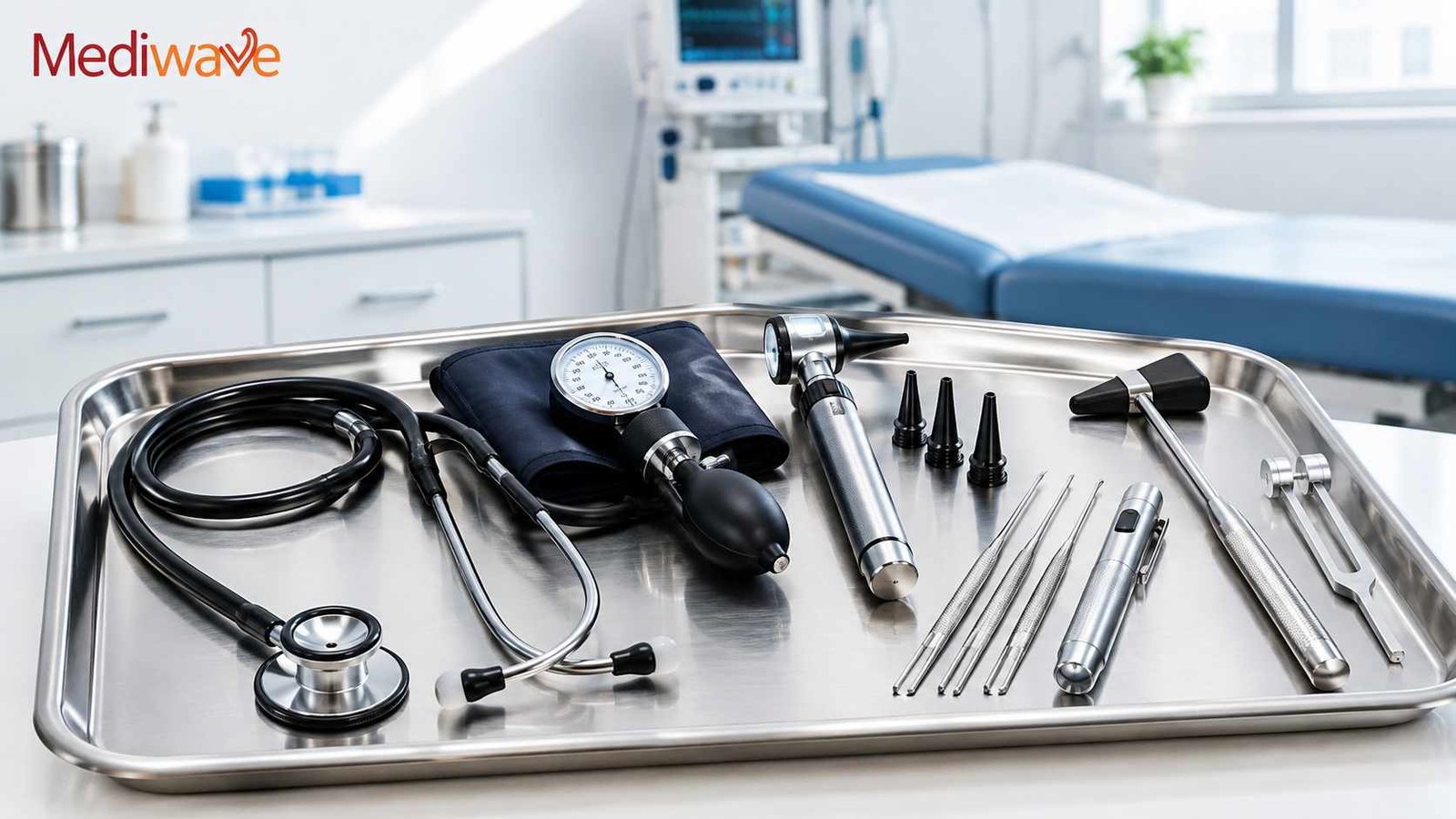
A blood-pressure reading looks wrong, the otoscope light flickers, and nobody can locate the calibration record. That is not a minor purchasing issue. It interrupts clinical work and can undermine diagnostic confidence. Reliable Diagnostic & Examination Instruments must be accurate, easy to disinfect, supported after purchase, and suitable for the workload of the facility using them. Price matters, but buying the cheapest quotation is a bad approach when the instrument will influence daily clinical decisions. In India, medical devices are regulated under the Drugs and Cosmetics Act, 1940 and Medical Devices Rules, 2017, making documentation part of procurement—not optional paperwork.
Specifications That Matter After the Quotation Is Approved
Different departments require different examination tools. Hospitals may procure stethoscopes, sphygmomanometers, otoscopes, diagnostic sets, examination lights, reflex hammers, thermometers and related accessories. Clinics usually need fewer categories but depend on them more frequently.
Measurement Accuracy and Readability
For measuring devices, request the stated accuracy range, graduation scale, operating limits and calibration procedure. Displays and gauges should remain readable under normal examination-room lighting. A vague claim such as “clinically accurate” is worthless without a test method, tolerance or supporting document.
Materials, Cleaning and Patient Contact
Confirm the materials used in patient-contact surfaces, tubing, diaphragms, handles and reusable accessories. Also check which disinfectants the instrument can tolerate. Nobody tells you that repeated cleaning can damage low-grade plastics, remove markings or cloud viewing lenses long before the main device fails.
Power, Accessories and Replaceable Parts
For illuminated or electronic instruments, check battery type, expected operating duration and local availability of lamps, cuffs, probes or charging components. A low-cost device tied to a proprietary accessory can become expensive after six months.
The Calibration Detail Buyers Commonly Skip
Ask whether the unit arrives with an individual calibration or inspection record, not merely a generic quality certificate for the product family. The WHO’s 87-page maintenance guidance distinguishes performance inspections, safety inspections, and preventive and corrective maintenance; those are four different activities, not interchangeable labels.
Five Tests for Diagnostic & Examination Instruments Manufacturers
1. Request Product-Specific Compliance Evidence
A credible supplier should identify the applicable device classification, licence or registration position, manufacturing standard and test records. A bad answer sounds like, “All our products are approved,” followed by documents that never mention the quoted model.
India uses four risk classes—A, B, C and D—so one compliance answer cannot sensibly cover every medical device.
2. Check Sample Consistency Against Bulk Supply
Approve a sample and document its material, finish, dimensions, accessories and packaging. Then require the dispatched batch to match it. Bad suppliers send an impressive sample and quietly substitute lighter components in the commercial shipment. That behaviour is dishonest, and procurement teams should reject the batch rather than negotiate away the discrepancy.
3. Demand a Written Defect Process
The supplier should state the inspection window, evidence required, replacement procedure and freight responsibility. “We will handle complaints case by case” is a bad answer. It means no settled policy exists.
4. Test Spare-Part and Service Availability
Ask for the availability and price of common replacement parts before issuing the purchase order. A weak supplier discusses service only after a failure. Which means your biomedical team inherits the delay.
5. Examine Delivery Capacity Honestly
Share quantities, destination, packaging expectations and required delivery date. A dependable supplier will identify stock items and made-to-order products separately. A bad answer promises immediate dispatch before checking quantity or configuration.
How Better Instruments Protect Budgets and Clinical Operations
Fewer Repeat Examinations
Consistent readings reduce avoidable rechecks caused by doubtful equipment. That protects clinician time and keeps OPD queues moving.
Lower Replacement Exposure
Replaceable cuffs, lamps and batteries can extend usable life without replacing the complete instrument. WHO identifies preventive maintenance as a way to extend equipment life and reduce failure rates.
Safer Infection-Control Routines
Surfaces compatible with the facility’s approved disinfectants are less likely to crack, fade or become difficult to clean. Here’s the risk: an instrument that cannot tolerate routine disinfection creates either premature replacement expense or an infection-control compromise.
Better Standardisation Across Departments
Buying common models reduces variation in accessories, operating instructions and staff familiarisation. A hospital standardising three cuff sizes across compatible devices, for example, has fewer stock-keeping errors than one managing unrelated fittings.
Less Downtime
Written warranty handling and available spares reduce the time a device remains out of service. Maintenance planning still takes more work than buyers expect because service intervals depend on utilisation, environment, device risk and manufacturer instructions.
Stronger Cost Control
The lowest unit price does not represent the lowest ownership cost. Freight, calibration, consumables, replacement parts and rejected batches belong in the comparison. Ignoring those costs is mediocre procurement, not saving money.
Procuring Diagnostic Instruments Across India
Diagnostic Instruments Manufacturers in India can shorten replenishment cycles and make documentation or replacement coordination easier, especially for hospitals buying across several categories. Yet geography alone proves nothing. Buyers should still verify manufacturing responsibility, inspection controls and post-sale support.
For northern facilities, sourcing from Jalandhar can reduce road transit compared with importing routine examination products through a distant port, although actual lead time depends on stock and destination. Mediwave lists its address in Jalandhar, Punjab, and states that it has operated since 2017. Buyers comparing Diagnostic and Examination Instruments Suppliers should request destination-specific freight and dispatch estimates rather than accepting “pan-India delivery” as a schedule.
About Mediwave India
We supply medical instruments and equipment for hospitals, clinics and institutional buyers from our Jalandhar base. Our range includes diagnostic, surgical, orthopedic, dental and gynaecology categories, helping procurement teams reduce the number of vendors involved in one requirement.
We know the difficult part is often not selecting a stethoscope or otoscope; it is matching the approved specification, accessories and documentation across the final shipment. Since 2017, we have worked with healthcare buyers who need those details confirmed before dispatch—not explained after delivery.
Send us the instrument list, quantities, preferred specifications, delivery PIN code and required date. We will confirm available models, documentation, dispatch position and whether an MOQ applies to your selected products. For urgent requirements, our website lists telephone assistance as available 24/7, although quotation and dispatch time depends on product configuration and quantity.
A Better Purchase Starts With Better Evidence
Reliable Diagnostic & Examination Instruments should be evaluated through specifications, records, serviceability and batch consistency—not catalogue claims. The Medical Devices Rules have governed India’s device framework since 2017, and procurement controls should reflect that reality. Buyers who document acceptance criteria now will be better prepared as clinical workloads and compliance expectations increase.
FAQs
1. Which Diagnostic & Examination Instruments are commonly required by clinics?
Commonly needed items are stethoscopes, sphygmomanometers, otoscopic sets, thermometers, reflex hammers and examination lights. Exact requirements will vary with each individual practice and its specialty and number of patients.
2. How should hospitals compare Diagnostic Instruments Manufacturers?
Compare specifications for each model, authorization documentation, calibration approach, warranty terms, availability of spares and batch-inspection procedures. Just Price comparison would leave too many clinical and ownership risks unmeasured.
3. Are all Diagnostic Instruments Manufacturers in India governed by the same requirements?
Medical Devices are subject to regulation under national rules but the applicable requirements depend on the classification of the device and its intended purpose. Buyers should check the quoted model as one certificate does not automatically cover everything.
4. Should every examination instrument arrive with a calibration certificate?
Not all non-measuring instruments have to be calibrated. For measuring instruments always ask for the relevant calibration / inspection record and check the recommended interval for recheck ordering.
5. What should buyers ask Diagnostic and Examination Instruments Suppliers about warranties?
Inquire on duration of guarantee, limitations, proof requirements for complaints, time to replace & who bears freight. A warranty offers no benefit if there‘s no written procedure for claims or spare support.