An improperly sealed bottle of lotion, an unclear list of ingredients or even a diaper that works well in the test sample but does not work after being put into mass production can affect more than just one order. It can affect the reputation of the buyer.
Selection of Baby Care Products demands thorough inspection since the baby's skin is still forming and the product will most probably be used multiple times per day. One should not trust good-looking packaging, claims about "gently care for your baby's skin" and a sample of the product since WHO refers to the newborn period as the first 28 days of life.
For pharmaceuticals, distributors, retailers and private labels, safety comes from the factory, not from the shelves.
Baby Care Products Specifications Worth Checking Before Approval
Product selection should begin with written specifications covering ingredients, absorbency, dimensions, packaging, test methods and permitted tolerances.
Skin-Contact Products Need Formula-Level Review
Baby lotions, wipes, shampoos, oils and creams require a complete ingredient declaration rather than a vague “natural formulation” statement. Buyers should review fragrance, preservatives, colourants, pH range and known allergens.
European safety guidance for cosmetics used on children under three recommends using preservatives only at their lowest effective concentration. It also warns manufacturers to assess toxic ingredients, potent allergens and substances with endocrine-disrupting activity.
That matters. “Dermatologically tested” is not a formulation specification.
Diapers and Absorbent Products Need Performance Data
For diapers, underpads and related hygiene products, ask for:
- Product dimensions and weight tolerance
- Absorbent-core composition
- Acquisition and retention performance
- Rewet results
- Adhesive and elastic specifications
- Leakage-control design
- Microbiological test limits
- Pack count and pack-weight tolerance
Most buyers check absorption but ignore rewet—the moisture transferred back to the skin after pressure is applied.
A diaper may absorb a high volume in an open laboratory test and still feel wet during actual use. That gap is harder to control than buyers expect because core distribution, elastic tension and topsheet performance must remain consistent across every production lot.
Powder and Feeding Products Need Relevant Standards
India has product-specific standards for certain infant-care categories. For example, IS 5339 covers skin powder for infants, while glass feeding bottles are addressed under IS 5168:2018. Buyers should identify which standards apply to their exact product instead of asking whether the factory is “BIS compliant” in general.
A certificate for one item does not automatically cover the entire catalogue.
Five Questions That Expose a Weak Baby Care Products Manufacturer
1. Can You Provide Current Product Test Reports?
A capable supplier should provide reports linked to the actual formulation, material and production unit.
A bad answer sounds like: “We test regularly, but reports are confidential.”
Confidential commercial information can be protected. Basic evidence of microbiological, stability, material or performance testing should not disappear behind that excuse.
2. How Do You Control Raw-Material Changes?
Ask whether buyers are notified before changing fragrance, nonwoven fabric, absorbent polymer, packaging film, preservatives or vendors.
A bad answer sounds like: “The quality remains the same even if the source changes.”
That is careless. A material can meet a broad description and still behave differently during filling, storage or consumer use.
3. What Is Your Batch Traceability Process?
Each commercial batch should be connected to its production date, raw-material lots, packaging components and quality records.
A bad answer sounds like: “We can trace it through our purchase department if required.”
Traceability should already exist. It should not become an investigation after a complaint arrives.
4. What Happens When a Batch Fails?
The supplier should explain segregation, root-cause analysis, corrective action and replacement responsibility.
A bad answer sounds like: “We have never received a complaint.”
Nobody believes that. Even a well-run factory faces packaging damage, variation or transport-related complaints. The real test is how quickly the supplier contains the problem.
5. Can Pilot Samples Be Reproduced at Commercial Scale?
Request samples produced with the intended formula, substrate, machinery and packaging—not a hand-prepared showroom sample.
A bad answer sounds like: “Bulk production will be almost the same.”
“Almost” is where disputes begin.
How Safer Products Protect Buyer Margins
Fewer Returns and Marketplace Complaints
Clear specifications reduce inconsistent absorbency, damaged seals, fragrance variation and pack-count errors. Fewer defects mean fewer replacements, refunds and negative product reviews.
Lower Regulatory Exposure
Documented ingredients, applicable standards and traceable batches make compliance reviews easier. BIS explains that certification is generally voluntary, but the Central Government makes compliance compulsory for certain products where health, safety or fair-trade concerns apply.
Better Repeat Purchase Rates
Parents rarely experiment repeatedly with a baby-care product that performs consistently. Once a diaper fits correctly or a wipe feels dependable, repeat buying becomes easier—protecting the retailer’s shelf movement and the brand owner’s acquisition cost.
Stronger Private-Label Control
Written tolerances give buyers a measurable basis for approval. Without them, every disagreement becomes subjective: the factory says the batch is acceptable, while the buyer says it feels different.
Reduced Inventory Write-Offs
Stable formulas and validated packaging reduce separation, leakage, drying, contamination and premature expiry. That matters when a distributor is holding several months of stock across warehouses.
Safer Brand Expansion
A documented development process makes it easier to add new pack sizes, fragrances or product variants without rebuilding quality controls from zero. Current European rules individually identify 26 fragrance allergens for cosmetic labelling, showing why ingredient-level review matters during range expansion.
Finding Baby Care Products Manufacturers in India
In India, customers can find experts who concentrate on delivering absorbent-hygienic production processes, flexible packaging solutions, pharmaceutical supply chains, and established export infrastructure in a single country. Yet geographical factors play a significant role when it comes to implementation. A factory located nearby sources of raw materials and freight routes may recover faster from a lack of packaging than a supplier who uses components delivered from different states.
Considering this, when selecting Baby Care Products Manufacturers in India, customers should take into account factors like lead times, plant locations, access to ports, concentration of suppliers and seasonal transport risks, and not only prices. According to UNICEF, in 2020, there were almost a million less newborn deaths compared to 2016 in India, which is an indicator of increasing focus on maternal and newborn health in the country.
Baby Care Products Suppliers in India offer various services such as private labelling, contract manufacturing, and mixed sourcing for importers. It is, however important to verify that the actual manufacturer is the supplier. A trader that has no interest in revealing where production occurs does nothing to provide transparency but adds to confusion.
Most importantly, a low quote from the factory is no guarantee that it will not end up being one of the most expensive orders owing to rejected packaging, late shipping, or poor batch uniformity.
How We Support Safer Baby Care Product Sourcing
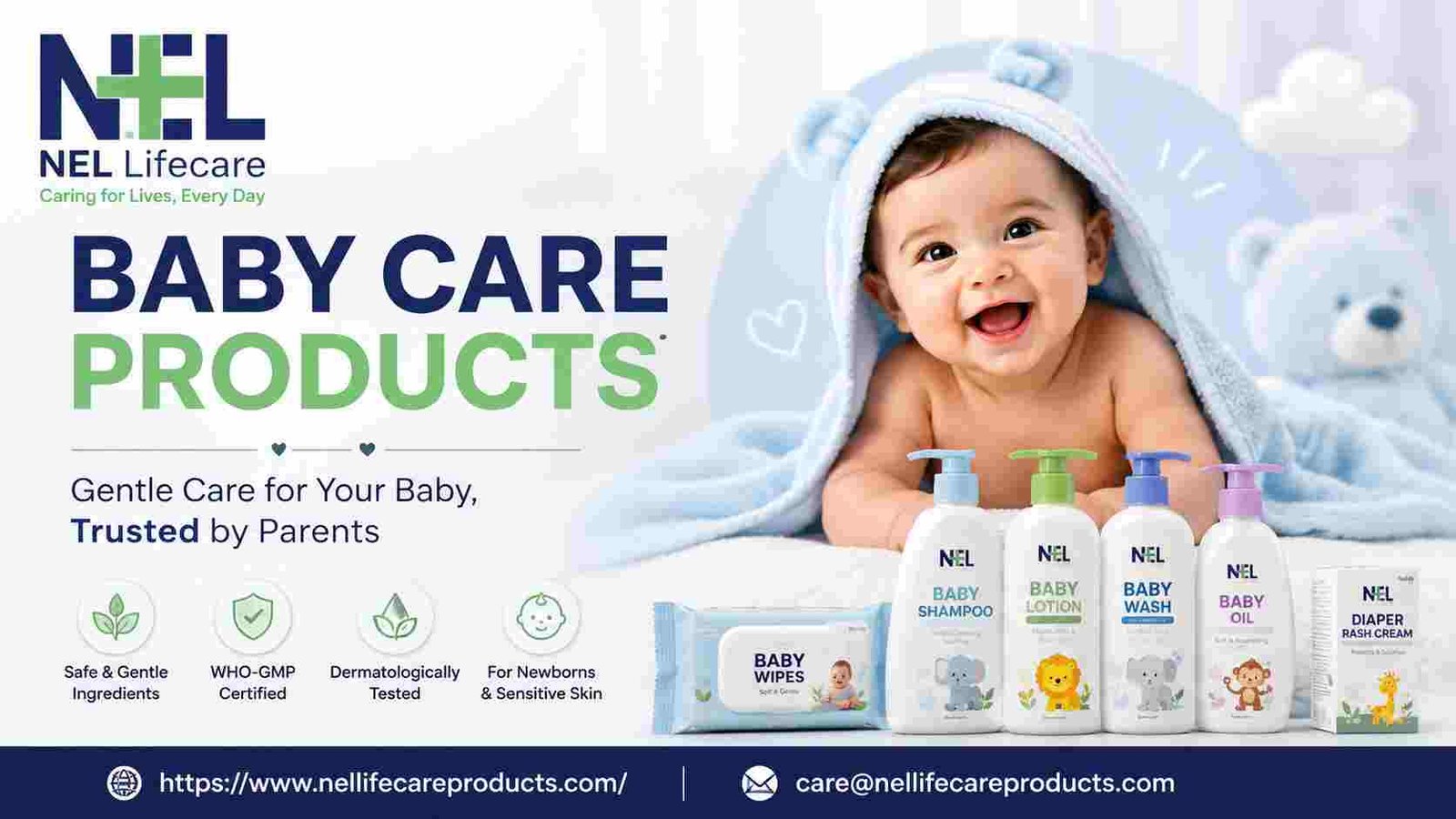
At NEL Lifecare, we cater to institutional purchasers, suppliers, retail stores, online marketplace sellers and private-label organizations in need of reliable production of personal care and baby care items.
We discuss features and specifications of the products, packaging, certifications and OEM requirements before launching the production.
Certificate of the World Health Organization proves that we are certified manufacturers, this fact must be reflected in the buyers’ documents, not merely used for marketing purposes.
However, this is something professionals realize very early that the formula itself is not everything. There are numerous complaints about the same formula if its pump, cap, substratum of wipes or film differs.
We see these elements as part of a product rather than as something we can leave to be decided upon later.
Send Us the Details Needed for an Accurate Quote
At NEL Lifecare, we cater to institutional purchasers, suppliers, retail stores, online marketplace sellers and private-label organizations in need of reliable production of personal care and baby care items.
We discuss features and specifications of the products, packaging, certifications and OEM requirements before launching the production.
Certificate of the World Health Organization proves that we are certified manufacturers, this fact must be reflected in the buyers’ documents, not merely used for marketing purposes.
However, this is something professionals realize very early that the formula itself is not everything. There are numerous complaints about the same formula if its pump, cap, substratum of wipes or film differs.
We see these elements as part of a product rather than as something we can leave to be decided upon later.
Choose Baby Care Products With Evidence, Not Claims
Safe Baby Care Products begin with controlled materials, defined tolerances and records that remain traceable after dispatch. A low quotation cannot compensate for weak testing or an undocumented formula change. Buyers who establish specifications before negotiating price are better positioned to build a dependable range as demand grows.
FAQs
1. What should buyers check before ordering Baby Care Products?
Check the complete ingredient or material specification, applicable standards, batch traceability, microbiological limits, packaging compatibility and complaint policy. For newborn products, WHO recognises the first 28 days as a particularly critical care period.
2. How do Baby Care Products Manufacturers test product safety?
Testing depends on the category. It may include microbiological examination, stability, pH, skin compatibility, absorbency, rewet, packaging integrity and raw-material verification. One test report cannot cover every product or future formulation change.
3. Can Baby Care Products Manufacturers in India provide private labelling?
Many Baby Care Products Manufacturers in India support OEM or private-label production, but capabilities vary. Some handle only manufacturing, while others assist with formulation, printed packaging and documentation. Confirm the precise scope before paying development charges.
4. What information do Baby Care Products Suppliers need for a quotation?
Baby Care Products Suppliers normally require the product type, composition, pack size, order quantity, target price, destination market and branding requirements. Without these details, the first quotation is usually an estimate rather than a production-ready offer.
5. Are Baby Care Products Suppliers in India suitable for export orders?
Experienced Baby Care Products Suppliers in India can support export documentation and private branding. The caveat is that export experience must be verified through documentation, packaging knowledge and destination-specific compliance—not photographs of containers.
Tags : Baby Care Products