Buying an Air Conditioner in Europe: Daikin, Mitsubishi or Climate King?
By Climate King BV Shop 23-09-2026 5
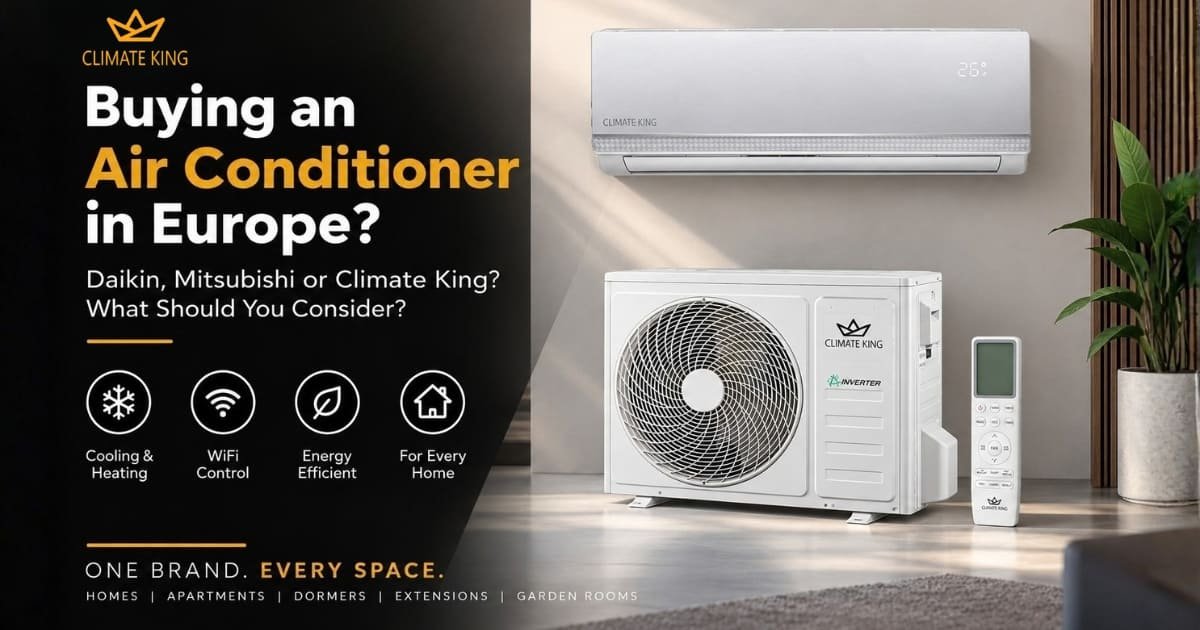
Buying an air conditioner in Europe is no longer simply about choosing a unit that can cool a room. Modern systems can also heat your home, offer WiFi control and provide different installation options depending on the property.
So, should you buy Daikin, Mitsubishi or Climate King?
The better question is: which air-conditioning system fits your home, your installation situation and the way you plan to use it?
In this guide, we look at the most important things to consider when buying an air conditioner in Europe, from cooling capacity and energy efficiency to noise, refrigerants and installation. We also look at where Climate King can be a particularly practical option for homeowners and professional buyers.
What Should You Consider Before Buying an Air Conditioner?
Before comparing brands, start with the requirements of your property. The most important factors are:
• Cooling capacity: Is the system correctly sized for the room?
• Heating: Do you want the air conditioner to provide heat as well as cooling?
• Energy efficiency: Compare the energy label, SEER and SCOP.
• Noise: Especially important for bedrooms and home offices.
• WiFi: Do you want to control the system from your phone?
• Installation: Can a conventional outdoor unit be installed?
• Refrigerant: Which refrigerant does the system use?
• Future regulations: Does the system fit the changing European refrigerant market?
Room size is only one part of the calculation. Insulation, windows, solar exposure, ceiling height and how the room is used can all influence the required capacity.
How Many kW Do You Need?
One of the most common questions when buying an air conditioner is: “What size air conditioner do I need?”
There is no reliable answer based only on square metres. A well-insulated bedroom with limited sunlight can have very different requirements from a large room with extensive glazing and high solar gain.
Climate King currently offers three main Single Split wall models:
- CK-25 — 2.6 kW cooling / 2.61 kW heating
- CK-35 — 3.5 kW cooling / 3.52 kW heating
- CK-50 — 5.1 kW cooling / 5.1 kW heating
The current range is designed for both cooling and heating and includes WiFi control.
The important point is to choose the capacity according to the actual building and room conditions rather than simply buying the largest model available.
Do You Want Cooling or Heating Too?
Modern air conditioners can also work as air-to-air heat pumps. This means the same system can provide cooling during warm weather and heating when temperatures drop.
When comparing an air conditioner with heating, look at both cooling and heating capacity, as well as SEER and SCOP.
Climate King's Single Split range is designed for cooling and heating, while the AirDeck Pro also combines both functions for suitable flat-roof applications.
For households looking for year-round use, this can make an air conditioner more than a summer-only appliance.
Single Split, Multi-Split, Monoblock or Mobile AC?
Different homes need different types of air conditioning.
Single Split: A common solution for one main room, with an indoor and outdoor unit.
Multi-Split: One outdoor unit can serve multiple indoor units, making it useful when several rooms need independent climate control.
Wall Monoblock: A different concept that does not use the conventional separate outdoor condenser of a split system.
Mobile AC: A flexible option where permanent installation is not practical.
Climate King offers several of these concepts, including Single Split, AirDeck Pro, Wall Monoblock and Mobile AC. This means the choice can be based on the property and installation situation rather than forcing every application into the same system type.
What If You Have a Flat Roof or Dormer?
This is where installation becomes especially important.
A conventional split air conditioner normally requires a suitable location for an outdoor unit. But homes with flat roofs, dormers, attics, extensions and roof extensions can have different requirements.
Climate King's AirDeck Pro air conditioner was developed specifically for flat-roof and dormer applications. The external part of the system is positioned on the roof while the indoor panel provides cooling and heating inside the property.
The current AirDeck Pro Type II specifications list 3.6 kW nominal cooling capacity, 3.4 kW nominal heating capacity, a stated suitability of up to 35 m² / 87.5 m³ under the manufacturer's specifications and built-in WiFi.
For homeowners searching for a flat roof air conditioner or an air conditioner for a dormer, this installation concept can be particularly relevant.
Internal link suggestion: use the anchor “flat roof air conditioner” to link to the Climate King AirDeck Pro page.
Can You Have an Air Conditioner Without a Conventional Outdoor Unit?
Yes. A conventional split system is not the only approach.
A wall-mounted monoblock combines the main components into one system and does not use the conventional separate outdoor condenser associated with a split system.
Climate King's CK-WT-2650W Wall Monoblock provides approximately 2.65 kW of cooling and 2.60 kW of heating and uses R290 refrigerant. It is intended for situations where a conventional outdoor unit cannot or should not be installed.
This can be relevant for apartments, properties with installation restrictions or homeowners who prefer not to have a conventional outdoor unit on the exterior.
Internal link suggestion: use the anchor “air conditioner without a conventional outdoor unit” to link to the Climate King Wall Monoblock page.
Daikin, Mitsubishi or Climate King?
Daikin and Mitsubishi have extensive European air-conditioning portfolios covering conventional wall-mounted systems and other formats.
Daikin offers residential ranges such as Sensira, Comfora and Perfera, alongside design-focused and other specialist systems. Depending on the model, features can include heating, cooling, smart control, air treatment and high energy-efficiency ratings.
“Mitsubishi” also covers two separate companies commonly encountered by consumers: Mitsubishi Electric and Mitsubishi Heavy Industries. Both offer residential air-conditioning systems, including wall-mounted and other installation formats.
Climate King's approach is somewhat different. Alongside conventional Single Split systems, its range includes the AirDeck Pro for flat roofs and dormers, Wall Monoblock systems and Mobile AC.
This means the useful question is not simply “Which brand is best?” It is “Which system fits my property and installation requirements?”
How Important Is Energy Efficiency?
Energy efficiency should be part of any air conditioner comparison.
SEER measures seasonal cooling efficiency, while SCOP measures seasonal heating efficiency. The energy label also provides useful information for comparing systems.
Climate King's current Single Split range is specified with A++ cooling and A+++ heating, with stated SEER 6.10 and SCOP 5.10 for the listed models.
Daikin and Mitsubishi also offer highly efficient systems, including models with high energy-efficiency ratings.
Compare the exact model rather than assuming that one brand is always more efficient than another. Actual energy use also depends on climate, room insulation, temperature settings and operating hours.
How Quiet Should an Air Conditioner Be?
Noise matters, especially when an air conditioner is installed in a bedroom, children's room or home office.
Look at the manufacturer's dB(A) specifications and check whether the figure refers to minimum or maximum operation. Indoor and outdoor noise should also be considered separately.
Climate King's AirDeck Pro Type II lists indoor sound pressure from 43 dB(A), with the manufacturer's specified range reaching 54 dB(A).
For any brand, compare the specific model and installation situation rather than relying on general statements that one brand is always quieter.
R32 or R290: What Should European Buyers Know?
Refrigerant is becoming an increasingly important consideration when buying an air conditioner in Europe.
R32 has a GWP100 of 675 and is classified as A2L. R290, propane, has a GWP100 of 0.02 under current EU regulatory values and is classified as A3.
Climate King's current Single Split and AirDeck Pro Type II systems use R32, while the CK-WT-2650W Wall Monoblock uses R290.
R290 has a much lower global-warming potential, but it also has a different safety classification. Refrigerant choice therefore involves environmental impact, equipment design, safety requirements and applicable regulations.
The European F-gas Regulation is also introducing tighter restrictions on certain air-conditioning equipment and refrigerants, so buyers should consider the longer-term regulatory direction as well as today's specifications.
Can You Control an Air Conditioner With WiFi?
WiFi control is now an important feature for many buyers.
Depending on the system, smartphone control can allow you to:
• Change the temperature remotely
• Switch cooling or heating on and off
• Set schedules
• Manage the system when you are away from home
Climate King's current Single Split and AirDeck Pro systems include WiFi functionality according to their product information. Daikin and Mitsubishi also provide smart-control options on selected systems.
Always check the exact model to see whether WiFi is included as standard or offered as an option.
Does the Installer Matter?
Yes. Even a good air conditioner needs to be correctly sized and installed.
Installation quality can affect:
• Performance
• Noise and vibration
• Condensate drainage
• Electrical safety
• Refrigerant work
• Long-term reliability
Country-specific requirements also apply, particularly where refrigerants and electrical installation are involved.
For this reason, compare not only the air conditioner but also the installer, warranty conditions, technical support and availability of spare parts.
Where Can You Buy Climate King?
Climate King uses separate channels for consumers and professional customers.
For homeowners and private customers, Climate King's consumer webshop is:
shop.climateking.eu
The webshop is intended for people buying air-conditioning products for their own home or other private applications.
For installers, HVAC companies, resellers, partners, project buyers and other professional customers, the B2B channel is:
climateking.eu
The Climate King B2B website provides professional product information, technical resources, installation materials and partner information. Business customers can also register through the B2B site.
This separation makes it easier to choose the correct buying channel depending on whether you are purchasing for your own property or buying professionally.
Which Climate King Air Conditioner Fits Your Situation?
The simplest way to narrow down the Climate King range is to start with the installation situation:
Standard bedroom or living room → Single Split
Flat roof or dormer → AirDeck Pro
No conventional outdoor unit wanted → Wall Monoblock
Flexible or temporary use → Mobile AC
Several rooms → Consider an appropriate multi-room solution
The correct choice still depends on the property, required capacity and installation conditions.
Conclusion
When buying an air conditioner in Europe, the brand is only one part of the decision.
Start with your property and ask what you actually need: cooling, heating or both? How much capacity is required? Where can the system be installed? Do you need WiFi? How important are energy efficiency and noise? Which refrigerant does the system use? And what will the European regulatory environment look like over the life of the equipment?
Daikin and Mitsubishi offer extensive European product ranges, while Climate King combines conventional Single Split systems with more specialised solutions such as the AirDeck Pro for flat roofs and dormers and the Wall Monoblock for applications where a conventional outdoor unit is not preferred.
For home buyers, explore the Climate King range at shop.climateking.eu.
For installers, resellers, HVAC partners and other professional customers, visit climateking.eu.
Quick Climate King Selection Guide