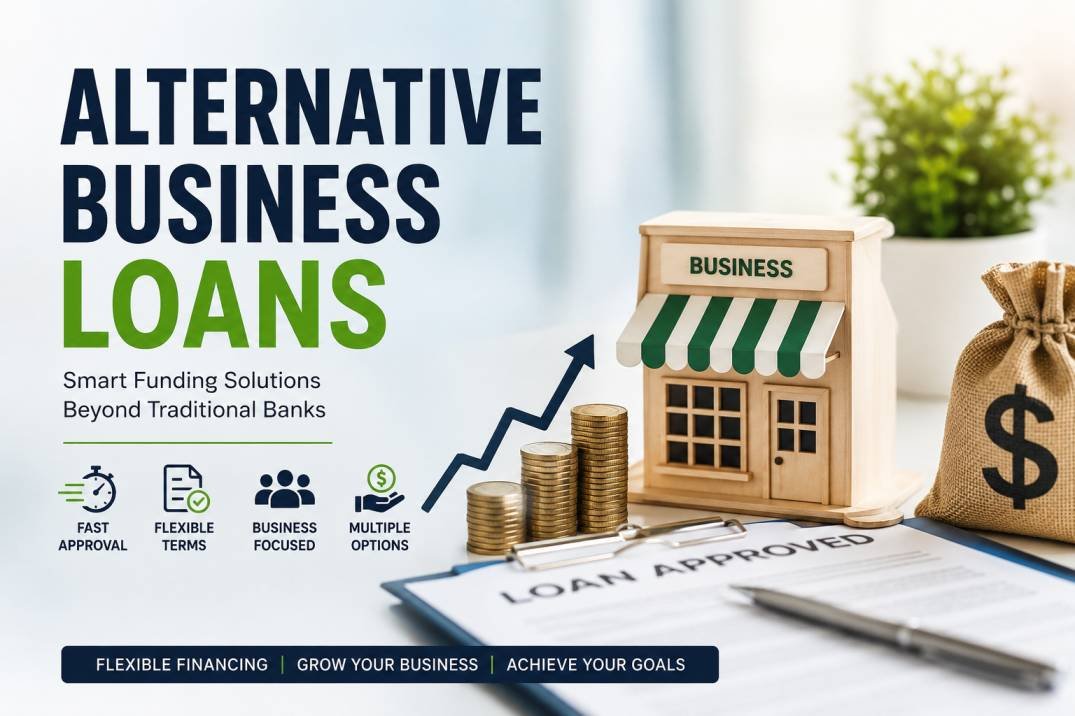
Small businesses often need additional capital to manage cash flow, purchase equipment, expand operations, hire employees, invest in marketing, or handle unexpected expenses. While a traditional business loan can be useful, it is not always the best financing solution. Strict eligibility requirements, lengthy approval processes, collateral requirements, and fixed repayment schedules can make conventional borrowing challenging for some businesses.
This is where business loan alternatives can provide greater flexibility. Depending on the business's financial position, funding requirements, and repayment capacity, alternatives such as business lines of credit, invoice financing, equipment financing, merchant cash advances, and crowdfunding may offer practical ways to access capital.
Understanding different business loan alternatives can help small business owners make informed financing decisions while avoiding unnecessary borrowing costs.
What Are Business Loan Alternatives?
Business loan alternatives are financing methods that provide businesses with capital without relying exclusively on a conventional term loan from a bank or financial institution.
Traditional business loans generally provide a predetermined amount that is repaid over a fixed period, often with scheduled monthly payments. Alternative financing can work differently. Some options provide access to funds only when required, while others are linked to invoices, sales, equipment purchases, or future revenue.
The right option depends on several factors, including:
- Amount of funding required
- Purpose of the funds
- Business revenue
- Cash-flow stability
- Credit profile
- Repayment capacity
- Funding speed
- Whether collateral is available
- Cost of financing
- Length of the financing requirement
For a small business, selecting appropriate business loan alternatives can be particularly important because cash flow can fluctuate significantly.
Why Consider Business Loan Alternatives?
A traditional business loan may not suit every business. Startups and small businesses can face difficulties meeting conventional lending requirements, particularly when they have limited credit history or inconsistent revenue.
Business loan alternatives may offer several advantages.
Flexible Funding
Some financing options allow businesses to draw funds only when necessary. This can prevent a company from borrowing more money than it actually needs.
Faster Access to Capital
Certain alternative financing products may have simpler application processes than conventional bank loans. Businesses facing urgent working-capital requirements may therefore find them useful.
Financing Based on Business Assets
Invoice financing and equipment financing can use specific business assets or receivables as the basis for funding rather than relying solely on the owner's overall credit profile.
Different Repayment Structures
Alternative financing can offer repayment structures connected to invoices, sales, or specific assets instead of a standard fixed monthly loan payment.
Access for Businesses With Limited Credit History
Some alternative financing providers may evaluate business performance, revenue, invoices, or assets alongside traditional credit information.
However, convenience and accessibility can sometimes come with higher financing costs, so business owners should carefully compare the total cost before choosing an option.
5 Smart Business Loan Alternatives for Small Businesses
1. Business Line of Credit
A business line of credit is one of the most flexible business loan alternatives available to small businesses.
Instead of receiving one large lump sum, a business receives access to a predetermined credit limit. The company can draw funds when needed and generally pays financing costs based on the amount used rather than the entire available limit.
For example, a business could have access to a credit limit of ₹500,000 but use only ₹150,000 to manage a temporary cash-flow shortage.
How a Business Line of Credit Works
A typical process involves:
- The lender approves a maximum credit limit.
- The business accesses funds when required.
- The business pays financing costs according to the applicable agreement.
- As borrowed funds are repaid, available credit may become available again.
- The business can continue using the facility during the approved period, subject to its terms.
Advantages
- Flexible access to working capital
- Useful for short-term expenses
- Can help manage cash-flow fluctuations
- Business pays for the amount used rather than necessarily taking the entire limit
- May be suitable for recurring financing needs
Disadvantages
- Interest or fees can vary depending on the product
- Credit limits may be lower for newer businesses
- Some facilities may include maintenance or transaction fees
- The lender may periodically review the business's financial position
Best For
A business line of credit may be suitable for companies that experience recurring short-term cash-flow gaps rather than needing a large one-time investment.
2. Invoice Financing
Invoice financing can be an effective alternative for businesses that sell products or services on credit and regularly have outstanding invoices.
Instead of waiting weeks or months for customers to pay, a business may use eligible invoices to obtain funding sooner.
For example, suppose a company has issued ₹1,000,000 worth of invoices to reliable customers, but payment is not due for 60 days. Depending on the financing arrangement, the business may be able to access a portion of the invoice value before the customer makes payment.
How Invoice Financing Works
The basic process generally involves:
- The business issues an invoice to its customer.
- The invoice is submitted to a financing provider.
- The provider evaluates the invoice and related risks.
- The business receives an advance against the eligible invoice.
- The customer pays the invoice according to the agreed payment terms.
- The remaining amount is settled after applicable fees or charges.
Advantages
- Improves cash flow
- Can reduce the waiting period for customer payments
- Useful for businesses with significant accounts receivable
- Financing is connected to outstanding invoices
- Can support working-capital requirements
Disadvantages
- Financing fees reduce the amount ultimately received
- Not suitable for businesses that operate primarily on immediate payment
- Customer creditworthiness can affect eligibility
- The business should understand whether the arrangement is with or without recourse
Best For
Invoice financing can be particularly useful for B2B businesses that have strong sales but experience delays because customers operate on 30-day, 60-day, or longer payment terms.
3. Equipment Financing
Businesses that need machinery, vehicles, technology, production equipment, or other business assets can consider equipment financing as an alternative to taking a general-purpose business loan.
The financing is specifically designed to fund the purchase or acquisition of equipment.
For example, a manufacturing company requiring a machine worth ₹2,500,000 could explore equipment financing rather than using general working capital for the purchase.
Why Equipment Financing Can Be Useful
Using a general-purpose loan for equipment can tie up funds that could otherwise be used for salaries, inventory, marketing, rent, or daily operating expenses.
Equipment financing separates the equipment purchase from other working-capital requirements.
Advantages
- Designed specifically for equipment purchases
- Can preserve working capital
- Equipment may serve as security depending on the financing structure
- Useful for businesses making significant capital investments
- Helps spread the cost of an asset over time
Disadvantages
- Financing is generally restricted to qualifying equipment
- The business may have obligations even if the equipment becomes obsolete
- Total financing costs should be compared with the asset's expected useful life
- Some agreements may require a down payment or additional security
Best For
Equipment financing is generally more appropriate for businesses purchasing machinery, commercial vehicles, computers, manufacturing systems, or other long-term business assets.
4. Merchant Cash Advance
A merchant cash advance is another form of alternative business financing. Instead of a traditional loan repayment structure, the financing provider provides an upfront amount in exchange for a portion of future business sales or receipts.
This can be particularly relevant for businesses that receive regular card or electronic payments.
For example, a retail business with consistent daily sales may use future revenue as the basis for financing.
How Merchant Cash Advances Work
The business receives an upfront amount and agrees to repay the provider according to the arrangement. Repayment may be structured as a percentage of future sales or through another agreed mechanism.
Because repayment can be linked to sales, the structure may differ significantly from a conventional fixed-payment loan.
Advantages
- Can provide relatively quick access to capital
- May be accessible to businesses with strong sales but less-established credit
- Repayment can be linked to revenue under some structures
- Useful for short-term business requirements
Disadvantages
- Can be significantly more expensive than some traditional financing options
- Frequent repayment can affect cash flow
- Effective financing costs can be difficult to compare if fees are structured differently
- Businesses should carefully examine the contract before accepting funding
Best For
A merchant cash advance may be considered by businesses with consistent sales and a short-term need for capital, but owners should carefully calculate the total repayment amount.
5. Crowdfunding
Crowdfunding provides another alternative to conventional business borrowing. Instead of obtaining funds from one lender, a business can seek contributions from a larger group of individuals or investors through an online platform.
Different crowdfunding models exist, including:
- Reward-based crowdfunding
- Equity crowdfunding
- Donation-based crowdfunding
- Debt crowdfunding
The appropriate model depends on the business, its offering, regulatory requirements, and the platform being used.
How Crowdfunding Works
A typical campaign involves:
- Creating a business or product proposal.
- Establishing a funding target.
- Presenting the idea to potential supporters or investors.
- Promoting the campaign.
- Receiving contributions or investments.
- Delivering the agreed rewards or meeting applicable investor obligations.
Advantages
- Can provide access to a large pool of potential supporters
- Can validate market interest
- Useful for innovative products and new business concepts
- Can support brand awareness
- May reduce dependence on traditional lenders
Disadvantages
- Funding is not guaranteed
- Campaigns require significant marketing effort
- Public disclosure of the business concept may be necessary
- Equity crowdfunding can involve ownership dilution
- Platform fees and legal or regulatory requirements may apply
Best For
Crowdfunding can be suitable for startups, consumer brands, innovative products, creative businesses, and companies with a strong community or customer base.
Comparing the 5 Business Loan Alternatives
How to Choose the Right Business Loan Alternative
Choosing among different business loan alternatives requires more than comparing the amount of money available. Business owners should evaluate the financing against their actual cash-flow requirements.
1. Determine How Much You Need
Avoid borrowing more than necessary. Calculate the exact amount required for inventory, equipment, payroll, expansion, marketing, or another specific business purpose.
2. Identify Why You Need the Money
The purpose of financing should influence the product you choose.
For example:
- Equipment purchase → Equipment financing
- Temporary cash-flow gap → Business line of credit
- Unpaid invoices → Invoice financing
- Immediate short-term funding → Alternative revenue-based financing
- New product launch → Crowdfunding
3. Calculate the Total Cost
Do not compare financing products solely on advertised rates.
Consider:
- Interest
- Fees
- Processing charges
- Origination charges
- Transaction costs
- Prepayment costs
- Other contractual charges
Calculate the total amount the business will actually repay.
4. Evaluate Repayment Requirements
A financing option may appear affordable until the repayment schedule starts affecting everyday cash flow.
Ask:
- How frequently are payments required?
- Are payments fixed or variable?
- Are payments connected to sales?
- What happens if revenue declines?
- Is there a penalty for early repayment?
5. Consider Collateral Requirements
Some forms of financing may require business assets or other security. Others may be unsecured but potentially more expensive.
Understand exactly what assets, guarantees, or obligations are involved before signing an agreement.
6. Review Eligibility Requirements
Different providers may consider:
- Business age
- Annual revenue
- Credit history
- Bank transactions
- Outstanding invoices
- Industry
- Business assets
- Customer payment history
Understanding these requirements can save time and help narrow down appropriate options.
Business Loan Alternatives for Startups
Startups often face greater financing challenges because they may have limited revenue, limited operating history, and little business credit history.
For startups, potential business loan alternatives include crowdfunding, business lines of credit where eligibility permits, equipment financing for asset purchases, and financing supported by strong receivables once sales begin.
Founders should avoid selecting financing solely because it is easy to obtain. The repayment structure should be compatible with the company's expected revenue.
Business Loan Alternatives With Bad Credit
Businesses with weak credit may have fewer financing choices, but that does not necessarily mean they have no options.
Depending on the circumstances, financing providers may evaluate alternative information such as:
- Recent revenue
- Bank account activity
- Customer invoices
- Business assets
- Sales volume
- Cash-flow history
However, financing available to businesses with weaker credit can carry higher costs. Business owners should therefore compare the total repayment obligation carefully and avoid financing arrangements that could create additional financial stress.
Business Loan Alternatives for Working Capital
Working capital is one of the most common reasons small businesses seek external financing.
A company may need short-term funds to pay suppliers before receiving customer payments, maintain inventory, manage seasonal demand, or cover operating expenses.
For these requirements, a business line of credit and invoice financing may be particularly relevant.
The key is to match the financing duration with the cash-flow cycle. Short-term financing should ideally support a short-term need rather than being used to fund a long-term investment.
Business Loan Alternatives for Equipment Purchases
If the main objective is acquiring equipment, using a financing option designed specifically for equipment may make more sense than taking general-purpose financing.
Consider:
- Purchase price
- Expected useful life
- Maintenance costs
- Revenue generated by the equipment
- Financing duration
- Down payment
- Total financing cost
- Resale value
The expected financial benefit from the equipment should justify the overall cost of acquiring and financing it.
Are Business Loan Alternatives Better Than Traditional Business Loans?
There is no universally best financing option.
Traditional business loans can be attractive when a business qualifies for competitive pricing and requires a predictable amount of capital over a defined period.
Alternative financing may be more suitable when a company needs flexibility, faster access to capital, financing against invoices or equipment, or a structure that does not resemble a traditional term loan.
The best approach is to compare multiple options based on the business's financial circumstances rather than automatically choosing the easiest or fastest source of funding.
Advantages and Disadvantages of Business Loan Alternatives
Advantages
Business loan alternatives can provide:
- Greater financing flexibility
- Multiple funding structures
- Faster access in some cases
- Financing based on invoices or assets
- Options for specific business requirements
- Potential access for businesses that may not qualify for traditional financing
Disadvantages
Potential drawbacks include:
- Higher financing costs
- Complex fee structures
- Shorter repayment periods
- Variable repayment obligations
- Collateral or personal guarantees
- Contractual restrictions
- Potential impact on cash flow
For this reason, alternative financing should be evaluated carefully rather than treated as automatically cheaper or easier than a traditional loan.
Common Mistakes to Avoid When Choosing Alternative Financing
Focusing Only on Approval Speed
Fast funding can be useful, but speed should not be the only consideration. A financing product with expensive terms can create a larger financial burden.
Ignoring the Total Cost
Always calculate the total amount payable instead of focusing only on the advertised rate or upfront amount.
Borrowing More Than Necessary
Excess borrowing increases financial obligations and may reduce future cash-flow flexibility.
Choosing the Wrong Repayment Structure
A business with irregular revenue may struggle with frequent fixed payments. The repayment model should match the company's cash-flow pattern.
Not Reading the Agreement
Fees, renewal terms, guarantees, penalties, and other conditions can significantly affect the actual cost of financing.
Frequently Asked Questions About Business Loan Alternatives
What are the best business loan alternatives for small businesses?
Some common alternatives include business lines of credit, invoice financing, equipment financing, merchant cash advances, and crowdfunding. The best option depends on the business's funding purpose, cash flow, eligibility, and financing cost.
Can startups use business loan alternatives?
Yes. Depending on eligibility and the financing structure, startups may consider options such as crowdfunding, equipment financing, or other forms of alternative financing. Startups should carefully assess repayment obligations before accepting funding.
What is the easiest business loan alternative to obtain?
There is no single option that is easiest for every business. Eligibility depends on factors such as revenue, business history, credit profile, invoices, assets, and the financing provider's criteria.
Are business loan alternatives cheaper than traditional loans?
Not necessarily. Some alternatives may offer flexibility or faster access but can have higher overall financing costs. Businesses should compare the total repayment obligation rather than assuming alternative financing is cheaper.
Can I get business financing with poor credit?
Some alternative financing providers may consider business revenue, invoices, assets, or cash-flow history in addition to credit information. However, financing may be more expensive and eligibility requirements can vary.
Is invoice financing a good alternative to a business loan?
Invoice financing can be useful for businesses that regularly issue invoices and wait for customer payments. It can help convert outstanding receivables into working capital without waiting for the normal payment cycle.
Which business loan alternative is best for equipment?
Equipment financing is specifically designed for purchasing business equipment and may be appropriate when a company needs machinery, vehicles, technology, or other qualifying assets.
What should I compare before choosing alternative business financing?
Compare the total cost, repayment structure, funding amount, eligibility requirements, fees, collateral requirements, financing duration, and potential impact on cash flow.
Final Thoughts
The growing range of business loan alternatives gives small businesses more ways to access capital beyond conventional term loans. A business line of credit can provide flexibility, invoice financing can unlock working capital tied up in receivables, equipment financing can support asset purchases, merchant cash advances can provide revenue-based funding, and crowdfunding can connect businesses with customers and investors.
However, alternative financing is not automatically better than a traditional business loan. The right choice depends on the purpose of the funding, the business's financial position, expected cash flow, financing cost, and ability to meet repayment obligations.
Before accepting any financing, calculate the total cost, read the agreement carefully, understand the repayment structure, and consider whether the funding will generate enough business value to justify its cost. A well-matched financing solution can support growth without unnecessarily putting pressure on a small business's cash flow.
Tags : Business Loan Alternatives