Breaking Cellular Limits: A Scientific Guide to understand Immortalized Cells vs Cancer Cells
By Kosheeka Primary Cells for Research 10-04-2026 162
Introduction
In biomedical research, cells isolated from multicellular organisms are transformed into immortalized cells in controlled laboratory environments. Immortalized cells, also known as cell lines, are widely used by researchers and scientists for various studies, such as cancer, cellular or molecular signaling, disease progression, developing diagnostic or prognostic biomarkers, or therapeutics. Often, Immortalized Cells and Cancer Cells are confused by new researchers. Understanding the key difference between Immortalized Cells vs Cancer Cells is crucial for anyone working with animal cell culture models.
What Does It Mean to Immortalize Cells?
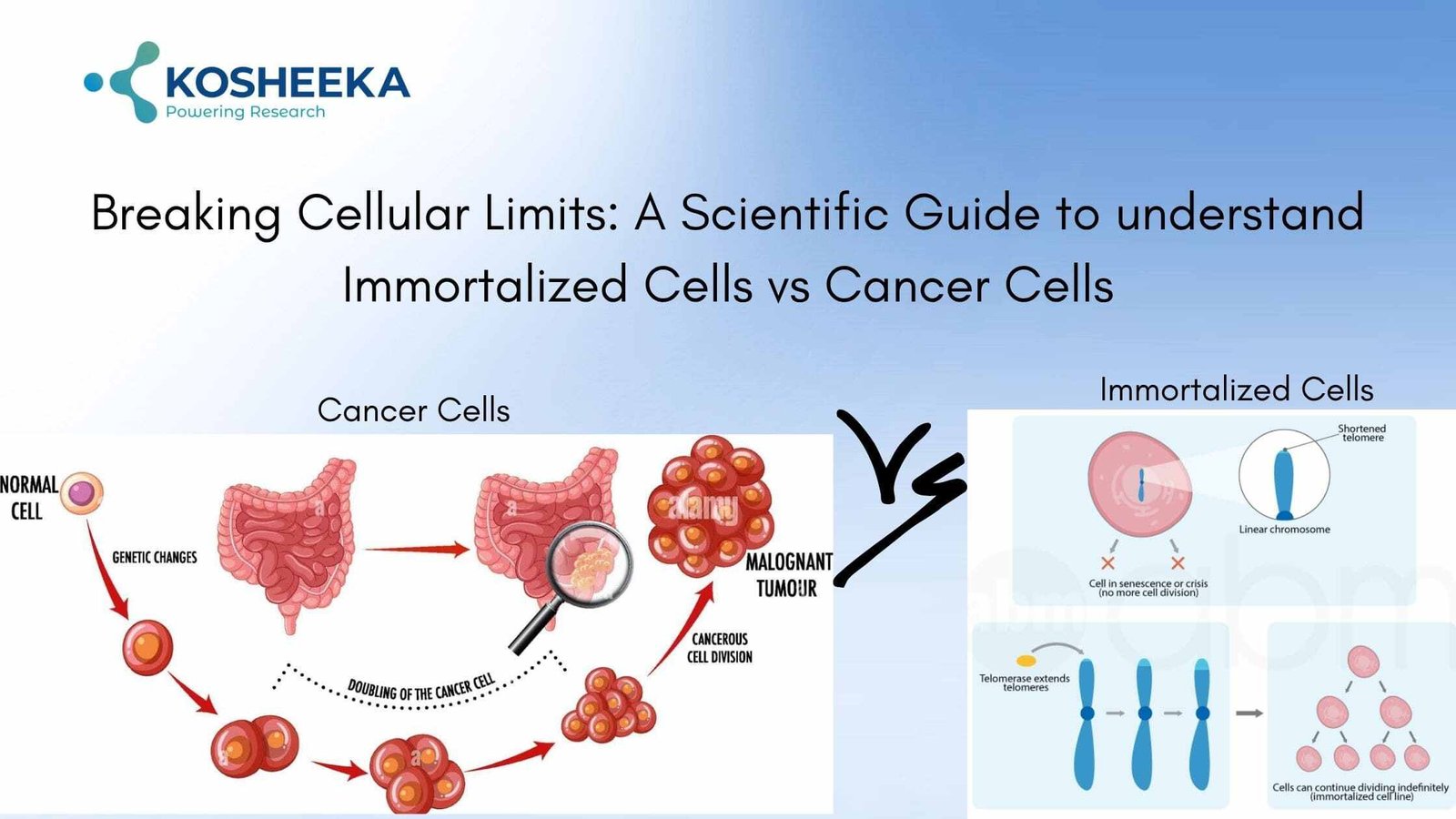
Immortalized cells are transferred primary cells that have bypassed their natural growth limits on replication. In normal condition the cells possess a finite ability for division before entering cellular senescence. This event is significantly controlled by the shortening of telomerase. Thus, the Immortalized Cells Definition can be explained as the cell population from multicellular organisms that skipped normal cellular senescence (Hayflick limit) by extending cellular lifespan. This definitely does not mean that cells have acquired malignant transformation.
The question then arises: what makes immortalized cells preferable over the use of primary cells in in vitro culture?
Why Primary Cells Have Limitations?
Primary cells are isolated directly from the tissue or organ of the multicellular organism. They share physiological relevance and genetic makeup similar to the parent tissue or organ. Primary cells closely follow the in vivo condition, making them a valuable tool for normal cellular processes. However, the use of primary cells is subjected to various challenges. This includes a finite lifespan (limited passage no), variability in cells depending on the donor, a result reproducibility challenge and difficulty in conducting long-term or large-scale experiments. To overcome such challenges, primary immortalized cells or Immortalized Primary Cells are transformed.
How Scientists Immortalize Primary Cells?
Transforming primary cells into immortalized cells involves several strategies. This includes:
- Introduction of viral genes, such as SV40 large T antigen or HPV E6/E7. This disrupts key regulatory checkpoint proteins in cells, such as p53 and Rb. These are checkpoint proteins that prevent uncontrolled cell division.
- Induced expression of telomerase, such as the hTERT enzyme. This enables maintaining of telomere length, thus cells can continue dividing without triggering senescence. However, cells do not transform into a cancerous nature. In rare cases, cells might undergo spontaneous immortalization.
The choice of cell immortalization technique depends on the research objective and cell type. For example, telomerase-based immortalization is preferred when cells are desired to maintain a normal phenotype.

What are the Characteristics of Immortalized Cells?
The characteristics of immortalized cells include:
- Longer lifespan, undergoes various passages (up to 21-50 passages) depending on cell types, and culture conditions
- Alteration in culture conditions might lead to reduced differentiation ability in some cells, or genetic or phenotypic alteration
- Exhibits increased cloning efficacy, or faster doubling time
- Lower immunogenicity
- Suitable for large-scale preliminary studies or longer-duration experimental planning
- Cost-effective, less complexity in maintaining culture
Immortalized Cells vs Cancer Cells: Key Differences
| Features | Immortalized Cells | Cancer Cells |
| Origin | Primary cells modified in laboratory condition | Naturally shows abnormal growth |
| Growth Characteristics | Maintains contact inhibition | Lose contact inhibition |
| Genomic stability | Maintains stable karyotype | Characterized by high genomic instability |
| Tumourigenicity | Does not have tumour forming ability if injected in animal | Posses tumour forming ability |
| Research use | Suitable for control sample | Cancer cells suitable for tumour related research |
| Example | HEK-293, hTERT | MCF-7, MDA-MB 231, HeLa, PANC-1 |
Thus, it is inferred that immortalization is a tool used in research, whereas cancer is a disease state.
Why Does Confusion Exist?
The confusion often arises because both immortalized and cancer cells bypass senescence. They might share similar molecular pathways, such as telomerase activation or disruption of cell cycle checkpoints. However, bypassing senescence isn’t enough to claim cells as cancerous. Full transformation into a cancer cell typically requires multiple genetic alterations that go beyond simple immortalization. This is why careful characterization of cell lines is essential in research.
Applications of Immortalized Cells in Research
There are wide range of applications associated with Immortalized Cells or cell lines, including:
- Research associated with drug discovery, toxicology studies
- Research on cellular or molecular mechanisms
- Experimental reproducibility
- Vaccine production and other biomolecule production
Limitations and Considerations
The key limitations include:
- Possible drift from the original phenotype
- Genetic changes possible can accumulate to result in efficacy
- Some immortalization methods involve genetic modification
- Results need to be tested, potentially on an animal model
Conclusion
Understanding the difference between immortalized and cancer cells is fundamental in biomedical research applications. Although both cells can divide uncontrolled, their behavior, characteristics, purpose, and biological implications are distinct. Immortalized cells act as a powerful research tool, offering consistency and longevity without the complexities of cancer.
By using the right cellular model and recognizing its limitations, researchers can generate more accurate and meaningful results—ultimately advancing our understanding of biology and disease.