Blog Content Writing That Actually Ranks: A No-Fluff Guide for 2026
By Nusrat Jahan Mim 14-06-2026 145
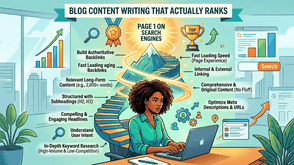
I want to be honest with you most blog content being written right now is not ranking. Not because the writers are bad, but because they're stuck following advice that made sense five years ago.
Here's the real problem: people sit down, type out 1,000 words, throw in a few keywords, hit publish and then wonder why Google completely ignores them. I've been there. And I've watched dozens of website owners make the exact same mistake.
What changed the game for me was understanding that blog content writing in 2026 is not about gaming the algorithm. It's about writing something so genuinely useful that Google has no choice but to surface it. That's what this guide is about practical, honest strategies for creating quality content writing that earns rankings, not just chases them.
Why Most Blog Posts Fail Before They Even Publish
Let me give you a scenario. You search for "how to grow tomatoes at home." You land on a page that repeats the phrase "grow tomatoes at home" 17 times, gives you five vague bullet points, and ends with "contact us for more info." You immediately hit the back button.
Google noticed that. It notices everything.
Google's Helpful Content System is specifically designed to identify content written primarily for search engines rather than people. If your blog feels hollow if it lacks real specifics, lived experience, or actual answers it gets flagged, quietly deprioritised, and eventually buried.
The fix is not a formula. It's a mindset shift. You need to write like someone who genuinely knows and cares about the topic, talking to someone who genuinely needs help with it.
How to Approach Blog Content Writing the Right Way
Start With Search Intent, Not Just Keywords
Before you write a single word, ask yourself: what does this person actually want when they search for this?
A search for "blog content writing" could mean someone wants to learn how to write blogs themselves, hire a content writer, or understand what makes blogs rank. Each of those needs a completely different article.
Getting this wrong is one of the most common reasons good writers produce content that never ranks. You can write beautifully and still miss the mark entirely if you're answering the wrong question.
I recommend pulling up the top three results for your target keyword and scanning what they cover. Not to copy them to understand what Google already believes satisfies this search. Then figure out where you can add something they missed.
Build Topical Depth, Not Just Length
Word count is not a ranking signal. Depth is.
A 900-word article that fully answers a specific question will outperform a 2,500-word piece that rambles. The goal is to cover the topic completely enough that the reader does not need to go anywhere else. In SEO circles, this is sometimes called "satisfying the search."
Practically speaking, this means:
Think about the follow-up questions your reader would naturally have. If someone is learning about blog content writing, they probably also want to know about headlines, structure, and how to avoid common mistakes. Weaving those answers naturally into your article creates topical depth without forcing word count.
The Anatomy of SEO Friendly Content Writing
Headlines That Earn the Click
Your H1 title has two jobs: tell Google what the page is about, and convince a human to actually click it. Most titles fail at the second part.
Specificity wins. "10 Blog Writing Tips" is forgettable. "Why Your Blog Posts Aren't Ranking (And What to Fix First)" makes someone think "that's me" and click.
Your subheadings work the same way. H2s and H3s are not just for SEO they're navigation tools. A reader should be able to skim your headings and understand the full story of your article without reading a single word of the body text.
The First 100 Words Are Everything
Most readers decide whether to stay or leave within the first few seconds. Your introduction needs to do three things fast:
Acknowledge the exact problem or question that brought them there. Show them you understand their situation. Tell them clearly what they're going to learn.
Skip the preamble. Nobody needs to know that "in today's digital world, content is more important than ever." Get to the point. Earn their attention before you ask for their time.
Paragraph Structure and Readability
Online readers scan before they read. Short paragraphs two to four sentences at most feel less intimidating and easier to consume. Long dense blocks of text signal effort to the reader's brain before they've even started, and many people simply won't bother.
Use plain language. If you can say it in simpler words, do that. Jargon creates distance between you and your reader, and distance is the enemy of trust.
Quality Content Writing Means Proving You Know Your Stuff
Google's E-E-A-T framework which stands for Experience, Expertise, Authoritativeness, and Trustworthiness is not just a checklist. It's a lens Google uses to evaluate whether content comes from someone who genuinely understands the topic.
What does that look like in practice?
It means citing specific data instead of vague generalisations. It means sharing what actually worked in your experience, not just repeating what everyone else says. It means being honest when something is complicated or situational, rather than giving false certainty.
For example, instead of writing "use keywords naturally in your content," you might write: "I aim to include my primary keyword in the first 100 words, once in an H2, and a few times in the body but only where it reads naturally. If I have to force it, I leave it out."
That specificity is what separates quality content writing from generic filler.
Common Mistakes That Kill Blog Rankings
Writing for the Crawler Instead of the Reader
Keyword stuffing is obvious and damaging. But there's a subtler version that many writers fall into writing with one eye constantly on the keyword rather than on the reader's actual experience. The result is content that feels mechanical, robotic, and strangely cold.
Write for the reader first. The keyword will appear naturally because you're covering the topic properly.
Ignoring the Introduction and Conclusion
Many writers put all their energy into the middle sections and treat the intro and outro as afterthoughts. Both are critical. The intro keeps people on the page. The conclusion tells them what to do next, which signals engagement to Google.
Publishing and Abandoning
One of the most underrated SEO strategies is updating existing content. A well-ranked article from two years ago that starts slipping can often be restored with a thorough refresh updated stats, new sections, improved structure. Blog content writing is not a one-and-done task for your best pieces.
A Simple Framework to Follow Every Time
When I sit down to write a blog post, I follow a consistent process:
I start by identifying the primary search intent what does the reader actually want? Then I map out the key questions I need to answer to fully satisfy that intent. I write the introduction last, after I know what the article covers. I read the draft out loud to catch awkward phrasing. And I always ask before publishing: "Would I find this genuinely useful if I searched for this topic?"
That last question cuts through a lot of noise.
Final Thoughts
Blog content writing has never been more competitive but it's also never been more rewarding when done well. The writers and businesses that invest in genuinely helpful, well-structured, experience-driven content are the ones building lasting search visibility.
You don't need a hundred tricks. You need clarity on who you're writing for, depth on the topic you're covering, and the discipline to keep improving what you publish.
If you're ready to go deeper, start with a content audit of your existing posts look at which ones are ranking and why, and which ones need attention. That's usually where the fastest wins are hiding.
And if you want to understand how keyword research shapes everything we've discussed here, that's the logical next step it's the foundation every strong blog content strategy is built on.
Tags : Content Writing









