Automatic Boom Barrier for Parking: Features, Applications & Buying Guide
By sunilkumar housysgroup 30-09-2026 32
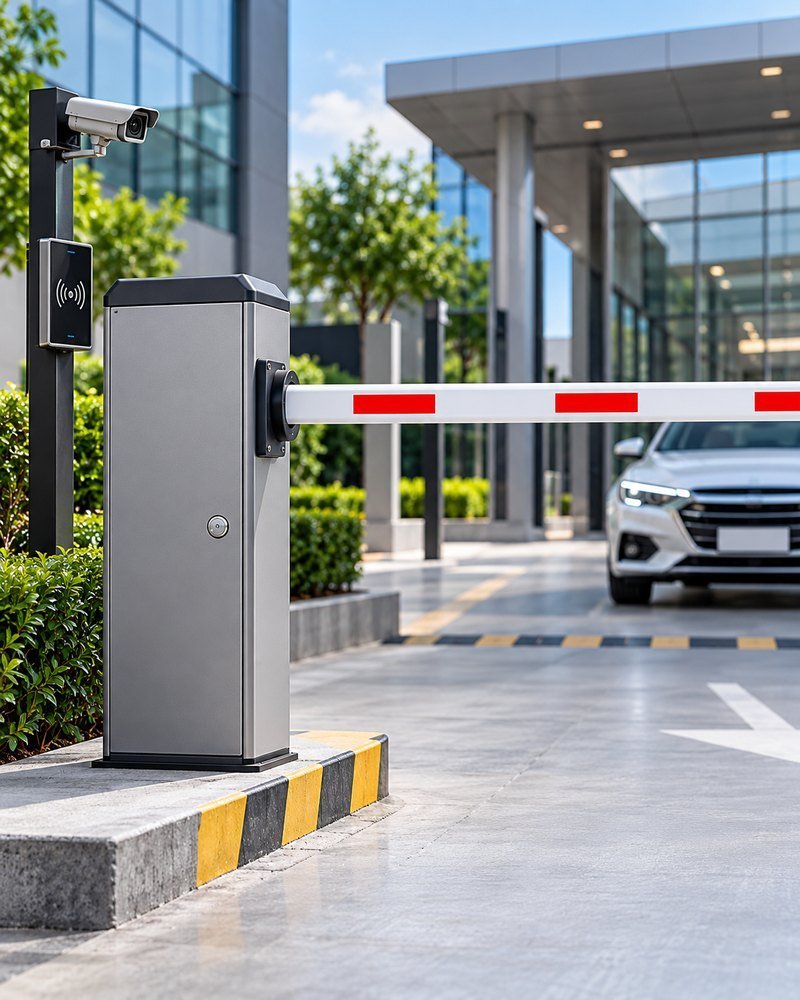
Managing vehicle movement at parking entrances, corporate premises, residential societies, factories, warehouses, and commercial properties requires a controlled and organized access system. An automatic boom barrier can help regulate vehicle entry and exit while working with identification and access-control technologies.
Modern boom barrier systems can be integrated with RFID, ANPR cameras, parking management systems, loop detectors, ticketing systems, and other access-control technologies. This makes them suitable for facilities where vehicle movement needs to be monitored and managed efficiently.
What Is an Automatic Boom Barrier?
An automatic boom barrier is a motorized vehicle access-control system that uses a horizontal barrier arm to control the movement of vehicles through an entrance or exit lane.
When an authorized vehicle is identified, the system receives an opening command and raises the barrier arm. After the vehicle passes and the lane is confirmed clear, the barrier can close according to the configured operating sequence.
Automatic boom barriers are commonly used where controlled vehicle access is required without manually operating a gate for every vehicle.
How Does an Automatic Boom Barrier Work?
A typical automated vehicle access process includes the following steps:
1. Vehicle Approaches the Entrance
A vehicle arrives at the designated entry lane and reaches the access-control point.
2. Vehicle Identification
The vehicle can be identified using RFID cards or tags, ANPR cameras, parking tickets, QR codes, access cards, or another configured authentication method.
3. Authorization
The connected access-control or parking management system verifies whether the vehicle is authorized to enter.
4. Barrier Opens
Once authorization is confirmed, the motorized boom arm raises to allow the vehicle to pass.
5. Vehicle Detection
Loop detectors, sensors, cameras, or other vehicle-detection technologies can help determine the vehicle's position.
6. Barrier Closes
After the vehicle passes and the lane is clear, the boom arm returns to its closed position according to the configured system logic.
This automated sequence helps create an organized vehicle entry and exit process.
Key Features of Automatic Boom Barriers
The exact features depend on the selected model and project requirements, but important considerations can include:
- Automatic motorized operation
- Different boom arm lengths
- Fast opening and closing operation
- RFID integration
- ANPR camera integration
- Parking management integration
- Loop detector support
- Safety sensor integration
- Manual or emergency release
- Access-control integration
- Remote control options
- Vehicle detection
- Suitable configurations for indoor and outdoor installations
- Installation and technical support
For high-traffic locations, buyers should consider operating cycle, opening speed, traffic volume, and maintenance requirements before selecting a system.
Boom Barrier and RFID Integration
RFID-based vehicle identification can be used to automate access for authorized vehicles.
An RFID tag can be assigned to a vehicle or user. When the vehicle approaches the designated access point, the RFID reader can identify the tag and communicate with the access-control system.
If the vehicle is authorized, the system can trigger the boom barrier to open.
This type of integration can be useful for:
- Corporate parking
- Residential societies
- Employee parking
- Industrial facilities
- Institutional campuses
- Restricted vehicle areas
Boom Barrier and ANPR Integration
Automatic Number Plate Recognition (ANPR) cameras can identify vehicle registration numbers and send the information to a connected access-control or parking system.
A boom barrier can be integrated with ANPR to support automated vehicle access based on configured authorization rules.
A typical process can include:
Vehicle → ANPR Camera → Number Plate Recognition → Access Verification → Boom Barrier → Entry
This can be particularly useful where organizations want to manage vehicle access without depending entirely on physical access cards or RFID tags.
Boom Barrier for Parking Management
Parking facilities often require more than simply opening and closing a gate.
An integrated parking management system can connect the boom barrier with vehicle identification, ticketing, payment, occupancy information, entry and exit records, and reporting functions.
For example, a parking facility may use:
Entry Boom Barrier + RFID/ANPR + Parking Management System + Exit Boom Barrier
This creates a coordinated vehicle-access process and can provide facility operators with better visibility into vehicle movement.
Where Are Automatic Boom Barriers Used?
Automatic boom barriers can be deployed across a wide range of locations.
Corporate Offices
Used to regulate employee, visitor, and authorized vehicle access.
Residential Societies
Can help manage resident and visitor vehicle entry at gated communities.
Industrial Facilities
Useful for controlling vehicle movement at factories, warehouses, and industrial premises.
Commercial Buildings
Shopping centers, hotels, hospitals, and office complexes can use boom barriers to organize parking and vehicle access.
Educational Institutions
Schools, colleges, universities, and campuses can use controlled vehicle entry systems.
Airports and Transportation Facilities
Boom barriers can be integrated into designated parking and controlled vehicle access areas.
Government and Institutional Premises
They can be used at entrances where controlled vehicle movement is required.
Safety Features to Consider
Safety should be an important consideration when selecting an automatic boom barrier.
Depending on the system configuration, safety technologies can include:
- Vehicle detection sensors
- Loop detectors
- Photocells
- Obstacle detection
- Emergency/manual release
- Automatic closing control
- Warning indicators
The actual safety configuration should be selected according to the site layout, traffic pattern, installation environment, and applicable requirements.
Automatic Boom Barrier vs Manual Barrier
Automatic and manual barriers serve different operational requirements.
Automatic Boom Barrier | Manual Barrier |
Motorized operation | Manually operated |
Can integrate with RFID and ANPR | Usually requires manual control |
Suitable for automated parking | Suitable for simpler access points |
Can connect with parking systems | Limited automation |
Supports controlled vehicle workflows | Operator-dependent |
Suitable for frequent vehicle movement | Better suited to lower-volume applications |
For facilities with frequent vehicle movement or automated access requirements, an automatic configuration may be considered based on the project's operational needs.
What Should Buyers Check Before Purchasing?
Choosing a boom barrier should involve more than comparing the initial product price.
Lane Width
The required boom arm length should match the vehicle lane.
Traffic Volume
Estimate normal and peak-hour vehicle movement.
Opening Speed
High-traffic facilities may require a configuration designed for frequent operation.
Operating Cycle
Check the expected operating frequency and duty requirements.
Integration
Determine whether the barrier needs to connect with RFID, ANPR, parking management, ticketing, or access-control systems.
Safety
Review available vehicle detection and obstacle-protection features.
Environment
For outdoor installations, consider construction, weather exposure, and the required protection rating.
Service and Support
Check installation assistance, warranty, spare parts, maintenance, and technical support.
How Much Does an Automatic Boom Barrier Cost?
The automatic boom barrier price can vary considerably depending on the configuration and project requirements.
Factors that can affect the overall cost include:
- Boom arm length
- Operating speed
- Motor and control configuration
- RFID or ANPR integration
- Safety sensors
- Vehicle detection systems
- Parking management integration
- Installation requirements
- Quantity of lanes
- Warranty and service requirements
For this reason, buyers should compare the complete system configuration rather than evaluating the barrier only by its basic unit price.
Why Choose a Reliable Boom Barrier Supplier?
A boom barrier becomes part of the site's vehicle-access infrastructure, so product selection should also consider installation and after-sales support.
Before purchasing, organizations should evaluate:
- Product specifications
- Integration capabilities
- Installation support
- Warranty
- Spare-parts availability
- Maintenance services
- Technical assistance
- Experience with similar projects
A supplier should be able to understand the site's vehicle flow and recommend a configuration appropriate for the entrance or parking environment.
Conclusion
An automatic boom barrier can provide a structured way to control vehicle entry and exit at parking facilities, corporate premises, industrial sites, residential communities, and other controlled-access locations.
When integrated with RFID, ANPR, parking management, vehicle detection, and safety technologies, a boom barrier can become part of a broader automated vehicle-access solution.
Before selecting a system, buyers should evaluate lane width, traffic volume, operating requirements, integration needs, safety features, installation conditions, and after-sales support.
Organizations looking for an automatic boom barrier should select the configuration according to their actual site requirements rather than choosing equipment based only on price.
Houston Systems provides vehicle access-control and parking solutions for organizations looking to implement automated entry and exit management. Contact the team for product specifications, configuration guidance, and a project quotation.
Frequently Asked Questions
What is an automatic boom barrier?
An automatic boom barrier is a motorized vehicle access-control system that regulates entry and exit using a movable barrier arm.
Where are boom barriers commonly used?
They are commonly used at parking facilities, offices, factories, residential societies, warehouses, hospitals, hotels, educational institutions, airports, and controlled-access premises.
Can a boom barrier work with RFID?
Yes. Automatic boom barriers can be integrated with RFID readers and access-control systems to automate vehicle identification and authorization.
Can ANPR be integrated with a boom barrier?
Yes. ANPR cameras can identify vehicle registration numbers and communicate with a connected access-control system to support automated vehicle access.
Can a boom barrier be integrated with a parking management system?
Yes. Boom barriers can form part of a parking management system that manages vehicle entry, exit, identification, payment, records, and reporting.
What factors affect boom barrier price?
Arm length, operating speed, motor configuration, integration requirements, safety equipment, installation, number of lanes, and service requirements can all affect the overall project cost.