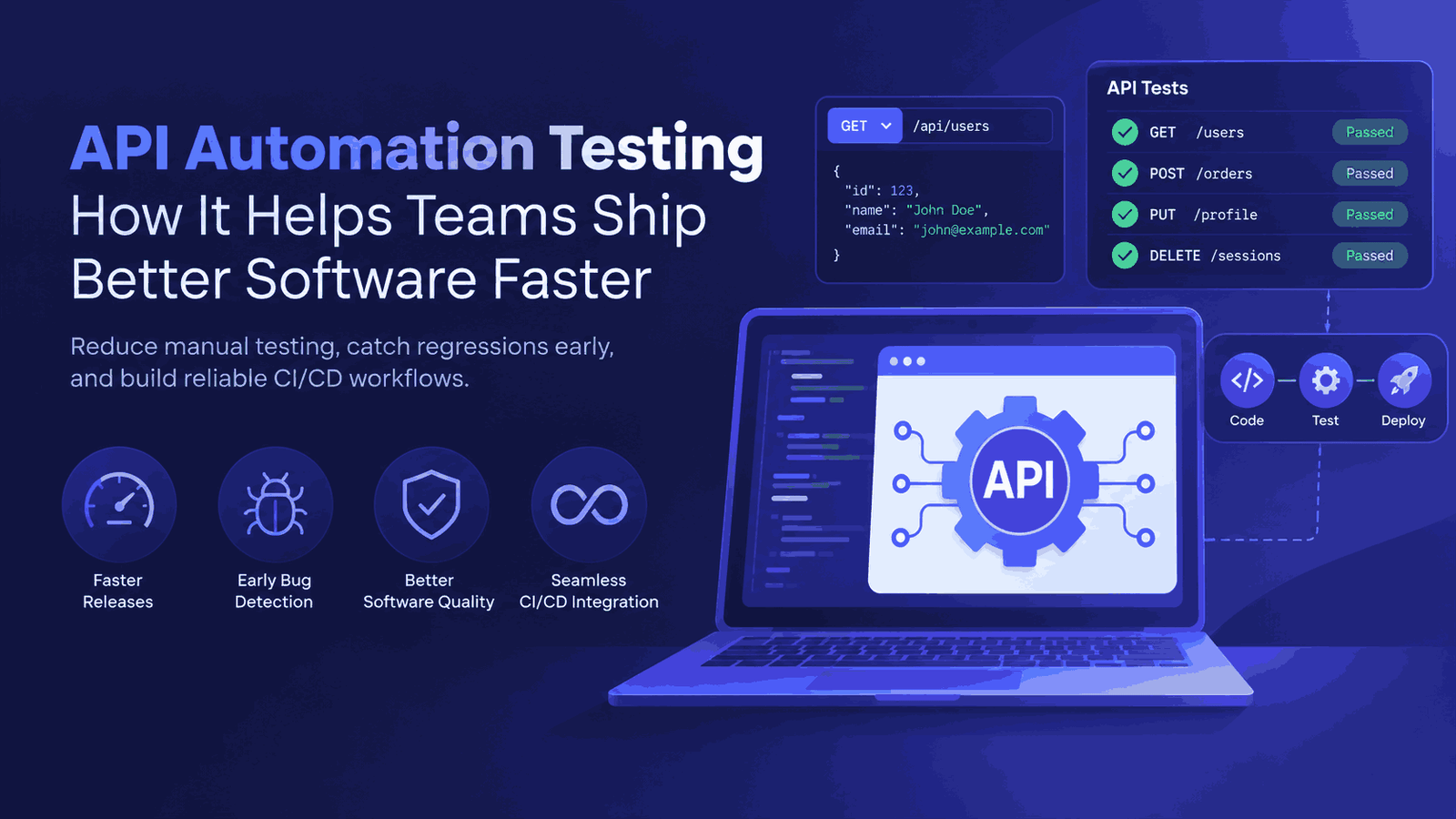
Software development has evolved rapidly over the last few years. Modern engineering teams release features frequently, deploy updates through CI/CD pipelines, and manage applications built on dozens of interconnected APIs. While this accelerates product development, it also creates a new challenge—ensuring that every API continues to work correctly after each code change. This is where API automation testing becomes an essential part of the software development lifecycle. If you're interested in learning how to automate API testing, understanding the principles behind automation is the first step toward building reliable and scalable applications.
Why API Testing Matters
Every modern application depends on APIs to exchange data between services, applications, databases, and external platforms. A single API failure can disrupt authentication, payments, notifications, or other critical business operations. Relying only on manual testing makes it difficult to detect these issues quickly, especially when development teams deploy updates multiple times a day.
API automation testing provides a consistent way to validate endpoints whenever changes are introduced. Instead of manually repeating the same requests, automated tests verify that APIs continue to behave correctly across different environments and release cycles.
The Value of API Automation
Automation is not simply about reducing manual work—it improves the overall software development process.
Some of the biggest advantages include:
Faster regression testing
Early bug detection
Consistent validation across environments
Better collaboration between developers and QA engineers
Improved deployment confidence
Shorter release cycles
When API tests execute automatically after every commit or deployment, development teams receive immediate feedback that helps prevent production issues.
Where to Begin
Many teams make the mistake of trying to automate every API from the beginning. A more effective strategy is to focus on the APIs that are most important to your application.
These often include:
Authentication services
User registration
Payment processing
Search APIs
Order management
Notification services
Automating these business-critical workflows provides the greatest value while keeping maintenance manageable.
Building Maintainable API Tests
Writing automated tests is only part of the process. The real challenge is maintaining them as applications evolve.
A well-designed automation framework should emphasize reusability and simplicity. Shared authentication logic, reusable request builders, centralized configuration files, and common validation methods reduce duplicate code and make updates easier when APIs change.
Independent test execution is equally important. Every test should run successfully without relying on another test, making debugging faster and improving reliability in CI/CD environments.
Integrating API Testing into CI/CD
Continuous Integration and Continuous Delivery have transformed how software is released. Instead of performing testing only before production deployments, API automation enables continuous validation throughout development.
Whenever developers:
Push new code
Open pull requests
Merge branches
Deploy applications
API tests can execute automatically.
This immediate feedback helps engineering teams identify regressions long before customers experience them, reducing both deployment risk and recovery time.
Challenges to Consider
Although API automation provides many advantages, teams often encounter obstacles while scaling their automation efforts.
Some common challenges include maintaining large test suites, handling changing API contracts, managing realistic test data, dealing with unstable environments, and testing APIs that depend on external services.
Addressing these issues requires regular maintenance, modular test design, and reliable testing environments. Successful automation is an ongoing process rather than a one-time implementation.
Best Practices for Success
Organizations that build sustainable API automation frameworks usually follow a few common principles.
They automate high-value workflows first, write reusable test components, keep test cases independent, integrate testing into CI/CD pipelines, and continuously review failed tests to eliminate flaky behavior. Instead of measuring success by the number of automated tests, they focus on creating reliable tests that provide meaningful feedback.
Selecting the Right Tool
Today's development teams have access to several API automation tools, including Postman, REST Assured, Karate DSL, Playwright, and Keploy. Each offers different capabilities depending on the project's technology stack and workflow.
When evaluating a solution, consider factors such as ease of maintenance, reporting features, language support, CI/CD compatibility, scalability, and developer experience. Choosing a tool that aligns with your engineering practices can significantly reduce long-term maintenance costs.
Looking Ahead
API automation testing continues to evolve as software becomes increasingly distributed. AI-assisted testing, automatic test generation, intelligent API mocking, and smarter regression analysis are helping teams reduce manual effort while improving test coverage.
As these technologies mature, engineering teams will spend less time maintaining test suites and more time delivering features that create value for users.
Final Thoughts
API automation testing has become a cornerstone of modern software development. It enables teams to release software faster, improve application reliability, and identify regressions before they impact customers. By focusing on critical workflows, building maintainable automation frameworks, and integrating testing into every stage of the development lifecycle, organizations can create scalable testing strategies that support long-term growth.
Automation is no longer just about replacing manual testing—it's about building confidence in every deployment and enabling development teams to innovate without compromising quality.