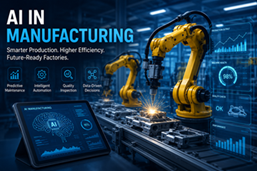
The manufacturing industry is undergoing a major digital transformation as businesses adopt artificial intelligence (AI) to improve production, quality, maintenance, and operational decision-making. With connected machines, sensors, and industrial systems generating massive amounts of data, AI in manufacturing helps businesses turn complex data into useful insights, predictions, and automated actions.
From identifying equipment failures before they happen to detecting product defects in real time, AI is creating new opportunities for manufacturers to improve efficiency, reduce waste, increase productivity, and control operational costs. By combining AI with IoT, machine learning, computer vision, and automation, manufacturers can build smarter and more responsive production environments.
Predictive Maintenance for Reliable Operations
Equipment downtime can quickly affect production schedules, revenue, customer commitments, and overall operational efficiency. AI-powered predictive maintenance helps manufacturers monitor machine performance continuously and identify early warning signs of potential failures before they result in unexpected downtime.
Machine learning algorithms can analyze sensor readings, temperature, vibration, pressure, equipment usage, historical maintenance records, and other operational data. By identifying patterns and unusual changes in machine behavior, AI systems can predict when equipment may require inspection or maintenance.
This enables maintenance teams to move from reactive repairs to a more proactive maintenance strategy. Instead of waiting for machinery to fail, teams can schedule maintenance based on actual equipment conditions and predicted risks.
The benefits of AI in manufacturing extend beyond maintenance. Predictive insights can help manufacturers improve asset utilization, reduce unnecessary maintenance, optimize spare-parts planning, and extend equipment lifespan. AI can also support production managers by providing real-time visibility into machine health and operational performance.
As manufacturing environments become increasingly connected, integrating AI into maintenance and production workflows can help organizations create more reliable, efficient, and data-driven operations. The result is a smarter manufacturing ecosystem where businesses can respond faster to operational challenges while maintaining consistent quality and productivity.
Smarter Quality Inspection
Quality control is another area where AI can make a significant difference. Traditional inspections often depend heavily on manual processes, which can be slower and less consistent.
AI-powered computer vision systems can inspect products automatically and identify defects such as cracks, scratches, incorrect assembly, or irregularities. Automated inspection can operate continuously on production lines, helping manufacturers maintain consistent quality standards.
Optimizing Production Processes
AI can analyze production data to identify inefficiencies and bottlenecks. By understanding relationships between machine performance, production schedules, material availability, and output, AI systems can recommend process improvements.
Manufacturers can use these insights to optimize:
- Production scheduling
- Machine utilization
- Workforce allocation
- Material consumption
- Energy usage
- Inventory planning
This can help factories achieve higher productivity without relying solely on additional resources.
AI and Robotics Working Together
Robotics has long been part of modern manufacturing, but AI is making robotic systems more intelligent and adaptable. AI-powered robots can use computer vision and machine learning to recognize objects, adjust movements, and respond to changing production conditions.
This combination can support applications such as assembly, sorting, packaging, material handling, and automated inspection.
Demand Forecasting and Supply Chain Intelligence
Manufacturers also need accurate information about future demand. Overstocking increases storage costs, while insufficient inventory can delay production.
AI can analyze historical sales, market trends, seasonal changes, inventory data, and other factors to generate more accurate forecasts. These insights can help businesses plan procurement and production more efficiently.
Creating Connected Smart Factories
AI becomes even more valuable when integrated with IoT devices, cloud platforms, edge computing, digital twins, and enterprise systems. These technologies allow machines and business applications to exchange data across the manufacturing environment.
A connected factory can provide real-time visibility into production performance, equipment health, quality, and resource utilization.
The Road Ahead
AI is no longer limited to experimental manufacturing projects. Businesses are increasingly applying it to practical challenges where measurable improvements can be achieved.
The best starting point is to identify a specific operational problem and determine whether AI can provide a meaningful solution. With the right data, technology, and implementation strategy, manufacturers can use AI to create smarter processes, reduce downtime, improve quality, and build more adaptable factories.
Tags : AI manufacturing