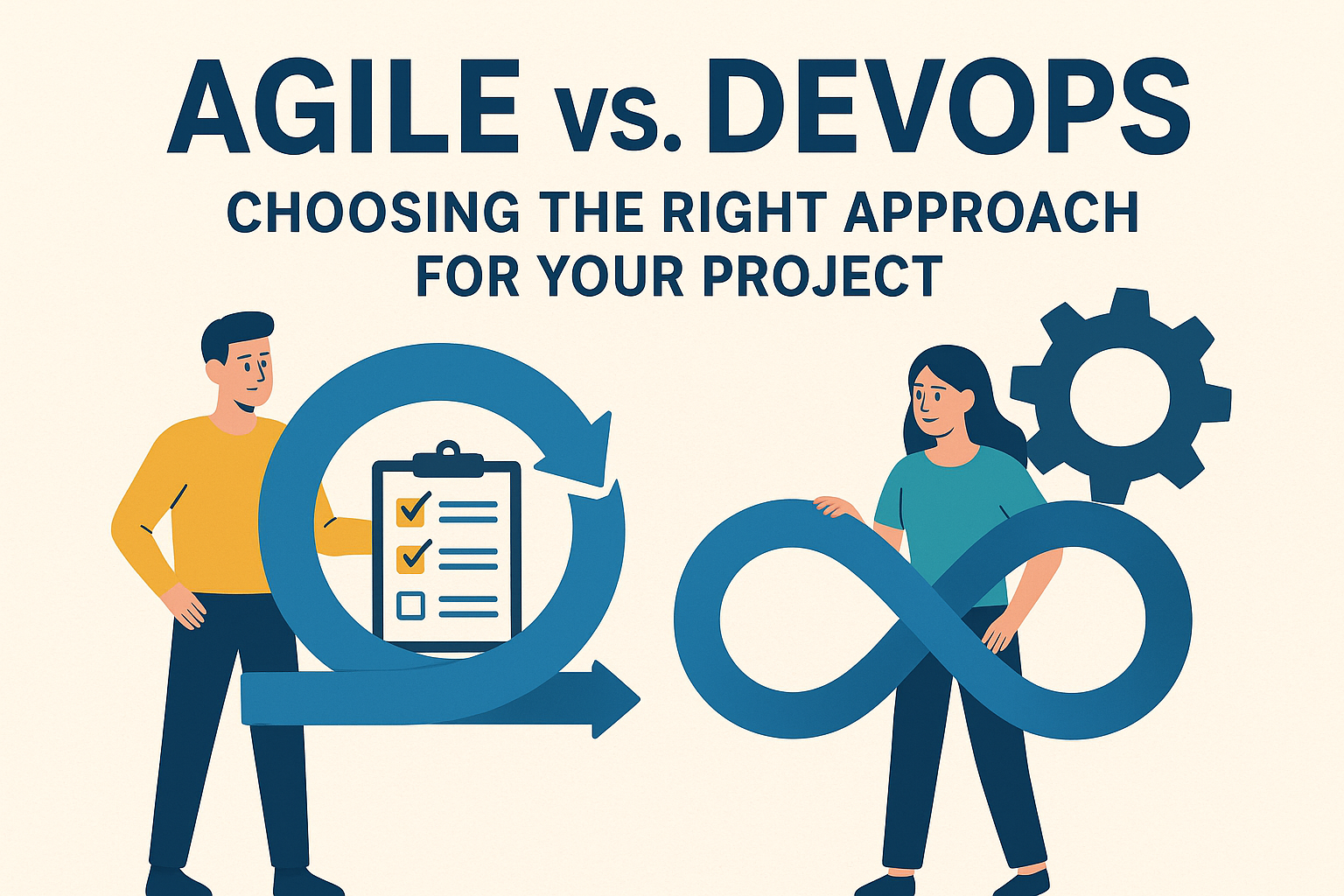
In the ever-evolving world of software development, two methodologies have revolutionized how teams build, deploy, and deliver products: Agile and DevOps. Both emphasize speed, collaboration, and continuous improvement, but they address different stages of the development lifecycle.
For organizations aiming to deliver high-quality software quickly and efficiently, understanding the difference between Agile and DevOps is critical. Let’s explore both methodologies, their key principles, differences, and how to choose the right approach for your project.
Understanding Agile
Agile is a project management and software development methodology that focuses on iterative development, collaboration, and customer feedback. Introduced in the early 2000s through the Agile Manifesto, it was designed to overcome the limitations of traditional waterfall methods that often delayed delivery and lacked flexibility.
Under Agile, projects are broken into small, manageable iterations known as sprints, typically lasting two to four weeks. Each sprint delivers a working increment of the product that can be tested, reviewed, and refined based on user feedback.
Core Principles of Agile
- Customer collaboration over contract negotiation – Continuous feedback drives product improvement.
- Working software over comprehensive documentation – Functionality takes priority over paperwork.
- Responding to change over time following a plan – Teams adapt quickly to evolving requirements.
- Individuals and interactions over processes and tools – Collaboration fuels innovation and efficiency.
Popular Agile Frameworks
Agile offers several frameworks that help teams implement its core principles effectively:
- Scrum: Focuses on iterative sprints, daily stand-ups, and defined team roles.
- Kanban: Uses visual boards to manage workflow and enhance transparency.
- Extreme Programming (XP): Emphasizes frequent releases and strong testing practices.
- Lean Development: Aims to eliminate waste and maximize value delivery.
Agile empowers teams to stay flexible and user-focused, ensuring faster delivery and continuous product enhancement.
Understanding DevOps
While Agile transformed development, DevOps revolutionized the bridge between development and operations. It emerged as a cultural and technical movement focused on collaboration, automation, and continuous delivery.
In traditional models, development teams wrote the code, and operations teams handled deployment and maintenance, often resulting in silos, miscommunication, and delays. DevOps aims to eliminate these barriers by creating a shared responsibility for the entire software lifecycle.
Core Principles of DevOps
- Collaboration and communication – Developers and IT operations work closely together.
- Automation – Automating repetitive tasks such as testing, deployment, and monitoring.
- Continuous Integration and Continuous Deployment (CI/CD) – Ensures frequent, reliable updates.
- Monitoring and feedback – Real-time monitoring improves performance and user experience.
- Infrastructure as Code (IaC) – Automating infrastructure management ensures consistency and scalability.
DevOps focuses on speed and reliability by integrating development and operations, ensuring that code moves seamlessly from idea to production.
Agile vs. DevOps: The Key Differences
Although both Agile and DevOps aim for faster, high-quality delivery, they operate differently. Here’s a breakdown of their distinctions:
Agile focuses more on how software is built and iterated, while DevOps focuses on how it’s delivered and maintained. In practice, they complement each other when combined effectively.
When to Choose Agile
Agile is ideal when your primary focus is rapid software development and flexibility. You should consider adopting Agile if your project:
- Has evolving requirements: Agile allows teams to adapt to user feedback and changing priorities.
- Needs frequent client collaboration: Regular sprint reviews encourage active stakeholder involvement.
- Requires early product delivery: The iterative nature of Agile ensures faster time-to-market.
- Involves smaller, cross-functional teams: Agile thrives in compact teams that communicate closely.
- Focuses on innovation: Agile is perfect for creative, experimental projects where adaptability is key.
For example, startups or companies developing MVPs (Minimum Viable Products) often prefer Agile to quickly validate ideas and pivot when needed.
When to Choose DevOps
DevOps is best suited for organizations looking to streamline end-to-end delivery and improve deployment efficiency. Choose DevOps if your project:
- Demands continuous delivery: When frequent releases are necessary, automation is essential.
- Requires operational stability: DevOps ensures smooth deployment, monitoring, and rollback mechanisms.
- Relies on large-scale infrastructure: Automated infrastructure management reduces manual errors.
- Focuses on collaboration between dev and ops: DevOps bridges the gap between coding and maintenance.
- Emphasizes scalability and reliability: Ideal for cloud-native and enterprise-grade applications.
DevOps works exceptionally well for established organizations managing large systems that must operate continuously without downtime.
Can Agile and DevOps Work Together?
Absolutely. In fact, Agile and DevOps are not mutually exclusive; they complement each other beautifully.
- Agile ensures that software is developed iteratively, aligning closely with customer needs.
- DevOps ensures that these iterations are deployed quickly, efficiently, and reliably.
When combined, Agile and DevOps create a seamless pipeline from concept to deployment. Teams can iterate faster (Agile) and deploy continuously (DevOps), achieving continuous improvement across the entire software lifecycle.
How They Integrate
- Agile teams develop small, functional increments.
- DevOps automates testing and deployment for these increments.
- Feedback from users is collected and analyzed continuously.
- The cycle repeats with improvements in every iteration.
Together, Agile + DevOps create a culture of speed, collaboration, and customer satisfaction, essential for success in today’s competitive digital landscape.
Choosing the Right Approach for Your Project
The decision between Agile and DevOps depends on your project goals, team structure, and organizational maturity.
- For innovation and flexibility: Choose Agile if your primary goal is to refine product features quickly based on customer feedback.
- For scalability and reliability: Choose DevOps if your focus is on optimizing delivery pipelines and infrastructure efficiency.
- For long-term success: Consider integrating both Agile for development speed and DevOps for deployment excellence.
In modern organizations, combining the two often yields the best results, fostering an environment of continuous innovation and delivery.
Final Thoughts
The debate between Agile and DevOps isn’t about which is superior; it’s about which fits your project’s unique needs. Agile helps you build the right product efficiently, while DevOps ensures you deliver it reliably and continuously.
The most successful software development company today don’t choose between Agile and DevOps; they embrace both, creating a culture where development and operations move in harmony. Whether you’re a startup building your first MVP or an enterprise modernizing your infrastructure, striking the right balance between Agile and DevOps can drive faster innovation, higher quality, and greater customer satisfaction.