Agentic Workflow Development: Building AI That Works Like a Digital Team
By Harris Anderson 19-08-2026 71
Business automation is entering a new era. Instead of relying on rigid rule-based workflows, organizations are adopting agentic AI—intelligent systems that can analyze information, make decisions, and execute tasks with minimal human intervention. This shift is transforming how enterprises manage customer service, finance, operations, HR, and software development.
Unlike traditional automation, which follows predefined if-then rules, agentic workflows combine large language models (LLMs), business logic, APIs, and enterprise data into autonomous AI agents that collaborate to achieve a goal. Think of them as a digital team capable of planning, reasoning, and acting across multiple business systems.
What is an Agentic Workflow?
An agentic workflow is a sequence of AI-driven actions where one or more intelligent agents complete business processes from start to finish. These agents can retrieve data from CRMs or ERPs, interpret customer requests, generate reports, trigger approvals, and update systems automatically.
For example, when a customer submits a support request, an AI agent can classify the issue, search the knowledge base, create a ticket, notify the right department, and draft a personalized response—all without manual coordination.
Key Components of an AI-Powered Workflow
Successful agentic workflow development typically includes:
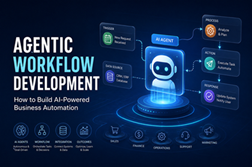
AI Agents: Autonomous decision-makers that understand goals and execute tasks.
LLMs: Provide reasoning, language understanding, and content generation.
Enterprise Integrations: Connect with CRM, ERP, databases, and third-party APIs.
Knowledge Retrieval (RAG): Gives agents access to accurate internal documents and business data.
Workflow Orchestration: Coordinates multiple agents and manages task sequencing.
Together, these components create intelligent automation that adapts to changing business scenarios rather than simply following static rules.
Real-World Business Applications
Agentic workflows are already transforming multiple industries by automating decision-heavy operations.
Customer Support
Classify tickets, retrieve knowledge, and generate personalized responses.
Sales & CRM
Qualify leads, schedule meetings, and update customer records automatically.
Finance
Process invoices, verify approvals, detect anomalies, and generate reports.
Human Resources
Screen resumes, coordinate interviews, onboard employees, and answer HR queries.
These intelligent workflows reduce repetitive work, improve response times, and allow teams to focus on strategic decision-making.
Where Businesses Are Using Agentic AI
Organizations across industries are already implementing agentic workflows for high-value operations:
Department | Example Workflow |
|---|---|
Customer Support | Resolve tickets and generate responses |
Sales | Qualify leads and update CRM automatically |
Finance | Process invoices and verify approvals |
HR | Screen resumes and schedule interviews |
Operations | Monitor systems and trigger automated actions |
These workflows reduce repetitive work while improving response times and operational accuracy.
Best Practices for Building Agentic Workflows
Successful implementation requires more than choosing the latest AI model. Organizations should begin with a clearly defined business objective and design workflows around measurable outcomes.
Start with a single process. Choose a high-impact workflow such as customer support, invoice processing, or lead qualification before expanding across departments.
Keep humans in the loop. Sensitive decisions involving finance, legal, or compliance should include approval checkpoints rather than complete autonomy.
Prioritize secure data access. AI agents should retrieve information only from authorized enterprise systems using secure APIs and role-based permissions.
Monitor and optimize continuously. Track workflow performance, response quality, task completion rates, and operational savings to improve agent effectiveness over time.
The Future of Business Automation
Agentic workflow development represents the next generation of enterprise AI. Rather than replacing employees, intelligent agents augment teams by handling repetitive coordination, allowing people to focus on strategy, creativity, and complex decision-making.
As organizations continue integrating AI into CRM platforms, ERP systems, customer portals, and internal operations, agentic workflows will become a competitive advantage—delivering faster decisions, greater efficiency, and more personalized customer experiences.
Companies that invest in scalable AI-powered automation today will be better prepared for the future of intelligent enterprise operations.
Tags : Agentic Workflow AI agents