A Real-World Look at Otoscope–Ophthalmoscope Sets and Why They Matter in Daily Practice
By CYNAMED 12-12-2025 44
If you work in healthcare long enough, you start to realize that some tools follow you into almost every exam room. The otoscope and ophthalmoscope are definitely two of them. They may not be as flashy as big diagnostic otoscopes, but anyone who deals with ear or eye checks knows how often they end up in your hand.
It doesn’t matter if you’re in family medicine, pediatrics, urgent care, or simply doing routine physicals — these little instruments become part of your daily rhythm. You also learn pretty quickly that not all sets are the same. Some feel solid and clear, and others feel like you’re trying to look through a foggy window.
What You Really Want From an Otoscope
A good otoscope doesn’t need a long explanation — it just needs to give you a clean, bright, reliable view. When you’re trying to see inside a tiny ear canal (especially on a squirmy kid), you don’t want dim lighting or a lens that distorts everything.
Clear visibility makes it easier to spot the usual troublemakers: redness, infections, wax buildup, perforations, fluid behind the drum and all the things you check for every day. Durability matters too. Clinics get hectic. Tools get dropped. They get cleaned a hundred times. A properly built otoscope doesn’t start flickering or falling apart after a few months.
And the Ophthalmoscope? Same Story — But Even More Precise
Often, the information obtained through the back of the eye is not given its proper value. An eye doctor with a good quality ophthalmoscope can see, for instance, changes in blood vessels, early signs of high blood pressure or diabetes, and diseases of the optic nerve. This is exactly the stage where clarity and adjustability have to be utmost.
In case the light is not evenly distributed or the focus is not well defined, the entire examination process will be more of a hardship than it ought to be. The operation of a top-quality ophthalmoscope is reassured — straighten up, click, focus, ready.
Why Buying the Set Usually Makes Sense
A lot of clinicians just buy the two as a pair, and honestly, it’s the easiest route. The handles fit the same charger, the lighting type matches, and everything stores together. If you work in multiple locations or carry your own gear around, having a matching set keeps life simple.
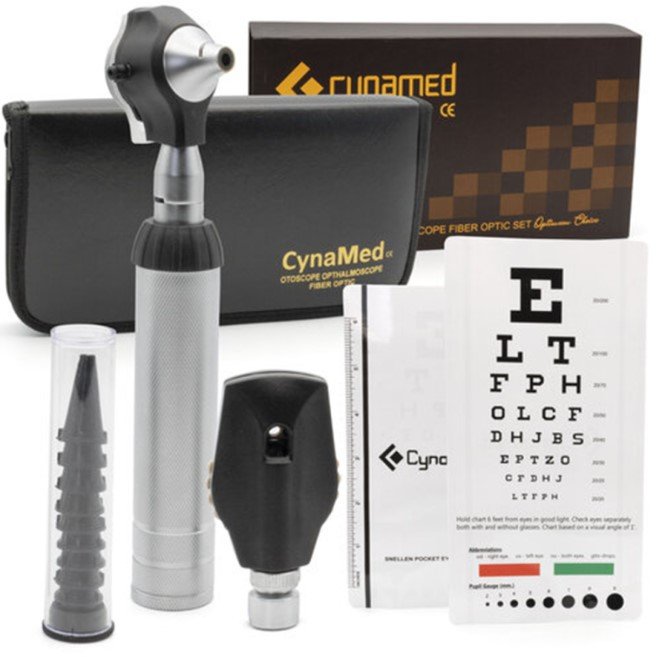
A proper set usually gives you:
Reliable LED or fiber-optic lighting
Lenses that don’t warp what you’re seeing
Rechargeable handles
Different specula sizes
A case that keeps everything together
Nothing fancy — just what you need for everyday use.
Why Quality Matters More Than You’d Think
Quality-wise, these are not the tools that you would use occasionally, like once a week. On the contrary, you would use them many times, in some cases right after each other, during the busy shifts. Their good performance means smoother exams, more relaxed patients, and less struggle for the operator to get the required information.
On the other hand, diagnostic otoscopes of poor quality slow down the whole process and make it more uncomfortable for the patients. Good view and light might not feel like much, but they influence the two aspects of accuracy and speed heavily.
Final Thoughts
If you’re a medical student, a new practitioner, or someone replacing outdated equipment, investing in a solid otoscope–ophthalmoscope set pays off every single day you practice. These tools become part of your routine, and having reliable ones just makes your work easier — and more accurate.