Data has become the backbone of modern business operations. Every customer interaction, online transaction, application, and connected device generates valuable information that can help organizations make better decisions. However, collecting data is only the first step. The real challenge lies in transforming raw, scattered information into meaningful insights that support business growth.
Data engineering services provide the expertise, infrastructure, and processes needed to collect, integrate, organize, and manage data efficiently. With the right data foundation, businesses can improve operational efficiency, enhance customer experiences, strengthen decision-making, and gain a competitive advantage.
As organizations continue to invest in digital transformation, the demand for reliable and scalable data solutions is growing rapidly. Companies that leverage Data engineering services are better equipped to turn complex data into actionable intelligence that drives measurable business outcomes.
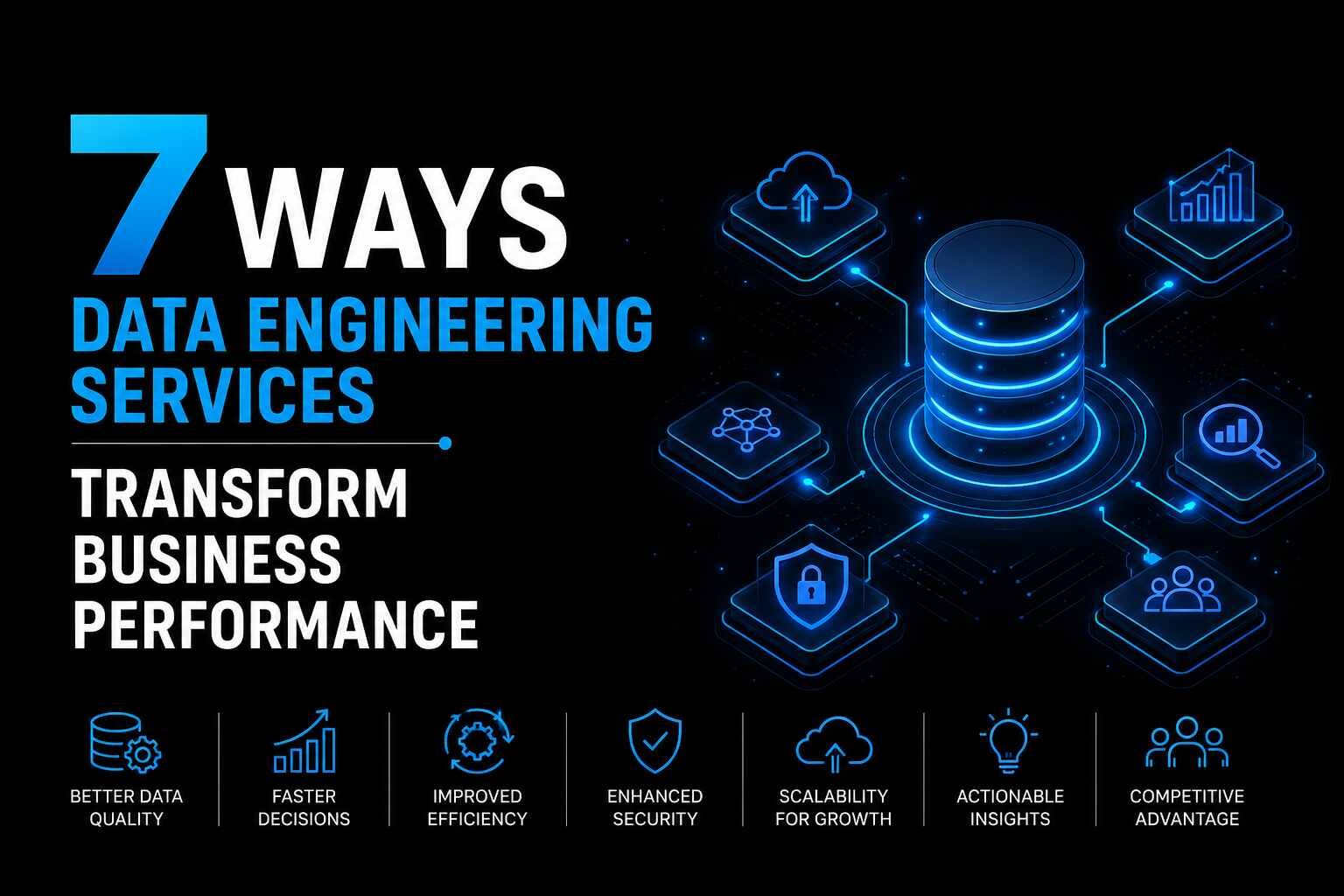
In this article, we explore seven powerful ways Data engineering services transform business performance and help organizations succeed in a data-driven world.
1. Eliminate Data Silos and Create a Unified Data Environment
One of the biggest challenges businesses face is managing data that exists across multiple systems and departments. Sales teams may use a CRM platform, finance departments rely on accounting software, while operations teams work with separate databases. These disconnected systems create data silos that limit visibility and collaboration.
Data engineering services integrate data from various sources into a centralized platform such as a data warehouse or data lake. This unified approach provides a single source of truth for the entire organization.
Key benefits include:
• Improved data accessibility
• Better cross-department collaboration
• Consistent reporting and analytics
• Greater business visibility
When all stakeholders work with the same accurate information, decision-making becomes faster and more effective.
2. Enable Faster and Smarter Decision-Making
Modern businesses cannot afford to wait days or weeks for reports. Markets change quickly, customer expectations evolve, and operational issues require immediate attention.
Through automated data pipelines and real-time processing capabilities, Data engineering services ensure that business leaders have access to timely and accurate information.
Organizations can monitor:
• Customer behavior
• Sales performance
• Operational metrics
• Supply chain activities
• Financial performance
Access to real-time insights allows companies to identify opportunities, solve problems faster, and make informed decisions with confidence.
3. Improve Data Quality and Reliability
Poor-quality data can lead to inaccurate reports, flawed business strategies, and lost revenue. Duplicate records, missing information, inconsistent formats, and outdated datasets often create significant challenges for organizations.
Data engineering services address these issues by implementing automated data validation, cleansing, and standardization processes.
• High-quality data helps businesses:
• Increase reporting accuracy
• Improve forecasting
• Reduce operational errors
• Strengthen customer insights
• Build trust in analytics
Reliable data provides a stronger foundation for strategic planning and business growth.
4. Support Advanced Analytics and Artificial Intelligence
Artificial intelligence and advanced analytics are transforming industries, but these technologies depend on clean and well-structured data.
Without a strong data infrastructure, organizations often struggle to implement machine learning models and analytics initiatives successfully.
Data engineering services prepare data for:
• Predictive analytics
• Machine learning applications
• Business intelligence reporting
• Customer segmentation
• Demand forecasting
• Fraud detection
By creating analytics-ready datasets, businesses can uncover trends, predict outcomes, and identify opportunities that would otherwise remain hidden.
5. Increase Operational Efficiency Through Automation
Many organizations still spend countless hours manually collecting, organizing, and preparing data. These repetitive tasks consume valuable resources and increase the risk of human error.
One of the most significant advantages of Data engineering services is automation. Data engineers design workflows that automatically collect, transform, and deliver information where it is needed.
Automation helps organizations:
• Reduce manual workloads
• Minimize errors
• Accelerate reporting processes
• Improve employee productivity
• Lower operational costs
As a result, teams can focus on strategic initiatives instead of time-consuming administrative tasks.
6. Build a Scalable Foundation for Business Growth
As businesses grow, so do their data requirements. Legacy systems often struggle to handle increasing volumes of information, new applications, and expanding customer bases.
Data engineering services help organizations build scalable architectures that can support future growth without sacrificing performance.
Modern data environments provide:
• Flexible cloud infrastructure
• Faster processing capabilities
• Seamless integration of new data sources
• Improved system reliability
• Better support for business expansion
A scalable data strategy ensures organizations can adapt to changing business needs and emerging technologies.
7. Strengthen Security, Compliance, and Data Governance
Data security has become a top priority for businesses across every industry. Organizations must protect sensitive information while complying with evolving regulatory requirements.
Data engineering services incorporate security and governance best practices into every stage of the data lifecycle.
These measures often include:
• Data encryption
• Access controls
• Audit trails
• Compliance monitoring
• Governance frameworks
Strong security and governance practices help businesses reduce risk, improve compliance readiness, and maintain customer trust.
Best Practices for Successful Data Engineering Initiatives
Organizations seeking maximum value from their data investments should focus on several proven strategies:
• Align Data Projects with Business Goals - Every initiative should support measurable business outcomes.
• Prioritize Data Quality - Reliable analytics begins with accurate information.
• Embrace Automation - Automated workflows improve efficiency and consistency.
• Invest in Scalable Infrastructure - Future-proof systems can support long-term growth.
• Implement Strong Governance - Security and compliance should be built into every data process.
• Work with Experienced Specialists - Partnering with experts such as GeoPITS can help organizations design, optimize, and manage data environments that support both current needs and future growth.
Conclusion
In today's digital economy, data is one of the most valuable assets a business possesses. However, the true value of data can only be unlocked when it is organized, accessible, accurate, and actionable. Data engineering services provide the foundation needed to transform raw information into meaningful business intelligence.
From eliminating data silos and improving data quality to enabling advanced analytics and strengthening security, Data engineering services deliver measurable benefits across every area of an organization. Businesses that invest in modern data infrastructure gain a competitive advantage through better decision-making, increased efficiency, and greater scalability.
For organizations looking to maximize the value of their data assets, GeoPITS offers expertise in building secure, scalable, and high-performance data environments that support long-term business success.
Frequently Asked Questions
1. What are Data Engineering Services?
Data Engineering Services involve designing, building, and managing systems that collect, process, store, and organize data for analytics and business operations.
2. Why are Data Engineering Services important?
They help businesses improve data quality, enable advanced analytics, automate workflows, and support better decision-making.
3. How do Data Engineering Services improve business performance?
They provide reliable access to data, reduce inefficiencies, support innovation, and help organizations make faster and more informed decisions.
4. Can Data Engineering Services support AI initiatives?
Yes. They prepare and manage the high-quality data required for machine learning, predictive analytics, and artificial intelligence applications.
4. What industries benefit from Data Engineering Services?
Industries such as healthcare, finance, retail, manufacturing, logistics, and technology can all benefit from modern data engineering solutions.
6. How does GeoPITS help businesses with data engineering?
GeoPITS provides expert data engineering solutions, including data integration, pipeline development, database management, cloud migration, and performance optimization.
7. What should businesses look for in a Data Engineering Services provider?
Organizations should look for experience, technical expertise, scalability capabilities, security practices, and a proven track record of successful implementations.
Tags : Data Engineering Services