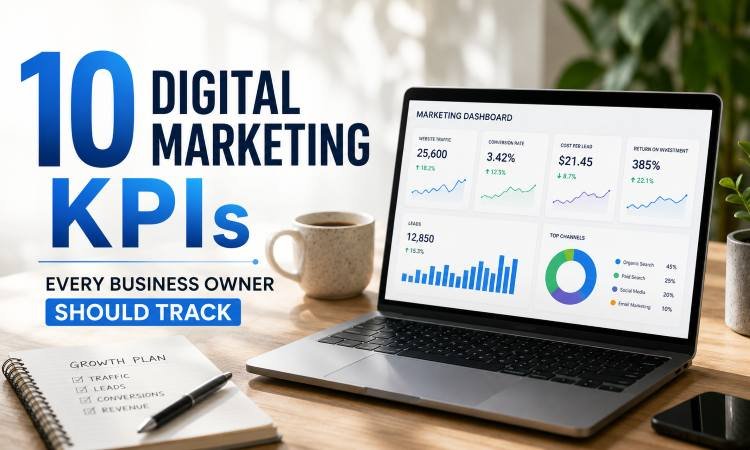
Digital marketing creates a large amount of data. Businesses can track website visits, ad clicks, leads, sales, email activity, and social media engagement. However, having more data does not automatically lead to better decisions.
The real value comes from tracking the right numbers.
This is where Digital marketing KPIs become important. A business should focus on metrics that connect marketing activities with meaningful outcomes such as qualified leads, conversions, revenue, and customer growth. The Pranav Jha website also highlights the importance of measuring metrics such as conversion, CTR, CPL, campaign performance, and overall growth rather than relying only on surface-level numbers.
What Are KPIs for Digital Marketing?
KPIs, or Key Performance Indicators, are measurable values used to understand whether a marketing strategy is moving towards its intended goal.
For example, a business running Google Ads may track leads, cost per lead, and return on ad spend. An SEO-focused business may pay more attention to organic traffic, rankings, clicks, and conversions.
The important point is simple: not every metric deserves equal attention.
A social media post receiving thousands of likes may look successful, but if it does not contribute to engagement, leads, or brand goals, its business value may be limited.
Why Are KPIs Important for Businesses?
KPIs bring clarity to marketing decisions. They help businesses understand what is working, what needs improvement, and where resources should be allocated.
Some major benefits include:
- Better measurement of campaign performance
- Improved budget allocation
- Easier identification of weak areas
- More informed decision-making
- Stronger alignment between marketing and business goals
A Digital Marketing Consultant can also use relevant KPIs to connect campaign activity with practical business objectives instead of focusing only on impressions or traffic.
Website and Traffic KPIs
Website performance is often the starting point for measuring digital activity.
1. Website Traffic
Website traffic shows how many users visit a website. It provides a broad view of online visibility and audience interest.
However, traffic alone is not enough. A large number of visitors has limited value if those users do not engage or convert.
2. Organic Traffic
Organic traffic refers to visitors who reach a website through unpaid search results.
It is particularly important for businesses investing in SEO and content. Growth in organic traffic can indicate that relevant pages are becoming more visible in search results.
3. Bounce Rate
Bounce rate can help businesses understand whether visitors leave without continuing their journey on the website.
A high bounce rate does not always mean failure. It should be evaluated alongside page purpose, user intent, and other engagement data.
Advertising Performance KPIs
Paid campaigns require close monitoring because every click or conversion may involve advertising spend.
4. Click-Through Rate (CTR)
CTR measures the percentage of people who click after seeing an ad, email, or search result.
A strong CTR can suggest that the message, targeting, or offer is relevant to the audience.
5. Cost Per Click (CPC)
CPC shows how much a business pays for each advertising click.
Monitoring CPC helps marketers understand how efficiently they are buying traffic. However, cheaper clicks are not automatically better if they do not produce quality leads.
6. Cost Per Lead (CPL)
CPL measures how much it costs to generate one lead.
For lead-generation campaigns, this is often more useful than simply measuring clicks or impressions.
Conversion and Customer Growth KPIs
Traffic is useful, but conversions often reveal whether marketing is producing meaningful results.
7. Conversion Rate
Conversion rate measures the percentage of users who complete a desired action.
That action may include:
- Filling out a form
- Making a purchase
- Booking a consultation
- Downloading a resource
- Signing up for a newsletter
8. Customer Acquisition Cost (CAC)
CAC measures how much a business spends to acquire a new customer.
It helps companies evaluate whether their marketing and sales efforts are financially sustainable.
Engagement KPIs for Content and Communication
Engagement metrics help businesses understand how audiences respond to their communication.
9. Social Media Engagement Rate
This can include interactions such as likes, comments, shares, saves, and other meaningful actions.
Instead of only counting followers, businesses should consider whether their audience is actively responding.
10. Email Click-Through Rate
Email click-through rate measures how many recipients click a link within an email.
This can be more meaningful than opens because it indicates that users took an additional action.
How to Choose the Right KPIs for Your Business
Not every business should track the same KPIs.
The right measurement framework depends on the objective. An eCommerce company may focus heavily on conversion rate, CAC, and customer value. A content-driven website may prioritise organic traffic, engagement, and conversions.
A practical approach is to follow these points:
- Start with a clear business objective.
- Select only the metrics connected to that objective.
- Avoid relying on vanity metrics alone.
- Compare performance over time.
- Review results regularly and make adjustments.
The Pranav Jha website also notes that KPIs vary according to the marketing strategy and that businesses should measure performance using appropriate tools and reporting.
Conclusion
Tracking the right Digital Marketing KPIs helps businesses understand whether their marketing efforts are actually delivering results. Metrics such as website traffic, conversion rate, cost per lead, customer acquisition cost, and return on ad spend provide useful insights into different areas of marketing performance.
However, businesses do not need to track every available metric. The focus should be on Key Performance Indicators that are directly connected to their goals. By regularly monitoring these KPIs, businesses can identify what is working, improve weak areas, and make better marketing decisions.
Ultimately, effective digital marketing is not just about generating more traffic or clicks. It is about turning marketing efforts into meaningful results that support long-term business growth.
Tags : .....