Glass for Commercial Building: How to Choose the Right Glass for Modern Indian Workspaces
By Gujarat Guardian Glass 23-10-2026 3
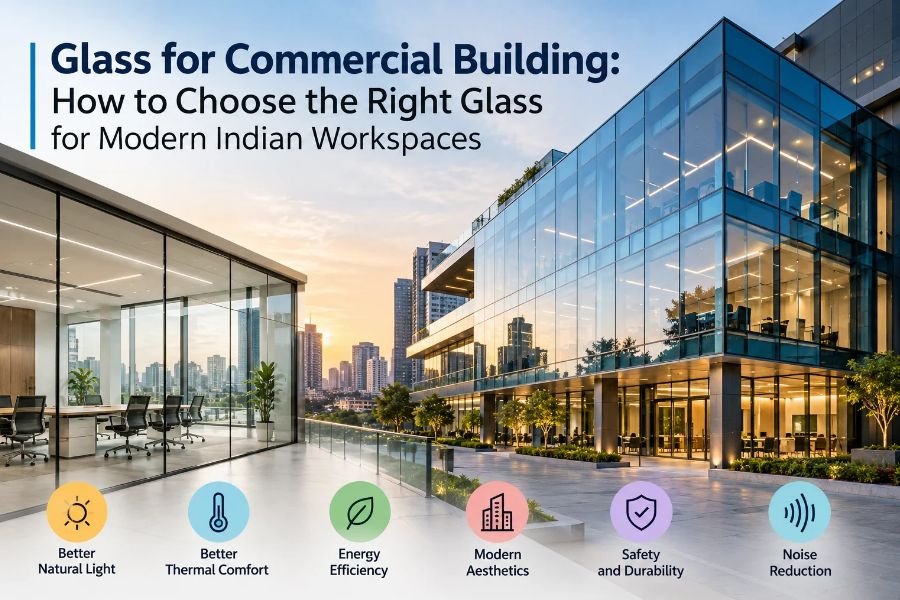
Walk into a modern office in Bengaluru, Mumbai, Gurugram, or Hyderabad, and you will probably notice how much glass has become part of commercial architecture. From expansive building facades to conference room partitions, glass helps create brighter interiors, open workspaces, and a more contemporary appearance. However, choosing glass for commercial building projects involves much more than selecting a design that looks attractive.
India's commercial buildings face a variety of practical challenges, including intense sunlight, seasonal heat, monsoon conditions, outdoor noise, and rising expectations for energy efficiency. The right glazing can help address these concerns while supporting the architectural vision of a project. Understanding the available glass types, their performance, and their suitability for different applications makes it easier for developers, architects, and building owners to make informed decisions.
Why Glass Matters in Commercial Construction
Glass influences several aspects of a commercial building, including natural lighting, indoor comfort, privacy, and exterior appearance. In offices, shopping centres, hotels, and corporate campuses, the right glazing can help balance daylight with solar heat entering the building.
Large windows may reduce the need for artificial lighting during daylight hours, depending on the building's layout and lighting controls. However, excessive solar heat gain can increase cooling requirements, particularly in India's warmer regions. This is why commercial glazing should be evaluated according to its thermal performance rather than appearance alone.
Safety is another important consideration. Buildings with public access, large glazed entrances, and extensive internal partitions require suitable glass specifications based on the location, application, and applicable safety standards.
Types of Glass for Commercial Building Projects
Different applications require different glass properties. Understanding the main options helps project teams avoid selecting materials based solely on price or appearance.
1. Float Glass
Float glass is a basic flat glass product manufactured using the float process, which produces a smooth, uniform surface. It is used as a starting material for many architectural glass products.
Depending on its thickness, processing, and intended application, float glass may be further transformed into tempered, laminated, coated, or insulated glazing. Standard annealed float glass should not automatically be considered suitable for every commercial installation, especially where safety glazing is required.
2. Solar Control Glass
Solar control glass is designed to manage the amount of solar energy entering a building. It can be particularly useful for commercial properties with large windows or glazed facades exposed to strong sunlight.
For Indian office buildings, this type of glazing can help reduce unwanted heat gain while maintaining useful daylight. The actual performance depends on factors such as solar heat gain coefficient, visible light transmittance, glass configuration, and facade orientation.
Architects should consider these factors together. A glass product that reduces heat effectively but allows insufficient daylight may not deliver the intended result for every workspace.
3. Insulated Glass Units
Insulated glass units, commonly called IGUs or double glazing, consist of two or more glass panes separated by a sealed cavity. This configuration can improve thermal insulation compared with a single pane, depending on the complete assembly.
IGUs are often considered for air-conditioned offices, hotels, and commercial buildings where indoor temperature control is important. Their effectiveness depends on the glass selection, cavity design, seals, frame system, and quality of installation.
4. Toughened and Laminated Safety Glass
Toughened glass is heat-treated to improve its strength compared with ordinary annealed glass of similar thickness. When it breaks, it generally fragments into smaller pieces.
Laminated glass contains multiple glass layers bonded with an interlayer. The interlayer helps hold fragments together when the glass breaks.
Both products serve different purposes, and neither should be selected without considering the application's safety requirements. Building designers should follow applicable Indian standards and specify the appropriate safety glazing for entrances, doors, partitions, facades, and other relevant locations.
Choosing Glass for Office Interiors and Facades
The requirements for glass for office interiors differ from those for exterior facades. An internal meeting room may need privacy, sound control, and a clean visual appearance, while an external facade must also manage weather exposure, solar radiation, structural loads, and thermal performance.
Before finalising specifications, consider these practical factors:
Climate and orientation: West-facing facades may receive strong afternoon sunlight, while other elevations experience different exposure throughout the day.
Energy performance: Review solar heat gain, visible light transmission, and thermal insulation in the context of the building's cooling and lighting systems.
Safety requirements: Select suitable safety glazing for the specific location and use.
Acoustic comfort: Consider the complete glazing system, including pane thickness, air gaps, frames, and seals, where traffic or urban noise is a concern.
Maintenance: Evaluate cleaning access, surface treatments where appropriate, and the long-term upkeep of large glazed areas.
Budget and lifecycle costs: Compare initial material and installation costs with potential operating expenses, maintenance needs, and expected service life.
These checks are especially important for commercial developments where glazing represents a substantial part of the building envelope.
The Role of Glass Manufacturers in India's Construction Industry
India's architectural glass industry supports a wide range of building requirements, from basic glazing to coated products designed for specific performance needs. Manufacturers, processors, architects, facade consultants, and contractors all contribute to ensuring that the selected glass performs as intended.
Gujarat Guardian Limited, a joint venture between Guardian Industries Corporation and Modi Rubber Limited, established a float glass plant in Ankleshwar, Gujarat, in 1993, followed by an automated curtain coating mirror plant in 1994. Its operations form part of the development of India's modern glass manufacturing sector.
For commercial construction professionals, understanding the capabilities of glass manufacturers is useful when comparing available products, requesting technical documentation, and assessing whether a proposed glazing solution meets a project's requirements. Product selection should always be based on verified performance data and suitability for the intended application.
Common Mistakes to Avoid When Selecting Commercial Glass
One common mistake is choosing glass primarily by its colour, reflectivity, or purchase price. Two visually similar products may have different solar and thermal performance characteristics.
Another mistake is treating the glass pane as the entire solution. Frames, sealants, spacers, installation quality, and facade detailing all influence the performance of the completed system. Even a carefully selected product may underperform if the installation is poorly executed.
It is also important not to assume that thicker glass automatically provides better thermal insulation or sound reduction. Thickness, construction, interlayers, cavities, and the overall assembly all play different roles.
Consulting a qualified facade specialist early in the design process can help prevent costly changes during construction.
Final Thoughts
Choosing glass for commercial building projects requires a balance between appearance, safety, comfort, energy performance, and long-term value. For India's varied climatic conditions, there is no single glazing solution that suits every office, retail space, hotel, or corporate facility.
The most effective approach is to define the building's needs first, compare technical specifications, and coordinate the glass selection with the facade design and building systems. When these decisions are made early, glass can become more than an architectural feature: it can contribute to a more comfortable, functional, and thoughtfully designed commercial space.